Hill's Tramroads, Blaenavon

Region:
Red Wheel Site:
Transport Mode(s):
Address:
Postcode:
Visitor Centre:
Opening Times:
Accessible at all times
Website:
Visit websiteThe primitive railway built by Thomas Hill in the years after he began to manage Blaenavon Ironworks in 1812, known as Hill's Tramroad, provides many insights into an important period of technological development, as well as evidence of the history of the Blaenavon Company. Not only did the railway establish a link with the Brecknock and Abergavenny Canal, it improved the means by which ore and limestone could be conveyed to the Ironworks from the north, and enabled pig iron from the furnaces to be carried to the forge opened at Garn-Ddyrys in 1817, where it was converted to wrought iron.
To follow the footpath along the course of the primitive railway, on daringly-constructed and almost level terraces on steep mountainsides, is a thrilling experience. On most stretches the stone blocks on which the rails were mounted remain in situ. The route includes connections to the limestone quarries at Pwll-Du and Tyla and to the forge at Garn-Ddyrys. A series of counter balanced inclined planes take the railway down the mountain to Llanfoist. The 2,400m long tunnel under the mountain at Pwll-Du was the longest ever constructed for a horse-operated railway in Britain.
The forge at Garn-Ddyrys, alongside the primitive railway built by Thomas Hill to link Blaenavon with the Brecknock and Abergavenny Canal at Llanfoist Wharf, came into operation in 1817. Pig iron from the Blaenavon Ironworks was taken through the tunnel at Pwll-du to Garn-Ddyrys to be forged into wrought iron, which was taken along the railway to the canal. The forge was making about 200 tons of iron a week in the early 1850s. It was closed in the early 1860s after the establishment of the Company's Forgeside works. The forge stands on a bleak hillside at an altitude of some 400m.(1315 ft.).
The principle features of the site are some extraordinarily sculptural blocks of solid ironworking waste, one of them 4m in height, remnants of the ponds which formed part of the forge's water power system, the ruins of a manager's house and workers' cottages, and traces of the primitive railway connections to the site, including an intact tunnel built to carry Hill's Tramroad underneath slag tips.
The outstanding feature of the Brecknock and Abergavenny Canal is the basin at Llanfoist, situated on the side of the mountain, and approached up a steep track. It was the terminus of the primitive railway built by Thomas Hill and completed in 1817. By this means, the Blaenavon Company hoped to avoid the high tolls charged by the Monmouthshire Canal, and to reach markets for their coal in the upper Usk Valley and to the east across the English border in Herefordshire. There is a substantial warehouse for storing pig iron and wrought iron bars and blooms before they were loaded on to canal boats.
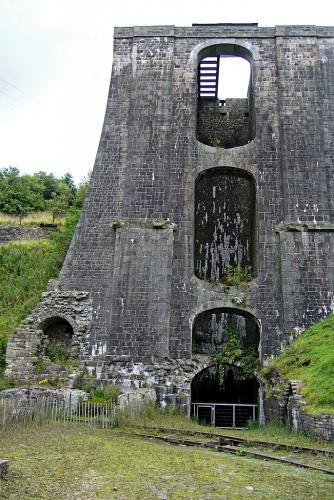

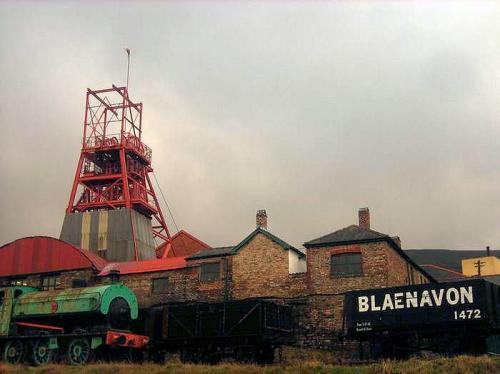
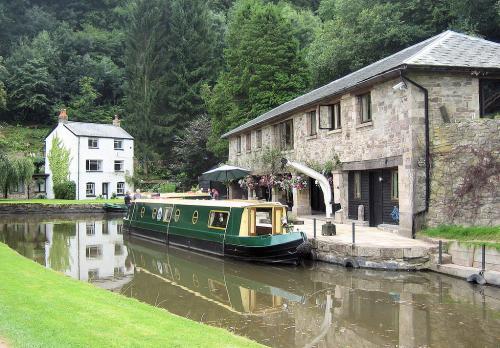
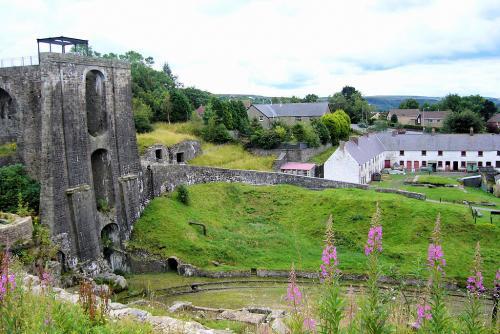

By road: Llanfoist Basin is on the Brecknock & Abergavenny Canal and the B4246. The tramroad is best accessed from the B4246 between Govilon and Blaenavon where it is signposted to Garnddyrys, the location of a forge built in 1817 (a scheduled Ancient Monument).
Barber, Chris, and Blackmore, M., Portraits of the Past., Blorenge Books, ISBN 1 872730 05 1 (1996)
Biddle, Gordon, Britain's Historic Railway Buildings, Oxford University Press, ISBN-10: 0198662475 (2003)
Biddle, Gordon & Nock, O.S., The Railway Heritage of Britain : 150 years of railway architecture and engineering, Studio Editions, ISBN-10: 1851705953 (1990)
Biddle, Gordon and Simmons, J., The Oxford Companion to British Railway History, Oxford, ISBN 0 19 211697 5 (1997)
Bonavia, Michael, Historic Railway Sites in Britain, Hale, ISBN 0 7090 3156 4 (1987)
Conolly, W. Philip, British Railways Pre-Grouping Atlas And Gazetteer, Ian Allan Publishing, ISBN 0-7110-0320-3 (1958/97)
Jones, G. and Dunstone, D., The Origins of the LMS in South Wales. ISBN 1 85902 671 0 (1999)
Morgan, Bryan, Railways: Civil Engineering, Arrow, ISBN 0 09 908180 6 (1973)
Morgan, Bryan, Railway Relics, Ian Allan, ISBN 0 7110 0092 1 (1969)
Morris, Chris, Under Blorenge Mountain, Tanners Yard press, ISBN-10 0954209613 (2003)
Rattenbury, P. G., Tramroads of the Brecknock & Abergavenny Canal, RCHS, ISBN-10 0901461245 (1980)Simmons, J., The Railways of Britain, Macmillan, ISBN 0 333 40766 0 (1961-86)
Simmons, J., The Victorian Railway, Thames & Hudson, ISBN 0 500 25110X (1991)
Smith, Martin, British Railway Bridges and Viaducts, Ian Allan, ISBN 0 7110 2273 9 (1994)
Turnock, David, An Historical Geography of Railways, Ashgate, ISBN 1 85928 450 7 (1998)
