Humber Bridge

When constructed, the longest single-span suspension bridge in the world
Region:
Red Wheel Site:
Transport Mode(s):
Address:
Humber Bridge Board, Ferriby Road, Hessle, East Yorkshire HU13 OJG
Postcode:
Visitor Centre:
Opening Times:
Permanently viewable
Website:
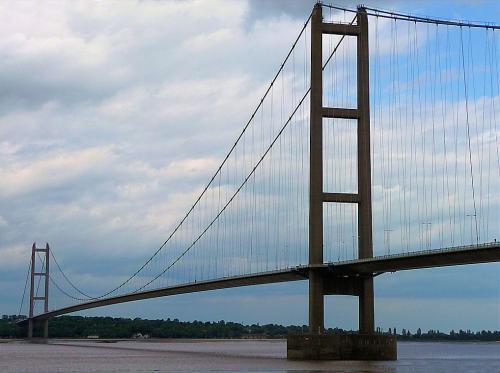
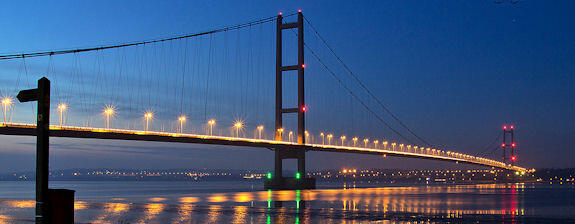
Visit websiteThe Humber Bridge, near Kingston upon Hull, England, is a 2,220 m (7,283 ft) single-span suspension bridge, which opened to traffic on 24 June 1981. When constructed, it was the largest of its type in the world. It spans the Humber, the estuary formed by the rivers Trent and Ouse, between Barton-upon-Humber on the south bank and Hessle on the north bank. For many years the Humber Estuary was a regional barrier to trade and development.
The first major crossing proposal, a tunnel scheme in 1872, was promoted by Hull merchants and businesses dissatisfied with the service provided by the New Holland ferry crossing. In 1928, a plan was drawn up by Hull City Council to build a multi-span truss bridge four miles west of Hull between Hessle on the north side and Barton-upon-Humber on the south, but the scheme was scuppered by the Great Depression.
The passing of the Humber Bridge Act and the creation of the Humber Bridge Board in 1959 authorised the project to proceed, but no financial resources were sanctioned until the 1966 Hull North by-election when, in an effort to save his government, the then Prime Minister Harold Wilson prevailed upon his Minister of Transport, Barbara Castle, to sanction the building of the bridge. Construction work started in 1973; the consulting engineers were Freeman Fox & Partners and the main contractor was Sir William Arrol & Co.
A suspension bridge was chosen because, as the navigable channel of the Humber is always changing, a bridge without support piers in mid-stream would not obstruct the estuary. The area's geology and topography would have meant that construction of a tunnel would have been excessively expensive. The bridge was opened by Elizabeth II on 17 July 1981, reducing the road distance between Hull and Grimsby by almost 80 km (50 miles).
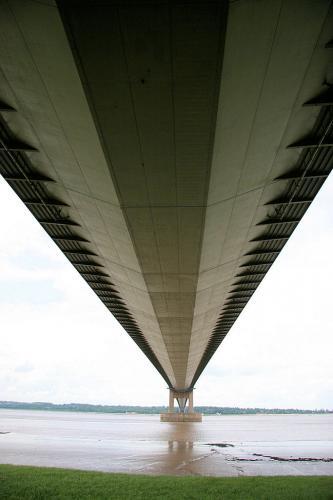
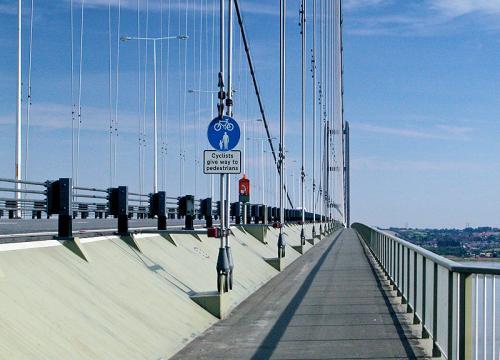
The bridge's surface takes the form of a dual carriageway with a lower-level foot and cyclepath on both sides, although traffic is often restricted to one lane both ways and there is a permanent 80 km/h (50 mph) speed limit. Each tower consists of a pair of hollow vertical concrete columns, each 155.5 m (510 ft) tall and tapering from 6 m (20 ft) square at the base to 4.5 — 4.75 m (14.8 — 15.6 ft) at the top. The bridge is designed to tolerate constant motion and bends more than 3 m (10 ft) in winds of 80 mph (129 km/h). Its slim graceful deck is an aerodynamically designed steel box girder; in a departure from previous practice, the connecting cables by which the deck is hung from the main cables are arranged in an inclined or zig-zag pattern rather than the normal vertical configuration.
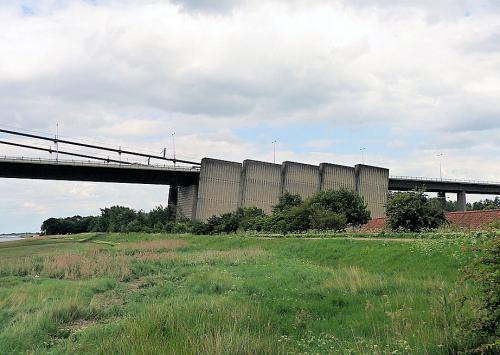
The towers, although both vertical, are 36 mm (1.4 in) farther apart at the top than the bottom due to the curvature of the earth. The total length of the suspension cable is 71,000 km (44,000 miles). The north tower is on the bank, and has foundations down to 8 m (26 ft). The south tower is in the water, and descends to 36 m (118 ft) as a consequence of the shifting sandbanks that make up the estuary.
The bridge held the record for the world's longest single-span suspension bridge until the opening of the Great Belt Bridge in June 1997, and was relegated to third place with the opening of the Akashi-Kaikyo Bridge in April 1998. It is now the fifth longest single-span suspension bridge after two longer span bridges opened in China, the Xihoumen Bridge and the Runyang Bridge. It remains the longest bridge in the world that one can cross on foot or by bicycle.


By road: On A15
By rail: Hessle Station is approx 3 kms away
Burr, William Hubert, A Course on the Stresses in Bridge and Roof Trusses, Arched Ribs and Suspension Bridges (1886), Kessinger Publishing, ISBN-10: 1104171740 (2009)
Drewry, C.S., A Memoir of Suspension Bridges: Comprising a History of their Origin, BiblioBazaar, ISBN -10 05547 25657 (2008)
Hephaestus, Toll Bridges in the United Kingdom, Including: Dartford Crossing, Clifton Suspension Bridge, Tamar Bridge, Humber Bridge, Second Severn Crossing...., Hephaestus Books, ISBN-10: 1243033495 (2011)
Lee, David, The Construction Of The Humber Bridge, David Lee Photography, ASIN: B001ARX9A0 (1991)
Melan, Josef, Theory of Arches and Suspension Bridges (1913, Kessinger Publishing, ISBN-10: 1437437125 (2008)
Minchinton, W., A Guide to Industrial Archaeology sites in Britain, Granada ASIN: B0020ZCPRY (1984)
Peters, Tom, Transitions in Engineering: Guillaume Henri Dufour and the Early 19th Century Cable Suspension Bridges, Birkhauser, ISBN-10: 3764319291 (1987)
Steinman, David, A Practical Treatise on Suspension Bridges: Their Design, Construction and Erection (1922), Kessinger Publishing, ISBN-10: 1436606446 (2008)
Steinman, David, Suspension Bridges and Cantilevers, BiblioBazaar, ISBN-10: 0559673132 (2008)