Hurst Point Lighthouse

Region:
Red Wheel Site:
Transport Mode(s):
Address:
Postcode:
Visitor Centre:
Opening Times:
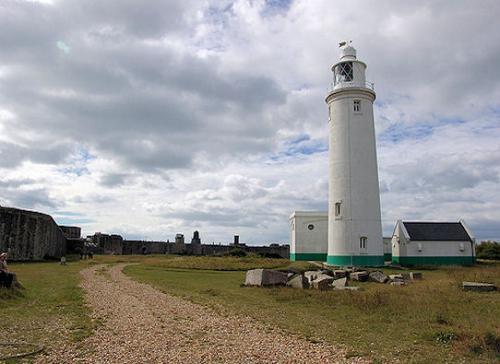
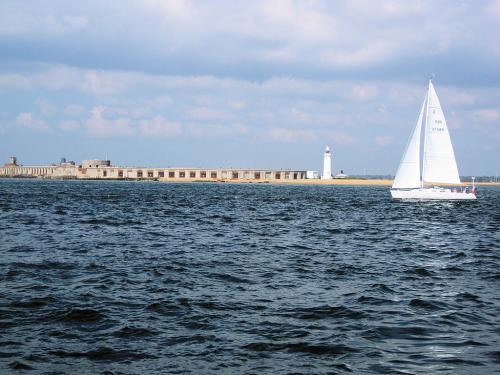
The lighthouse is readily seen from Hurst Castle which is open to the public.
Website:
Visit websiteHurst Castle is situated at the seaward end of the shingle spit that extends 2.4 km (1.5 miles) from Milford-On-Sea. The end of the spit is only 1.2 km (0.75 miles) from the Isle of Wight. Designed to defend the western approach to the Solent, it was built by Henry VIII as one of a chain of coastal fortresses and was completed in 1544. Charles I was imprisoned there in 1648 before being taken to London for his trial and execution. The castle was modernised during the Napoleonic wars and again in the 1870's when the long armoured wings were constructed. Two of the huge 38-ton guns installed in the 1870's can be viewed in their casemates. During World War II, Hurst was manned with coastal gun batteries and searchlights. The castle now incorporates a lighthouse museum.
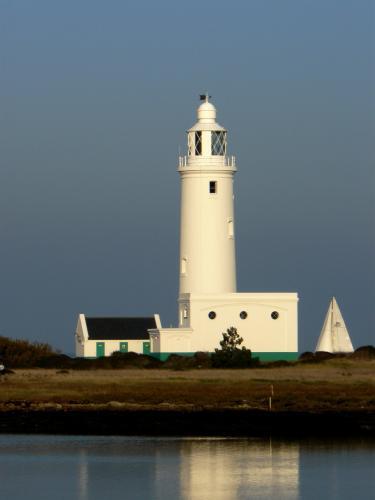
Hurst Point Lighthouse guides vessels through the hazardous western approaches to the Solent, indicating the line of approach through the Needles Channel. A light was shown on Hurst Point as early as 1733, although the first Trinity House record relates to a meeting of shipmasters and merchants in 1781 to approve the terms of a formal petition to Trinity House for lights in the neighbourhood of the Isle of Wight. A patent was obtained in 1782, directing that the lights should be "kept burning in the night season whereby seafaring men and mariners might take notice of and avoid dangers ... and ships and other vessels of war might safely cruise during the night season in the British Channel".
Trinity House erected three lighthouses in 1785, designed by R. Jupp, at the Needles, St. Catherine's Point and Hurst. The Hurst Tower, sited to the south west of Hurst Castle, was lit for the first time in 1786, but as shipping found that this light was obscured from certain directions, an additional and higher light was constructed in 1812.
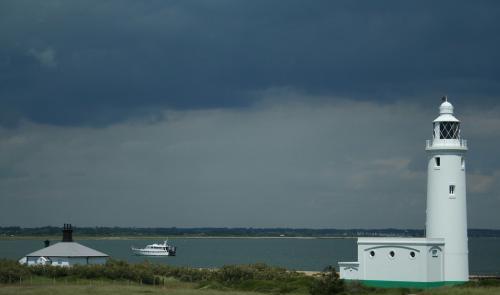
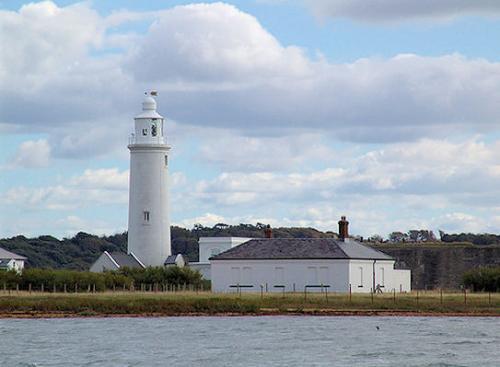
Extensive additions were made to the castle between 1865 and 1873 necessitating the repositioning of the lights. A new lighthouse - the Low Light - was built to replace the old Hurst Tower in 1866 and consisted of a white circular granite tower with a red lantern. This was replaced in 1911 by a new Low Lighthouse, a red square metal structure standing on a framework of steel joists attached to the wall of Hurst Castle. The High Lighthouse of 1812 was also replaced in 1867 by the 26 m (85 ft) tower which is still working today.
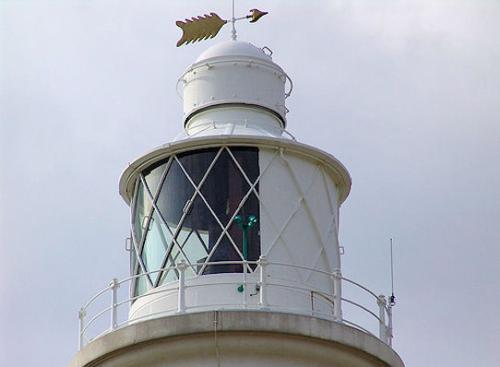
A major modernisation of Hurst Point High Lighthouse was completed in July 1997, following growth in the volume and diversity of traffic using the Needles Channel, adding high intensity projectors which mark the channel between the Needles and the Shingles Bank day and night. The projectors, sited in the service room below the lantern of the High Lighthouse, provide an accurate system of red, green and white directional lights giving precise cut offs over narrow arcs of visibility which can be realigned in the event of movement of the Shingles Bank.
The main light at Hurst High still uses the unusual first order lens which is separated into sectors of different focal lengths with a red sector provided by shades inside the lantern. The acetylene light source has been replaced by standard Trinity House electrically powered equipment. The Low Lighthouse, which was built on the wall of Hurst Castle, was decommissioned and painted grey to match the surrounding background colours in order to eliminate navigational confusion.
In 2006, the first room of the Trinity House Lighthouse Exhibition was opened in the West Wing of the Castle, and this was expanded further in 2007 with the opening of a second room alongside. The exhibition has a display of artefacts including optics, fog horns and light buoys. The finishing touch to the exhibition is the Egypt Point optic (originally at West Cowes, Isle of Wight) which has been restored and is now located outside the display rooms.
By road: Off A337, via B3058 Lymington Road to Lymington and Keyhaven. It is not possible to reach Hurst Castle itself by car, but there is adequate parking on the sea front at Milford-On-Sea and the castle is situated at the seaward end of the shingle spit that extends 2.4 km (1.5 miles) eastward from the town.
By boat: A regular ferry service from Keyhaven is operated from April until the end of October (timetables may vary due to extreme weather, tide and other conditions). Visit www.hurstcastle.co.uk or telephone 01590 642 500.
Bowen, J.P., British Lighthouses, British Council, ASIN: B001A8HS24 (1947)
Denton, A. & Leach, Nicholas, Lighthouses of England and Wales: A Complete Guide, Landmark Publishing, ISBN-10: 1843063190 (2007)
Hague, Douglas and Christie, Rosemary, Lighthouses, Their Architecture, History and Archaeology, Gomer Press, ISBN-0850883245(1975)
Naish, John, Seamarks, Their History and Development Adlard Coles Nautical, ISBN-10: 0540073091 (1985)
Nicholson, Christopher, Rock lighthouses of Britain; The end of an era?, Whittles Publishing, ISBN 1870325419. (1995)
Payton, Charles, Lighthouses: Towers of the Sea, National Trust Books, ISBN-10: 1905400128 (2006)
Woodman, Richard & Wilson, Jane, The Lighthouses of Trinity House, ISBN 1 904050 00 X (2002)