Isle of May Lighthouse

Region:
Red Wheel Site:
Transport Mode(s):
Address:
Isle of May, Fife KY10 3
Postcode:
Visitor Centre:
Opening Times:
Visible at all times. The island is a nature reserve but trips by sea are run in the summer from Anstruther and can be booked on Tel: 01333 310 054.
Website:
Visit websiteA coal-fired beacon was established in 1635 by James Maxwell of Innerwick, and John and Alexander Cunningham, who charged shipping a tonnage-based fee. This was originally 2 Scottish shillings per ton for Scottish ships (equivalent to two pence sterling) and twice this amount for non-local shipping per voyage, but was reduced to 1 shilling and sixpence, and three shillings respectively in 1639 with some shipping entirely exempt during the summer.
The beacon, the first permanently manned one in Scotland and considered at the time to be one of the best in existence, used around 400 tons of coal per year, requiring three men to look after it. One of the three lightkeepers, his wife and five of his six children were suffocated by fumes in January 1791, the exception being a three-year old girl who was discovered alive three days later. Ash and clinker had piled up beside the forty foot high beacon tower over the previous ten years and had reached the window of keepers' room, and was set smouldering by coals falling from the beacon.
The light was sometimes hard to recognise, for example HMS Nymphe a 36-gun fifth rate captured from the French in 1780 and HMS Pallas were wrecked near Dunbar on the night of 19 December 1810 because their navigators had mistaken a lime kiln on the mainland coast for the beacon.
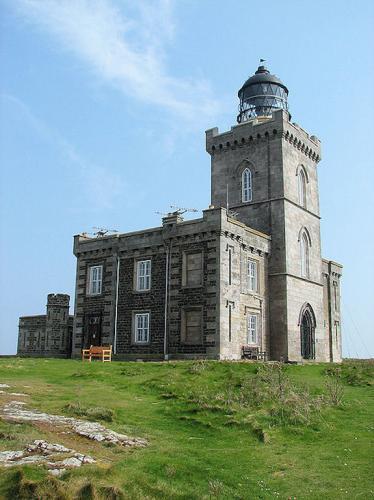
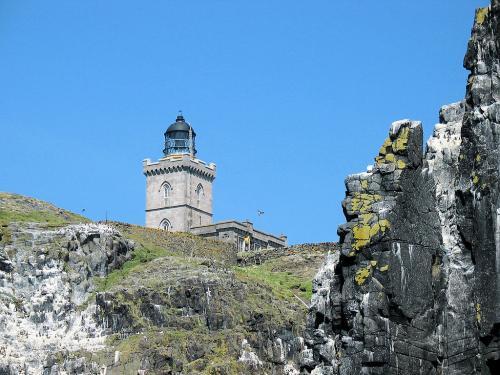
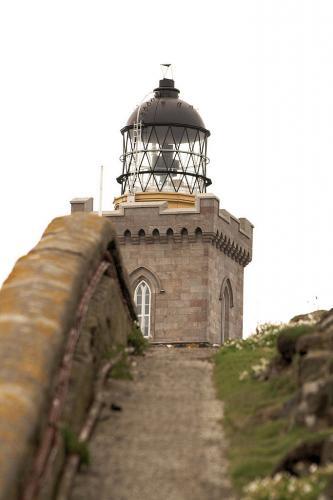
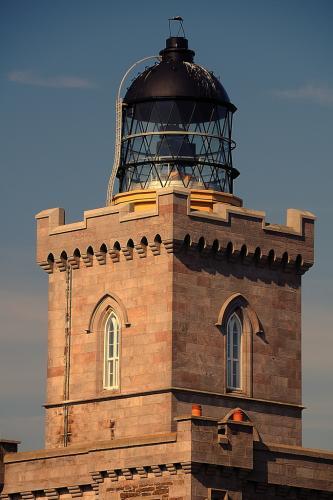
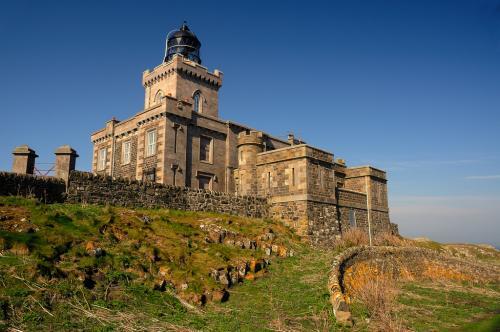
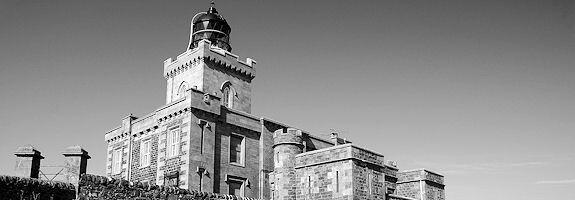
The Northern Lighthouse Board purchased the island in 1814 from the Duke and Duchess of Portland for £60,000, by which time the beacon was the last remaining private lighthouse in Scotland. A proper lighthouse was built on the island in 1816 by Robert Stevenson. and is an ornate gothic tower on a castellated stone building designed to resemble a castle, 24 metres high and with accommodation for three light keepers and their families, along with additional space for visiting officials. The new lighthouse started operating on 1 September 1816, and is now a listed building.
It was upgraded in September 1836, when a new light and refractor lens was fitted, and further extensive work took place in 1885-1886. Additional dwellings, boiler and engine houses, a workshop and a coal store were built 270 yards (250 m) from the lighthouse in a small valley containing a fresh water loch. The engine house was fitted with two steam-powered generators, at 4.5 tons each the largest ever constructed at that time, and with a total output of 8.8 kilowatts. These powered an arc lamp in the lighthouse, with a three-wick paraffin lamp kept lit but turned down in case the electric lamp failed. The new light was first used on 1 December 1886 and produced four flashes every 30 seconds. The high cost of the coal, around 150 tons per year, along with improvements in oil lights led to the replacement with an incandescent mantle in 1924.
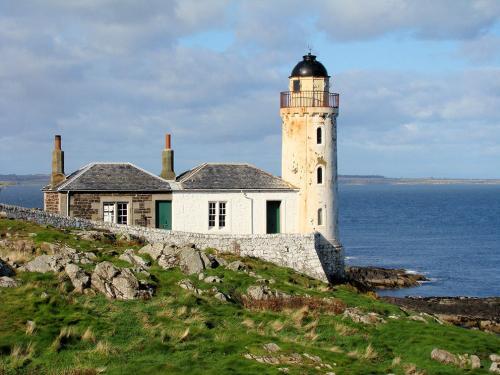
Another smaller lighthouse, the Low Light was constructed a few hundred yards from the main light in 1843 to provide (with the main lighthouse) a pair of lights which would become aligned to help ships avoid the North Carr Rock seven miles (11 km) to the North of the island. It was first used in April 1844, but is no longer used, having been made redundant by the establishment of the North Carr Lightship in 1887 and the building is now used for bird watching.
In 1930 two keepers rescued four crew members of the wrecked commercial trawler George Aunger by swimming out to it. The lighthouse became a "rock" station on 9 August 1972, meaning that the keeper's families were no longer accommodated at the lighthouse but on the mainland, and a fully automatic one on 31 March 1989 shortly before ownership of the island passed to the Nature Conservancy Council. It is now monitored and controlled via a UHF radio link to Fife Ness Lighthouse and then by landline to the Northern Lighthouse Board headquarters in Edinburgh.

By boat: Boats operate from the harbour in Anstruther; May is 8 km off the coast of Fife.
Bathurst, B., The Lighthouse Stevensons, Harper Perennial, ISBN-10: 0007204434 (2005)Bowen, J.P., British Lighthouses, British Council, ASIN: B001A8HS24 (1947)
Chance, Toby, Lighthouses: The Race to Illuminate the World, New Holland Publishers, ISBN-10: 1847731740 (2008)
Denton, A. & Leach, Nicholas, Lighthouses of England and Wales: A Complete Guide, Landmark Publishing, ISBN-10: 1843063190 (2007)
Eggeling, W. J., The Isle of May: A Scottish Nature Reserve, Oliver & Boyd, ASIN: B0000CKSRH (1960)
Hague, Douglas and Christie, Rosemary, Lighthouses, Their Architecture, History and Archaeology, Gomer Press, ISBN-0850883245(1975)
Naish, John, Seamarks, Their History and Development Adlard Coles Nautical, ISBN-10: 0540073091 (1985)
Nicholson, Christopher, Rock lighthouses of Britain; The end of an era?, Whittles Publishing, ISBN 1870325419. (1995)
Payton, Charles, Lighthouses: Towers of the Sea, National Trust Books, ISBN-10: 1905400128 (2006)
Woodman, Richard & Wilson, Jane, The Lighthouses of Trinity House, ISBN 1 904050 00 X (2002)
Northern Lighthouse Board - Isle of May