Lincoln High Bridge

The second oldest masonry bridge in Britain, Grade I listed and an Ancient Monument.
Region:
Red Wheel Site:
Transport Mode(s):
Address:
207, High Street, Lincoln LN5 7AU.
Postcode:
Visitor Centre:
Opening Times:
Open at all times.
Website:
Visit websiteThe first bridges were probably of felled trees lain across the river (Stockbridge and Trowbridge both refer to tree trunk bridges) and then of worked timber.
The Romans built bridges in wood, and probably stone, but none remain in Britain. The oldest surviving timber bridge is over the River Ouse at Selby and dates from 1790.
The first simple stone bridges - clapper bridges comprise large slabs of stone rested on stone piers to span a stream or small river. Tarr Steps, which crosses the River Barle in Somerset, is the longest with 17 spans supporting stone slabs 5 feet wide. It is too narrow for carts but Pont Sarnddu in Carnarvonshire is ten feet across and wide enough for vehicles.
Packhorse bridges, small arched bridges, with very low parapets so as not to get in the way of the horse's panniers, can still be found for example at Wycoller in Lancashire, Moulton in Suffolk, and Fifehead Neville, Dorset.
More sophisticated stone bridges were built abundantly in the 13th century, the use of timber continued into the 16th century. The river Skell at Fountains Abbey, Yorkshire, is crossed by probably the oldest arched bridge in England. Thirteenth to fourteenth century bridges can be recognised by their pointed arches and by the V-shaped extensions over the cutwaters for pedestrian refuges. These were superseded by bridges which were ribbed under the arches (14/15century), and those with semi-circular arches.
But all of these styles are modified by the needs and knowledge of the locality. In the early eighteenth century Daniel Defoe observed "...the Nyd, smaller then the Wharfe, but furiously rapid, and very dangerous to pass in many places, especially upon sudden rains. Notwithstanding, such lofty high built bridges are as not to be seen over such small rivers in any other place".
Masonry arch and cast iron bridges derive from the late 18th and 19th centuries. Bridges were usually made from local materials. In the eastern counties they were first built with timber and then brick. Mayton Bridge 8 miles north of Norwich has four centred brick arches.
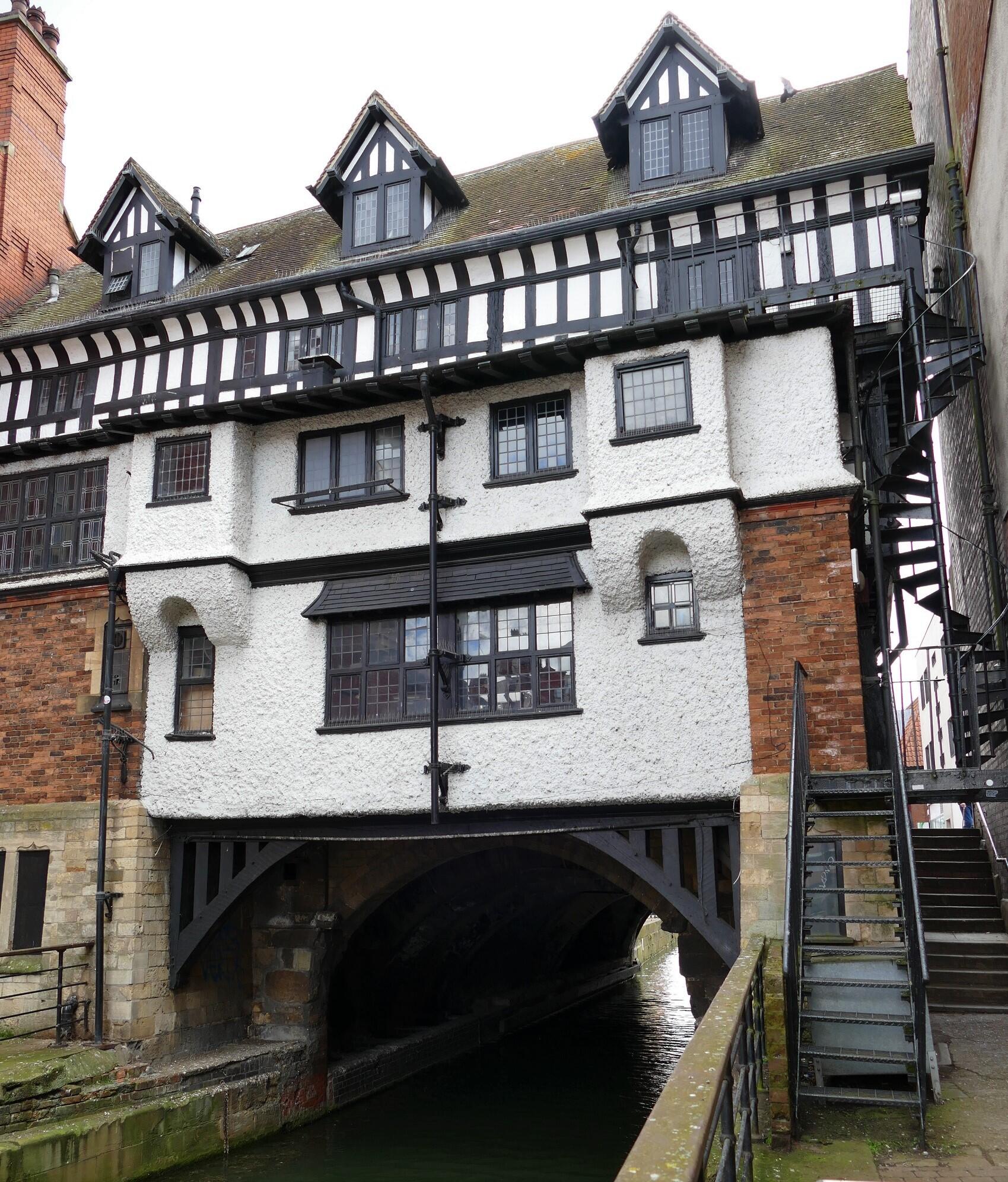
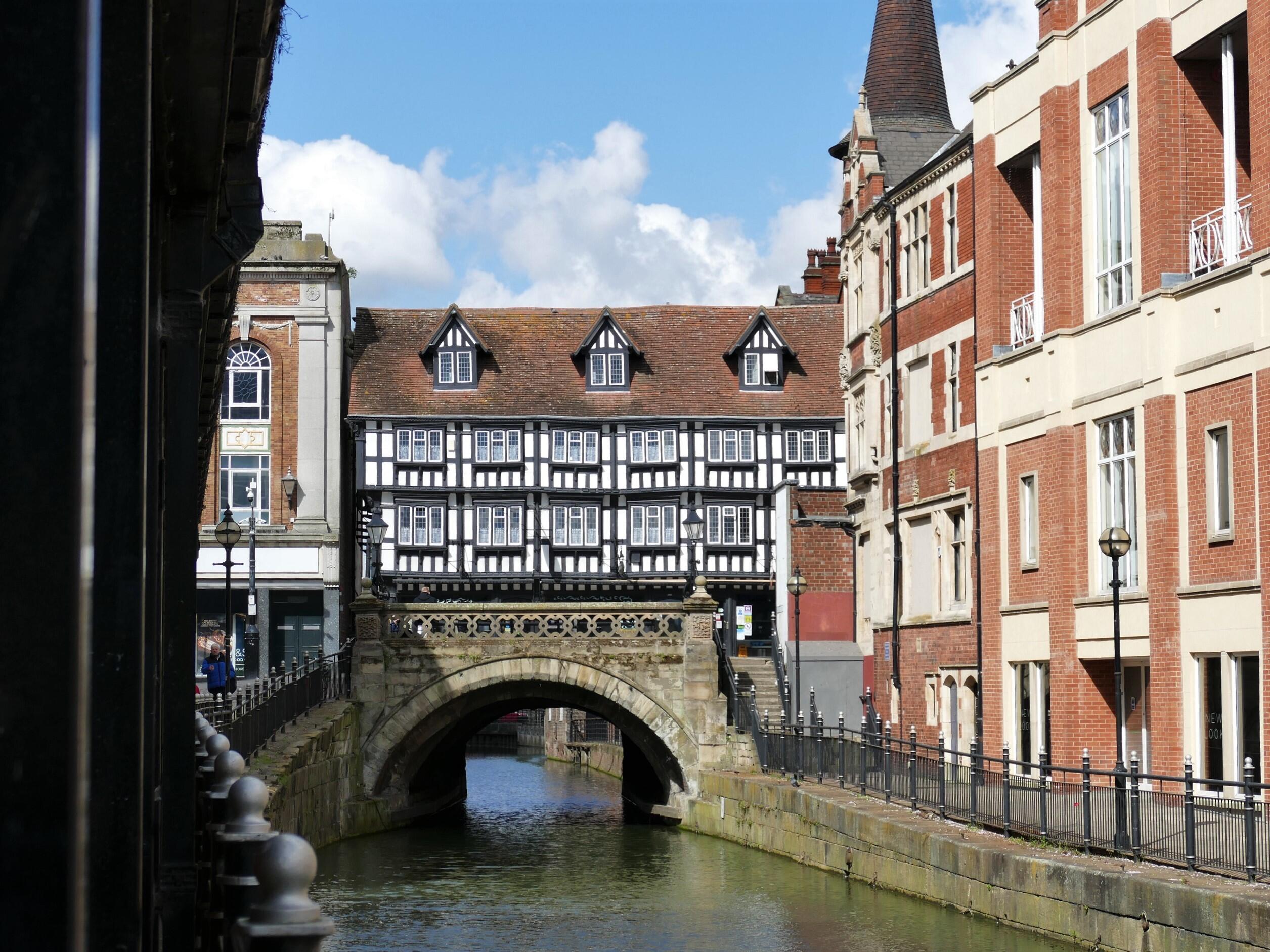
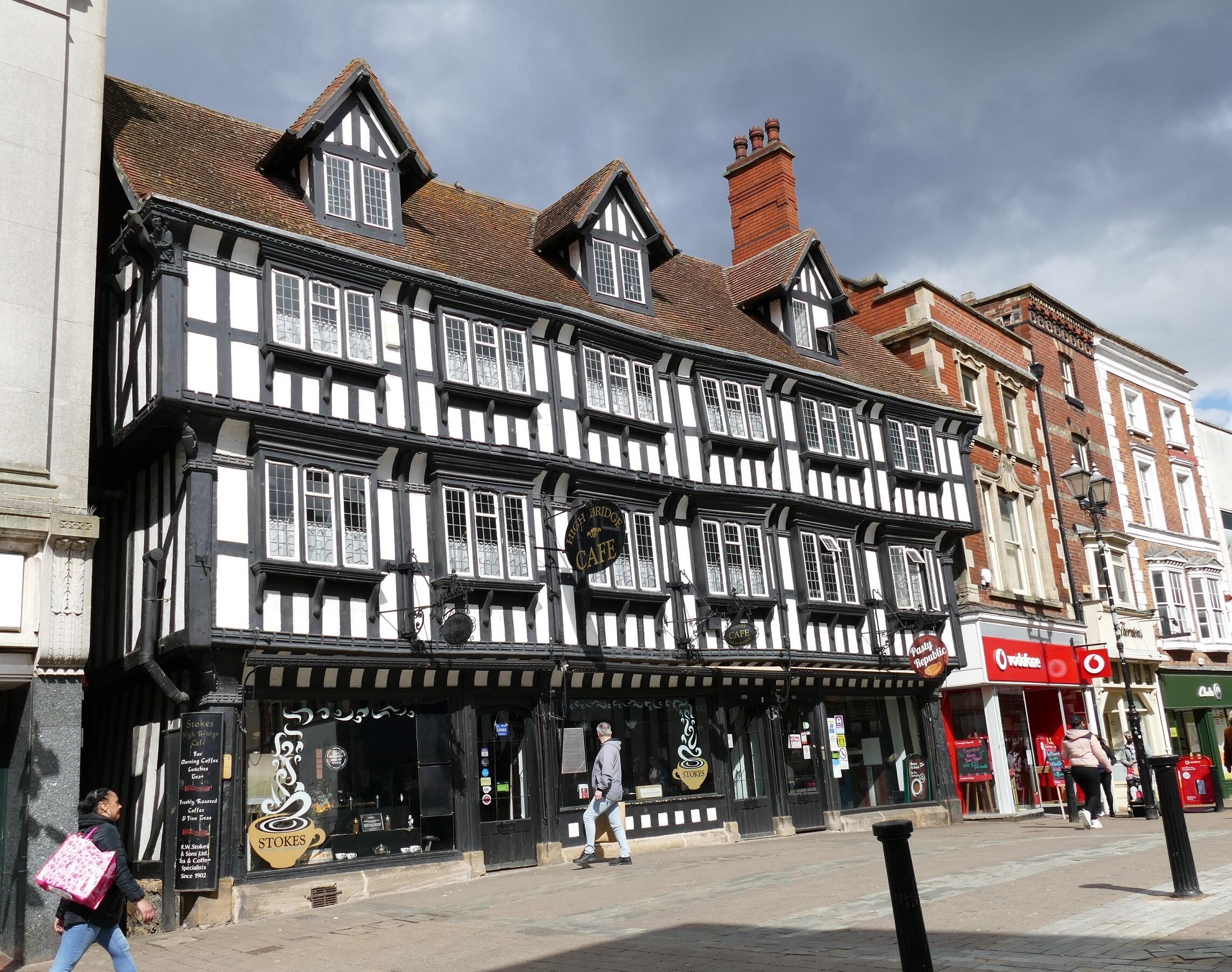
The High Bridge in Lincoln, is the oldest bridge in the United Kingdom which still has buildings on it. It was built in the 12th century and the oldest building dates from the 14th century. Bridges like this were common in the Middle Ages, the best known being London Bridge, but most have long since been demolished because of their obstruction to the river flow and to shipping.
The Glory Hole is the name given by generations of boaters to the High Bridge in Lincoln. It has a narrow and crooked arch which sets a limit on the size of boats using the Witham and going from Brayford Pool, at the start of Foss Dyke, to Boston and the sea. Since the 14th Century the bridge has contributed to floods in Lincoln and after any heavy rain the bridge is virtually unnavigable. A design by William Jessop in the 19th century to reroute the waters of the Witham through the south of the town was never implemented.
By Road: Between the A 57 and A 15 in the centre of the city. it is best approached on foot from the High Street.
By Rail: to Lincoln Station.
Addison, Sir William, The Old Roads of England, Batsford, ISBN 0 7134 1714 5 (1980)
Albert, W., The Turnpike Road System in England 1663-1840, Cambridge University Press, ISBN O 5210 3391 8 (1972)
Barker, Theo, The Rise and Rise of Road Transport, 1700-1990, Cambridge University Press, ISBN-10 0521557739 (1995)
Codrington, Thomas, Roman Roads in Britain: Early Britain, Kessinger Publishing, ISBN-10 0548240310 (2007)
Davies, Hugh, Roads in Roman Britain, History Press, ISBN-10 0752425030 (2008)
Davies, Hugh, Roman Roads, Shire, ISBN-10 074780690X (2008)
Harrison, David, The Bridges of Medieval England: Transport and Society 400-1800, Oxford University Press, ISBN-10: 0199226857 (2007)
Hindle, P., Roads and Tracks for Historians, Phillimore & Co, ISBN-10: 1860771823 (2001)
Hindley, G., History of the Roads, Peter Davies, ISBN 0 8065 0290 8 (1971)
Jackson, Gibbard, From Track to Highway, Nicholson and Watson, ASIN B00085R4D8 (1935)
Jervoise, E., Ancient Bridges of England, Architectural Press, ASIN B00085PLDI (1932)
Johnston, David, An Illustrated History of Roman Roads in Britain, Spur Books, ISBN-10 0904978338 (1979)
Peel, J. H. B., Along the Roman Roads of Britain, Macmillan, ISBN-10: 0330239309 (1976)
Sheldon, G., From Trackway to Turnpike, Oxford University Press, ASIN B001N2GS2S (1928)
Smiles, Samuel, The Life of Thomas Telford Civil Engineer with an Introductory History of Roads and Travelling in Great Britain (1867), The Echo Library, ISBN-10: 1406805866 (2006)
Taylor, C., Roads and Tracks of Britain, Littlehampton Books, ISBN 0 460 04329 3 (1979)