London Waterloo Station

The largest station in Britain and probably the best laid out terminus.
Region:
Red Wheel Site:
Transport Mode(s):
Address:
Waterloo Station, London SE1 8SW
Postcode:
Visitor Centre:
Opening Times:
Daily, but see timetables or telephone 08457 48 49 50
Website:
Visit websiteThe London and South Western Railway (L&SWR) opened the station on 11 July 1848 when its main line was extended from Nine Elms. The unfulfilled intention was for a through station with services to the City. Instead, in 1898 the Waterloo & City tube was opened with a line under the Thames to Bank.
The name on opening was 'Waterloo Bridge Station', from the nearby Waterloo Bridge across the Thames. In 1886 it officially became 'Waterloo Station' reflecting the long-standing common usage, and that of some L&SWR timetables.
As the station grew it became increasingly ramshackle: a little-used railway line even crossed the main concourse on the level and passed through an archway in the station building to connect to the South Eastern Railway's smaller station, now Waterloo East, whose tracks lie perpendicular to those of Waterloo. Passengers were confused by the layout and by the two very close stations called 'Waterloo'. This complexity and confusion became the butt of jokes by writers and music hall comics. In Jerome K. Jerome's book Three Men in a Boat no one at Waterloo knows the wanted train's platform, departure time or destination.
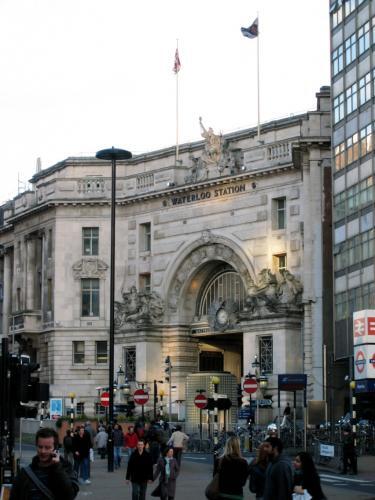
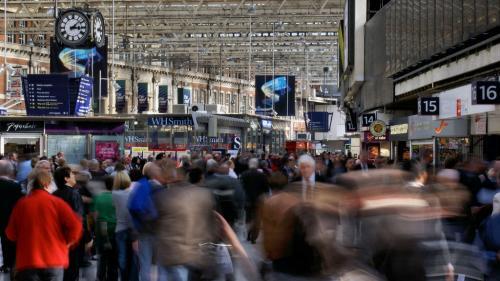
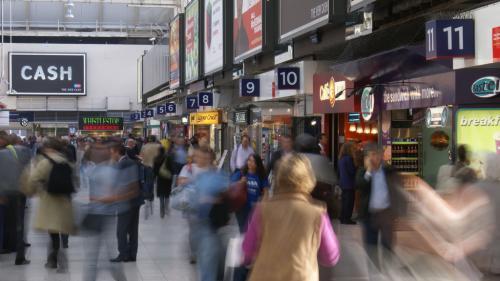
Extensive reconstruction between 1900 and 1922 gave 21 platforms and a concourse nearly 244 m (800 ft) long. The main pedestrian entrance, the Victory Arch, serves as a memorial to company staff who were killed during the two world wars. Damage in World War II required considerable repair but entailed no significant changes to the layout.
A past curiosity of Waterloo was that a spur led to the adjoining dedicated station of the London Necropolis Company from which funerary trains, at one time daily, ran to Brookwood Cemetery bearing coffins at 2/6 each. This station was destroyed during World War II. Andrew Martin has written an atmospheric novel set on this line.
Platforms 20 and 21 were lost to the Waterloo International railway station site, which from 1994 until 13 November 2007 was the London terminus of Eurostar international services. Construction necessitated the removal of decorative masonry forming two arches from that side of the station, bearing the legend "Southern Railway". This was subsequently re-erected at the private Fawley Hill Museum of Sir William McAlpine, whose company built Waterloo International. Waterloo International closed when all Eurostar services transferred to the new St Pancras railway station with the opening of the second phase of "HS1", High Speed route 1, formerly known as the Channel Tunnel Rail Link or CTRL.


By bus, train or Underground to Waterloo. By road, it stands on York Way, south of Waterloo Bridge.
Betjeman, J., London's Historic Railway Stations, John Murray, ISBN 0 7195 2573 X (1972)
Biddle, Gordon, Great Railway Stations of Britain. David & Charles, ISBN 0 7153 8263 2 (1986)
Biddle, Gordon, Britain's Historic Railway Buildings, Oxford University Press, ISBN-10: 0198662475 (2003)
Biddle, Gordon & Nock, O.S., The Railway Heritage of Britain : 150 years of railway architecture and engineering, Studio Editions, ISBN-10: 1851705953 (1990)
Ellis, C. Hamilton, The South Western Railway, George Allen & Unwin, (1956)
Jackson, Alan, London's Termini, David & Charles, ISBN 0 7153 4474 9 (1969)
Faulkner, J.N., Railways of Waterloo, Ian Allan, ISBN 07110 2237 2 (1994)
Jerome, Jerome, K., Three Men in a Boat, (a classic novel)
Martin, Andrew. The Necropolis Railway, Harvest Books, ISBN-10 0156030683 (2005)
White, H.P., A Regional History of the Railways of Britain, Southern England. David & Charles, ISBN 0 7153 4733 0 (1970)
South Western Circle - London & South Western Railway