Oswestry Station & Works

Headquarters station and Central workshops of the Cambrian Railway serving Shropshire and mid-Wales from 1864 until closure in 1966
Region:
Red Wheel Site:
Transport Mode(s):
Address:
Postcode:
Visitor Centre:
Website:
Visit websiteOrigins
The first rail service to reach Oswestry, in 1848, was a short branch of Shrewsbury and Chester Railway. Not until 1860, with the building of the Oswestry and Newtown Railway, did the town began its rise to regional prominence as a transport hub. Successive railway lines brought prosperity to the town, which doubled in size between 1851 and 1901, and saw the construction of a number of grand and prominent buildings.
In 1864 a number of the independent Welsh and English railway lines were consolidated to form the Cambrian Railways, an important component of the emerging national rail network. The Cambrian Railways connected Mid-Wales with the West Midlands and the cities and industrial areas beyond. In 1866 Oswestry became established as the administrative and engineering headquarters of the company. A large station with first-floor company boardroom was built, along with ancillary structures including a goods shed, carriage sidings and signal box.
In the same period the Cambrian established railway workshops on the opposite side of the tracks for the construction, repair and maintenance of railway locomotives and rolling stock. The design was based on the Shrewsbury and Hereford Railway works at Coleham, Shrewsbury, and is attributed to the Manchester locomotive builders Sharp, Stewart & Company. The workshops were adapted and expanded in the later C19 and early 20th century to include a gas works and other structures.
Later History
In the 1923 Grouping the Cambrian Railways were absorbed into the GWR. The single-track branch from Gobowen had terminated at a separate Oswestry station adjacent to the Cambrian. After 1923 the GWR saw no sense in keeping two stations and moved its branch train to a new bay platform in the Cambrian station, leaving the old branch station as a goods loading dock.
The expansion of road traffic after WW2 led to the railway’s gradual decline. Transferred from the Western to London Midland Region of BR in 1963, the workshops were closed in phases through 1964-66; passenger services through Oswestry ceased in 1966 and goods traffic stopped in 1988. No trace remains of the old branch station which would have been under what is now a car park. Track N to Gobowen and S to Blodwel Quarry remained as a siding for some years and part is still in situ, cared for by a heritage railway trust. By the 1990s the former workshops had been adapted for a variety of other commercial uses including a bar/restaurant and an antiques emporium. A £4.5m renovation project in 2011 provided a health centre and four private residences.
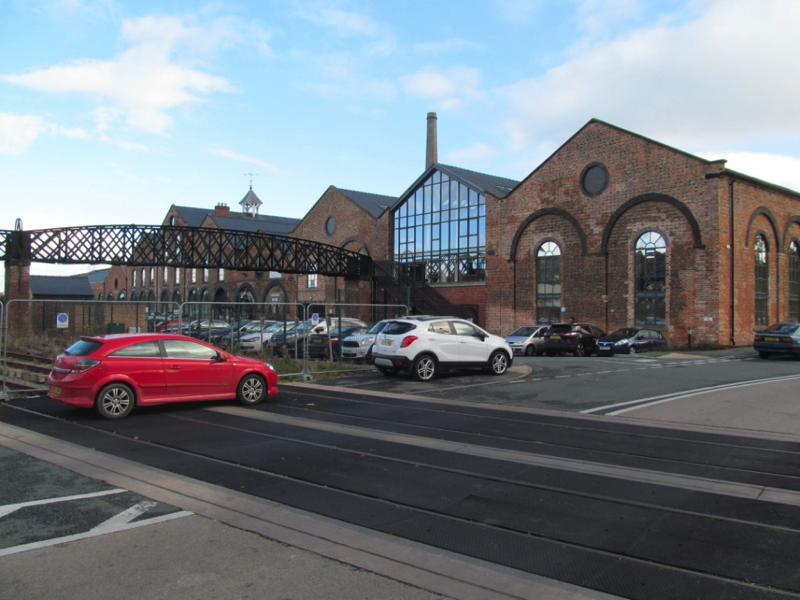
Access to the works complex is by level crossing and a footbridge (extant but sadly locked out of use) over the old railway tracks.
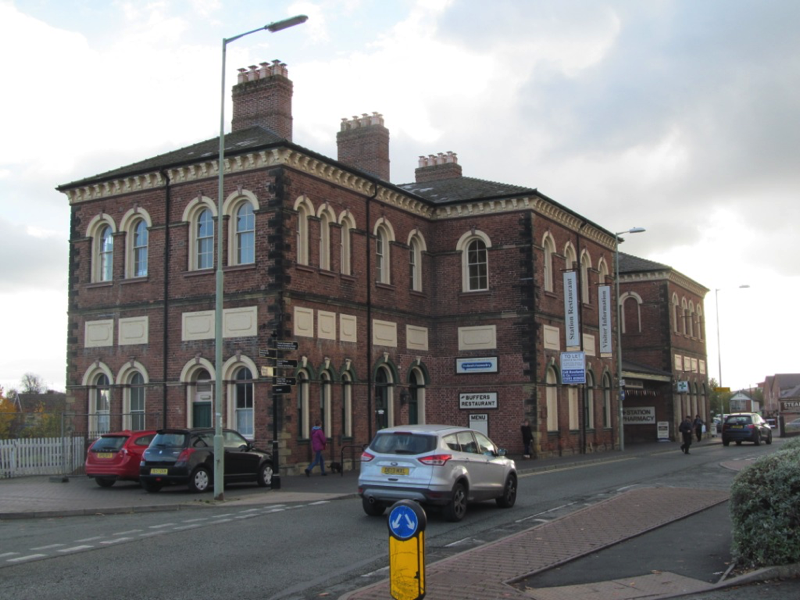
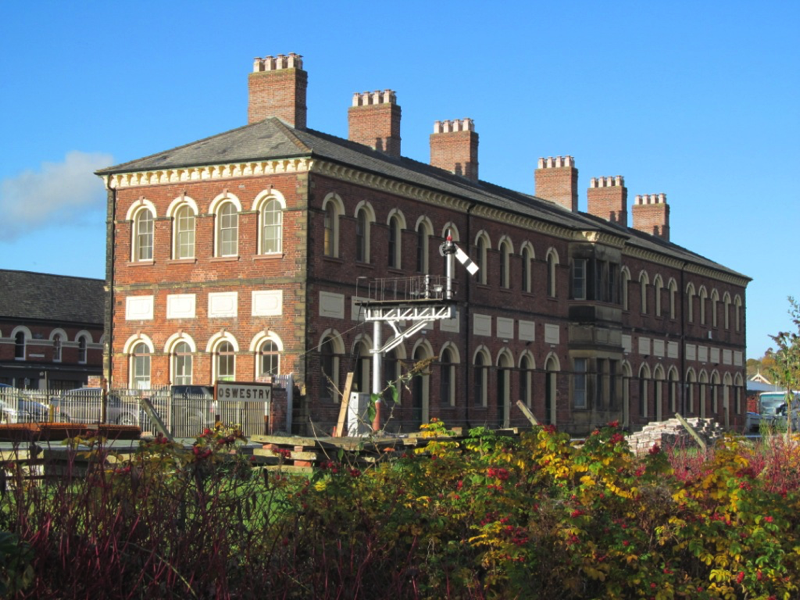
Old Railway station
Railway station and former headquarters of the Cambrian Railway Company, now shop. Circa 1865 with later additions and alterations. Red brick on moulded stone plinth with painted stone dressings and chamfered angle quoins, hipped slate roof with 4 rendered ridge stacks. 2 storeys, decorated bracketed eaves cornice with rosettes and other emblems alternating with each bracket, moulded floor and impost bands; entrance side: 5:4:4:4:5 windows, second sets from left and right forming projecting bays, round-headed 8-paned sashes with projecting keystones and moulded cills, each ground-floor window with moulded stone rectangular panel above (square over triple windows to outer end of left and right bays); central section has corrugated iron lean-to roof supported on cast-iron brackets with 20th century facia board to front, half-glazed doors. Platform side: details as on entrance side, 19 bays with full-height ashlar-faced 4-window canted bay to centre. 20th century additions to front abutting right-hand end and in angle with left projecting bay are not of special architectural interest.
Signal Box
Ambleside Road, SY11 1RE 80m S of former Oswestry Station
Signal box. Late C19 with later alterations. Red brick, slate roof with pointed wooden finial. 2 levels; 4 fixed-light windows to upper level and 2 round-arched fixed-light windows below, left blocked; first-floor entrance to left gable approached by flight of wooden steps. Given Listed status for group value.
Former Railway Works and Footbridge
1 Gobowen Road, SY11 1HQ 200m NE of former Oswestry Station
A former railway works with attached footbridge of 1865/6, attributed to Sharp, Stewart & Company, Thomas Savin and John Robinson, with later additions and alterations.
MATERIALS: Red, brown and blue brick, slate and corrugated iron roofs with coped verges. Some sheds, and their roofs, are constructed of steel.
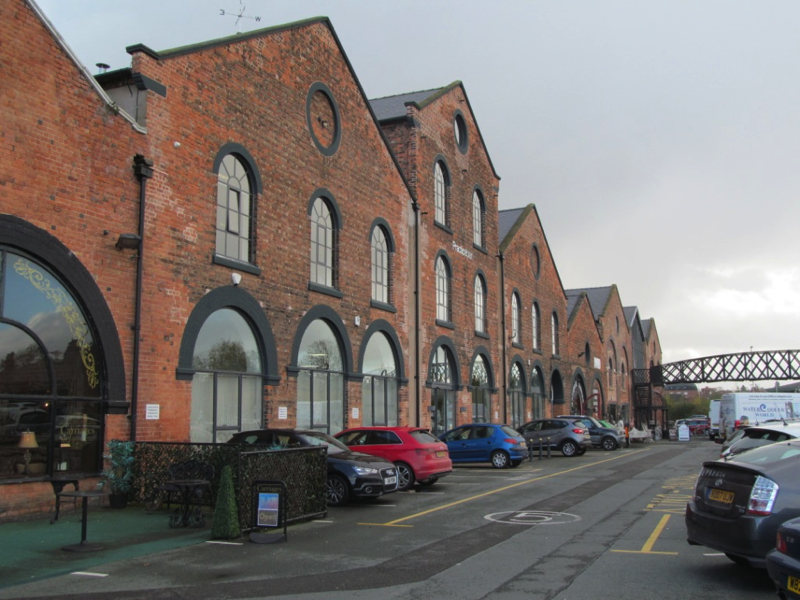
PLAN: The main range of the works has a two-bay central section arranged over three storeys, with two-storey, three-bay buildings attached to either side. The group forms the former works offices, stores and washhouses. It has later, inserted staircases and wall divisions. Either side of the group, and to the rear, are long ranges, a single-bay wide, that form a courtyard. To either side of the main range are locomotive and carriage sheds. The seven-bay sheds to the left (the former carriage shops) are subdivided by a red brick division with round-arched openings, alternately sealed in red brick. The sheds to the right, with an attached footbridge, have been redeveloped with new buildings inserted, and their historic layout is no longer legible. The other sheds, the wagon and paint shops and the foundry, remain in their original open plan, although there is a heavy steel platform and concrete structure inserted at the north-west end of the wagon shops. The cambered arches between the carriage and wagon shops have been infiled.
EXTERIOR: The main façade has three gables to the centre, with lower gables to the left and right. To the left is a seven-bay engine shed (the former carriage works). To the right are three further gabled ranges. The windows are round-arched with cast-iron glazing to the centre. The central gabled ranges have roundels, some of which are sealed. The larger windows to the ground floor form a 19-bay round-arched arcade. There are 20th century openings inserted to the outer bays of the centre. The three gabled ranges to the right have reconfigured openings to the front. The south-west flank wall has twelve round-arched openings with blue brick arches. A courtyard is entered through an arch in the right bay of the centre-right gable. The elevations facing the yard have a range of openings with round or segmental arches. Some openings are sealed and fenestration is a mixture of cast iron and timber. The boiler house range to the south-east has a tall, tapering, octagonal chimney of brown and red brick. Attached to the north-east of the seven-bay engine shed are three sheds of phased construction. The northernmost two sheds (the former wagon shop) are steel-framed, early 20th century structures, clad in later 20th century steel sheet. The former paint shop shed to the south-east has a red brick exterior with stone kneelers, skew arches, original shop doors, and an arcade of blank arches along its south-eastern wall. The roof structures of the sheds have a variety of treatments, but are partly of early-20th century date. The roof of the central gable has a lantern with a weathervane to the ridge.
The footbridge is attached to the left of the right gables. It is constructed of wrought-iron, latticed trusses, and supported by two sets of cast-iron columns and a central brick pier.
INTERIOR: The central bays of the main works building have been reconfigured with the insertion of partition walls, ceilings and staircases. Structural cast-iron columns remain in situ. The roof structures are constructed of substantial timber beams in a queen-post arrangement. The connecting bays, former shops and the smithy, are open areas with no fittings of note in the areas inspected. The bays to the right, formerly the locomotive and tender shop, are currently being restored and refurbished, and new buildings inserted within the envelope of the building. The C19 sheds to the left, the former carriage shops have cast-iron columns supporting the roof. The 20th century sheds further left are supported by steel structure.
SUBSIDIARY FEATURES: To the rear of the works buildings is a red brick sheet room, with an attached 20th century range, and a further attached C19 single-storey gas works. The sheet room has a queen-post roof and attic lights, although there is no first-floor structure.