Peckham Rye Station

Region:
Red Wheel Site:
Transport Mode(s):
Address:
Station Arcade, Rye Lane, Peckham, London SE15 5DQ
Postcode:
Visitor Centre:
Opening Times:
Opening times vary - see website or telephone 08451 272920
Website:
Visit websitePeckham Rye Station opened on 1 December 1865 for London, Chatham & Dover Railway trains and on 13 August 1886 for London, Brighton & South Coast Railway trains.
Charles Henry Driver (1832-1900) was a significant British architect of the Victorian era, with a reputation for pioneering use of ornamental iron work for which he was seen as a leading authority. He was also an expert in its casting and manufacture and assisted Joseph Paxton on the construction of Crystal Palace as part of the Great Exhibition of 1851 and designed the Orangery and the Aquarium.
Driver pioneered the use of ornamental tile work in industrial interiors. He worked with the engineer Joseph Bazalgette on the construction of the extensive London sewerage system, designing the great pumping houses at Abbey Mills and Crossness, which were decorative temples to Victorian engineering and steam power.
From 1865, he worked with R.J. Hood on many of the railway stations on the London, Brighton and South Coast Railway, including the London Bridge terminus and stations at Battersea Park, Demnark Hill and Peckham Rye. Peckham Rye has arguably the most impressive and architecturally accomplished design of the group; and because of the largely complete state of its neighbours at Denmark Hill and Battersea Park reconstructing the full picture of the original architectural scheme is straightforward for the historian. Many details in the construction drawings for Peckham Rye survive on the other stations; canopy spandrels, narrow wooden arcaded subways and wooden platforms and shelters with attractive valancing can all be studied at Battersea Park.
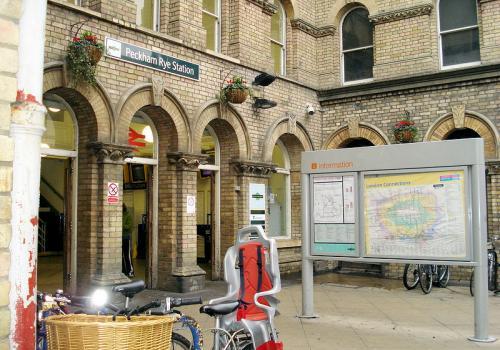
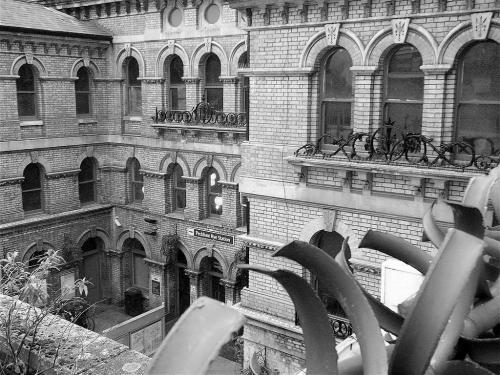
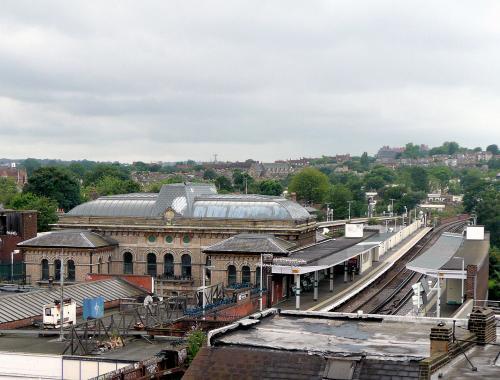
The tripartite street elevation has deep projecting wings flanking the wider entrance elevation of five bays; whilst the least altered aspect of the station, a shopping arcade was built directly in front of it in the 1930s. The fa§ade was restored and cleaned in the late 1990s and the window ironwork refurbished or replaced where it had been lost ‘“ in particular the balconette of the central upper floor window which had been removed in the 1920s. Typical Driver features include Suffolk bricks in subtly differing hues of yellow and pink; a free mixture of round-headed Italianate windows and a French-style roof; a heavy cornice with decorated stone brackets; the skillful integration of vertical pipework into the decorative design (the original pipes are lost but a similar treatment survives at Abbey Mills with barley-sugar shaped pipes); and a flower motif carved in the keystone of windows representing the L, B & SCR, a feature of all Driver’s stations for the company.
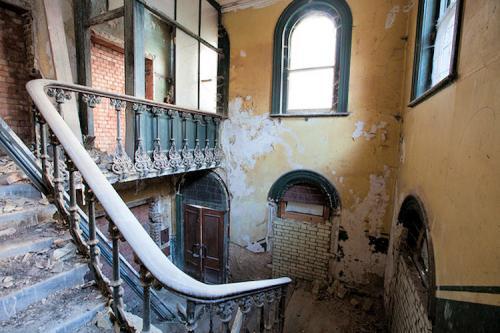
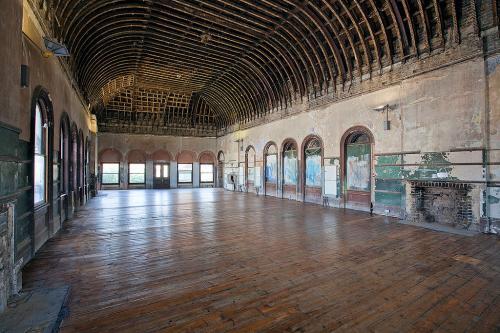
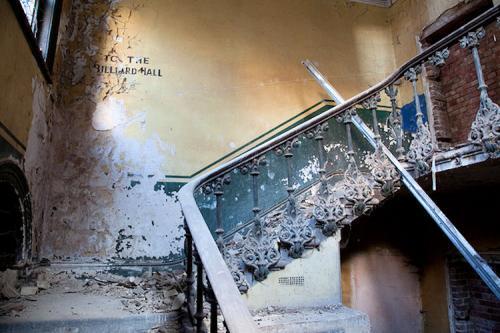
The Booking Hall is largely stripped of original features but the original coving mid-way up its walls indicates the position of the former mezzanine level. This original stone south staircase with cast iron balusters of highly ornamental design and woodwork survive, although hidden from the public. The extensive upper level waiting room, 21.3 m (70 ft) by 12.2 m (40 ft) stands empty, with the roof ribs exposed after the collapse of the ceiling plaster.
From 2012, the station has formed part of the London Overground service from Clapham Junction to Surrey Quays; this marked the end of the London Bridge to Victoria service because of space constraints arising from the Thameslink Programme. The building is Listed Grade II.

By road: Off A202, Peckham High Street
Barman, Christian, An Introduction to Railway Architecture, Art & Technics, ASIN: B0000CHT2B (1950)
Betjeman, J., London's Historic Railway Stations, ISBN-10: 071952573X (1972)
Biddle, Gordon, Great Railway Stations of Britain, David & Charles, ISBN-10: 0715382632 (1986)
Biddle, Gordon, Britain's Historic Railway Buildings, Oxford University Press, ISBN-10: 0198662475 (2003)
Biddle, Gordon & Nock, O.S., The Railway Heritage of Britain : 150 years of railway architecture and engineering, Studio Editions, ISBN-10: 1851705953 (1990)
Biddle, Gordon and Simmons, J., The Oxford Companion to British Railway History, Oxford, ISBN-10: 0192116975 (1997)
Biddle, Gordon, and Spence, Jeffry, The British Railway Station, David & Charles, ISBN-10: 0715374672 (1977)
Body, Geoffrey, Railways of the Southern Region, Patrick Stephens, ISBN-10: 185260297X (1989)
Butt, R.V.J., The Directory of Railway Stations, Sparkford: Patrick Stephens, ISBN-10: 1852605081. (October 1995, 1st Edition)
Conolly, W. Philip, British Railways Pre-Grouping Atlas And Gazetteer, Ian Allan Publishing, ISBN-10: 0711003203 (1958/97)
Gray, Adrian, The London Chatham & Dover Railway, Meresborough Books, ISBN-10 0905270886 (1985)
Jackson, Alan, London's Termini, David & Charles, ISBN 0 7153 4474 9 (1969)
Lloyd, David and Insall, Donald, Railway Station Architecture, David & Charles, ISBN 0 7153 7575 X (1978)
Nock, O. S., The South Eastern & Chatham Railway, Ian Allan, ISBN-10: 0711002681 (1972)
Simmons, J., The Railways of Britain, Macmillan, ISBN-10: 0333407660 (1961-86)
Simmons, J., The Victorian Railway, Thames & Hudson, ISBN-10: 050025110X (1991)
Turner, J. H., The London Brighton and South Coast Railway: Origins and Formation, Batsford, ISBN-10: 071340275X (1977)