Portland Bill Lighthouse

The first British lighthouse to be fitted with Argand lights, sited with turbulent sea on three sides.
Region:
Red Wheel Site:
Transport Mode(s):
Address:
Portland Bill, Dorset, DT5 2JT
Postcode:
Visitor Centre:
Opening Times:
The lighthouse and visitor centre opening times may be obtained from telephone: 01305 861233.
Website:
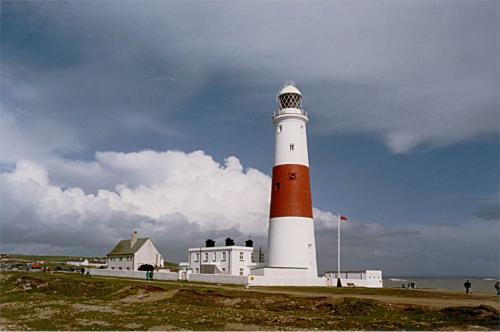
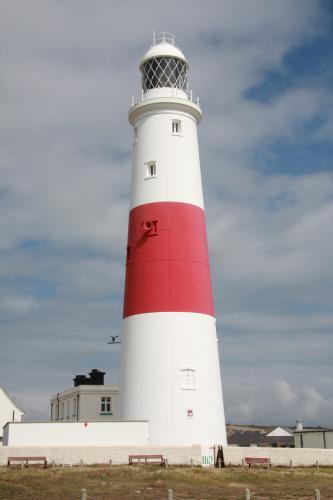
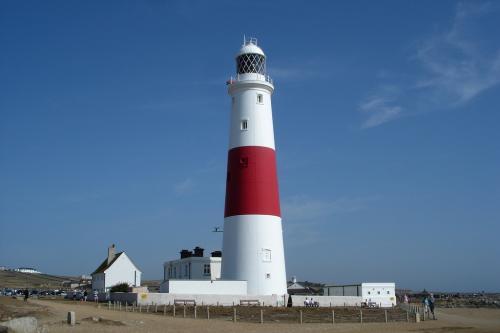
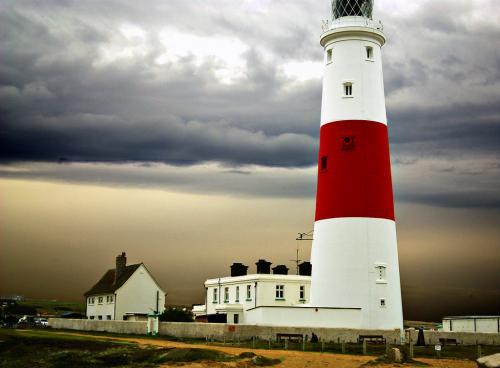
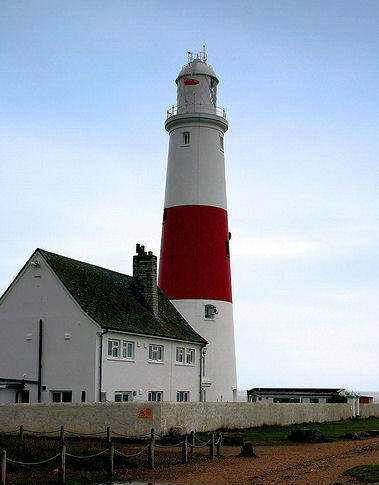
Visit websitePortland Bill -a narrow promontory of Portland stone which forms the most southerly part of Isle of Portland - and Chesil Beach are the graveyards of many vessels owing to the Portland Race, the meeting of the tides between the Bill and the Shambles sandbank, some 4.8 km (3 miles) to the south east. Strong currents break the sea so fiercely that from the shore a continuous disturbance can be seen. Portland Bill Lighthouse guides vessels heading for Portland and Weymouth through these hazardous waters as well as acting as a waymark for ships navigating the English Channel. The Shambles sandbank is marked by a red sector light.
Sir John Clayton was granted a patent to erect a lighthouse in 1669, but his scheme fell through and it was not until early in the eighteenth century that Captain William Holman, supported by the shipowners and the Corporation of Weymouth, put a petition to Trinity House for the building of a lighthouse at Portland Bill. Trinity House opposed it, suggesting that lights at this point were needless and shipowners could not bear the burden of their upkeep. However, the petition continued and Trinity House obtained a patent from George I in 1716.
A sixty one year lease was assigned to a private consortium, which built two lighthouses with enclosed lanterns and coal fires. The lights were badly kept, sometimes not lit at all - an inspection was made in 1752 by two members of the Board of Trinity House who approached by sea to find "it was nigh two hours after sunset before any light appeared in either of the lighthouses". With the termination of the lease the lights reverted to Trinity House.
In 1789 a local builder, William Johns, demolished one of the towers and erected a new one at a cost of £2,000. It was sited so that it served as a mark, by day or night, to direct ships moving up and down Channel or into Portland Roads clear of the Race and Shambles. Over the doorway on a marble tablet was the following inscription: In August 1788 Argand lamps were installed, Portland being the first lighthouse in England to be fitted with them. In the upper or old house there were two rows, seven in each row, lit by oil and furnished with highly-polished reflectors. Low light tests were made by Thomas Rogers with his new lens light, and six Argand lamps were installed, their lights increased by lenses.
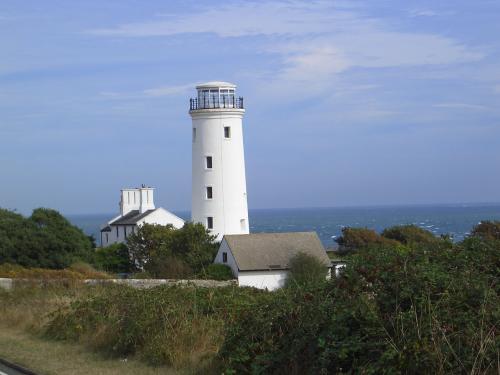
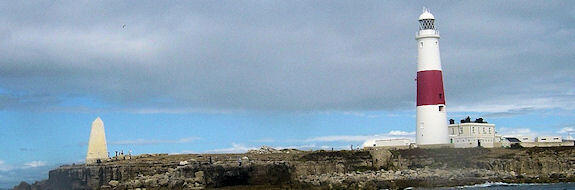
Two 8.2 kg (18 lb) cannons were installed at the lighthouse when Napoleon threatened invasion in 1798. A 7 m (23 ft) tall obelisk of white stone was built in 1844 at the Southern tip of Portland Bill as a warning of a low shelf of rock extending 30 m (98 ft) south into the sea. It still stands near the current lighthouse. New high and low lighthouses were built in 1869 and acted as leading lights. In 1906 Trinity House replaced them with a single tower - the present lighthouse. The old towers can still be seen from the outside; the low light has retained its original appearance but the lantern on the high light has been removed and is now used as a bird observatory and field centre.
The present optic at Portland Bill is very unusual as due to the arrangement of the panels the character gradually changes from one flash to four flashes between the bearings 221°and 224° and from four flashes to one flash between bearings 117° and 141°. Portland Bill Lighthouse was automated on 18th March 1996 when monitoring and control of the station was transferred to the Trinity House Operations Control Centre at Harwich.
By Road: The A354 ends in Portland at the north end of the Isle of Portland. Thereafter follow signs to Easton, Southwell and then follow Portland Bill road to the southern tip.
Bowen, J.P., British Lighthouses, British Council, ASIN: B001A8HS24 (1947)
Denton, A. & Leach, Nicholas, Lighthouses of England and Wales: A Complete Guide, Landmark Publishing, ISBN-10: 1843063190 (2007)
Hague, Douglas and Christie, Rosemary, Lighthouses, Their Architecture, History and Archaeology, Gomer Press, ISBN-0850883245(1975)
Jackson, Brian L. Isle of Portland railways. ISBN 0853615403 (1999)
Morris, Stuart, Portland, an Illustrated History The Dovecote Press, Wimborne, Dorset: ISBN 0-946159-34-3 (1979)
Morris, Stuart, Portland (Discover Dorset Series) The Dovecote Press, Wimborne, Dorset: ISBN 1-874336-49-0. (1998)
Naish, John, Seamarks, Their History and Development Adlard Coles Nautical, ISBN-10: 0540073091 (1985)
Nicholson, Christopher, Rock lighthouses of Britain; The end of an era?, Whittles Publishing, ISBN 1870325419. (1995)
Payton, Charles, Lighthouses: Towers of the Sea, National Trust Books, ISBN-10: 1905400128 (2006)
Woodman, Richard & Wilson, Jane, The Lighthouses of Trinity House, ISBN 1 904050 00 X (2002)