Post Office Railway

Region:
Red Wheel Site:
Transport Mode(s):
Address:
Postcode:
Visitor Centre:
Opening Times:
Not normally accessible to the public.
Website:
Visit websiteIn 1859, the Pneumatic Dispatch Company was formed to carry parcels, goods and - subject to their agreement - Post Office mail. Following construction of a test line at Battersea, the company built a tube which ran from premises adjacent to the Post Office's North Western District Office to the Parcel Office at Euston Station. The system proved problematical, but a second line was added from Euston Station to The General Post Office. This forerunner of the London Underground system eventually closed in 1874, due to lack of interest from the Post Office. An short-lived effort to revive the system was made in 1899 by the Pneumatic Dispatch Company; the tunnels were eventually purchased by the Post Office to carry telephone cables.
During the early years of the 20th century, throughput of mail at Postal Headquarters in Mount Pleasant, London, grew steadily, with annual volumes of items carried reaching 5.9 billion items by the eve of World War 1. A high proportion of this figure, and nearly all inbound international mail, passed through London. The problem of shipping a formidable number of mailbags between the capital's sorting offices and its major train stations needed attention.
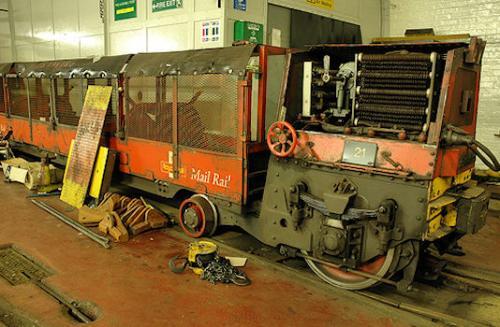
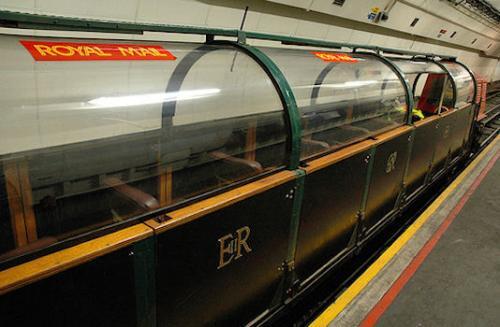
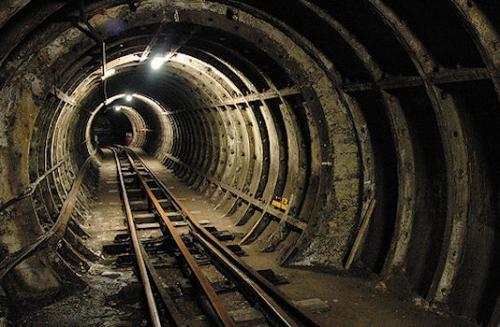
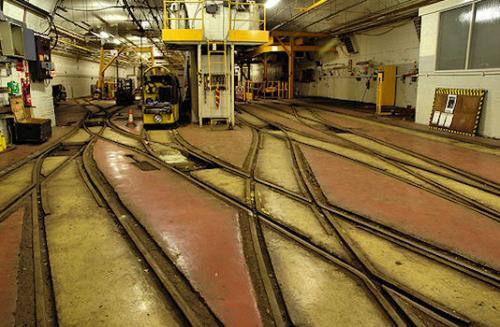
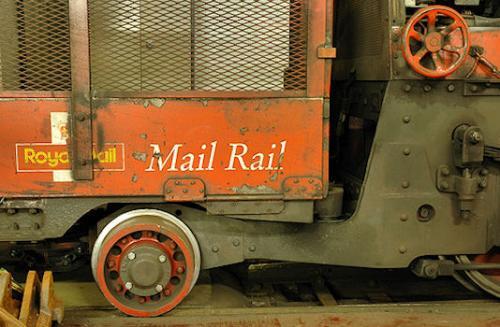
To avoid London's congested streets, the Post Office decided to travel underneath them. Construction of the Post Office Underground Railway (later known as Mail Rail) began in 1914. Work was delayed by the outbreak of the First World War, with national art treasures protected from the Zeppelin air raids in the unfinished tunnels. The completed railway had 37 km (23 miles) of two-foot gauge track running through tunnels 21.5 m (70 ft) below the ground. The line ran from Paddington Station in the west, to Whitechapel delivery office in the east. The driver-less electric trains were controlled by switch cabins at each station. When it opened in December 1927 it was hailed by the press variously as 'The Robot Railway', 'Post Office Wonder Railway', and even 'The ghost trains run by robot hands'.
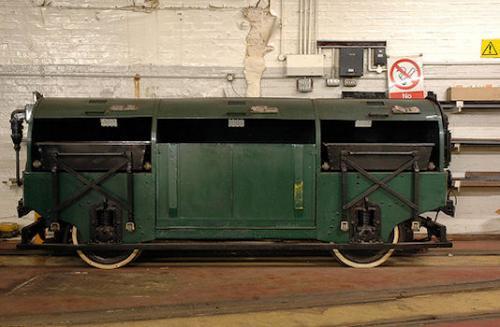
Each car had four containers, together carrying an average load of sixty bags of letter mail or twenty-four of parcels. As the train came to a standstill alongside the platform, a hinged metal ramp on the vehicle was let down to bridge the gap between car and platform. The loading and unloading of the vehicle was then by hand. A system of lifts and spiral chutes, in which mail matter for east and west-bound trains was seperated, connected the platform at each station with the sorting offices above. Slow-moving containers were also installed at some stations to carry mail up to, and from, the sorting offices and station platforms above.
On weekdays the system worked virtually round the clock, shutting down only between 7 and 9 am to permit track inspections. The service was also suspended between 11 pm on Saturday night until midnight on Sunday to allow general maintenance and repair. This level of operation was unmatched by other subway system around the world. To avoid system failures, virtually all equipment was duplicated.
Plans were drawn up in the early 1950's to extend the railway, with branches to Euston and Kings Cross stations, but the new lines never appeared. In 1965, a 400m (0.25 miles) deviation to the existing line was tunelled, mating with a new Western District office and station. This coincided with the closure of the stations serving the Western Parcels Office and the Original Western District Office, the disused sections of tunnel being used as a store.
Mount Pleasant station, the largest of the eight original stations, housed the important maintenance workshop - space pemitted storage of 81 of the original 90 cars, although they were routinely positioned at points along the line to maximise efficiency. A shaft allowed for the lifting of rolling stock in and out of the yard adjoining Phoenix Place.
In its last years of operation, because the King Edward Building and the West Central District Office in New Oxford Street were sold, the underground links below were sealed off. Closure of the station at Liverpool Street left just four stations in operation - Paddington Sorting Office, the Western Delivery Office at Rathbone Place, Mount Pleasant Sorting Office and the Whitechapel Eastern Delivery Office. The system was finally closed and mothballed in 2003.
By road: On A201, Farringdon Road.
Connor, J. E., London's Disused Underground Stations, Capital Transport Publishing, ISBN-10: 185414250X (2001)
Duncan, Andrew, Secret London: Exploring the Hidden City, New Holland Publishers, ISBN-10: 1847733158 (2009)
Johnson, Peter, Mail by Rail: History of the Travelling Post Office, Ian Allan, ISBN-10: 0711023859 (1995)
Long, David, Tunnels, Towers and Temples: London's 100 Strangest Places, The History Press, ISBN-10: 0750945095 (2007)
Smith, Stephen, Underground London: Travels Beneath the City Streets, Abacus, ISBN-10: 0349115656 (2005)
Wolmar, Christian, The Subterranean Railway: How the London Underground Was Built and How it Changed the City Forever, Atlantic Books, ISBN-10: 1843540231 (2005)
The British Postal Museum & Archive - Mount Pleasant Sorting Office
Mail Rail - London's Post Office Railway
Mike's Rail History - Driverless Subway Trains
Subterranea Britannica - Post Office Railway