St. Ann's Head Old Lighthouse

Region:
Red Wheel Site:
Transport Mode(s):
Address:
Postcode:
Visitor Centre:
Opening Times:
Permanently viewable, but now private property with the associated accommodation and used as holiday homes.
Website:
Visit websiteMilford Haven has long been recognised by merchants and shipowners as one of Britain's finest deep water harbours, and it was from here that Henry II led his army into Ireland in 1172. Large fleets of trawlers and oil tankers now use the anchorage. At the approach to this famous port lie dangerous reefs just below the surface, almost in mid channel and in two groups through which shipping must pass.
At Mill Bay just to the north of St. Ann's Head, Henry Tudor landed in 1485 prior to defeating Richard III at the Battle Bosworth. In the light of his success he had a chapel built dedicated to St. Ann. There has been a light at St Ann's Head since well before the time of Queen Elizabeth 1, probably using this chapel, with a coal-fired brazier attended by a monk or hermit. Over the years, a series of lighthouses has been built.
Trinity House approved in principal a coal fired light at St. Ann's Head in the second half of the 17th century to guide Milford bound shipping. It was to be supported by voluntary payment of dues. However, the owners extracted dues illegally from shipowners and the light (which was the only one on the west coast) was discontinued. Forty more years passed before another light was established although it is said that sea traders petitioned many times for the area to have lights.
On 15th March, 1712, a patent was granted to Trinity House to build a lighthouse at St. Ann's Head. Trinity House in turn (as was its policy at the time) leased it to the owner of the land, Joseph Allen, who agreed to build 2 lighthouses and keep them in good repair. The terms of the lease were for 99 years at an annual rent of £10, and to help maintain the lights, Allen was permitted to collect dues from the shipmasters at Milford Haven amounting to one penny per ton of cargo on British vessels and two pence on foreign vessels. Allen established two towers near the old disused lighthouse and lit coal fires on them in June 1714.
Robert Stevenson visited the Station in 1801 and describes them as leading lights guiding vessels clear of the Crow Rock off Linney Head and that 'the light is from Argand burners with parabolic silvered copper reflectors each twenty and a half inches in diameter. In the one lantern there are sixteen reflectors and in the other eleven, and although they are only about one hundred paces distant from each other there is a distinct keeper at each lantern, so that they are in the most complete state of cleanliness and good order.'
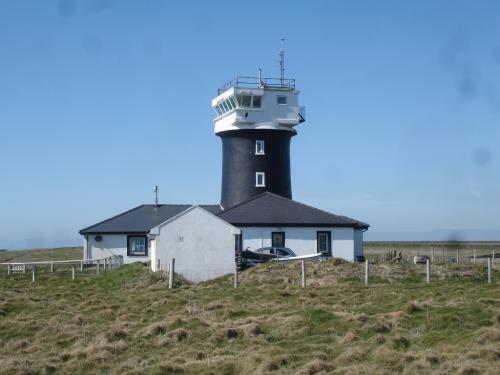
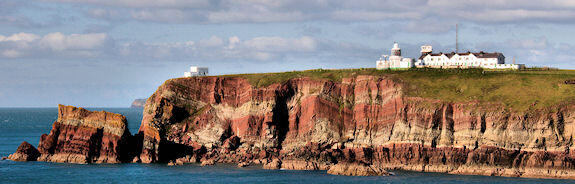
The front light, known as St. Ann's Low Light, was rebuilt in 1841, when cliff erosion endangered the old tower, the new one being situated 9 m (30 ft) or so from the cliff edge. When the rear light, now known as the Old Light, was closed in 1910, a Matthews burner was installed at the front light, and in 1958 the station was converted to mains electricity with generators for standby. During World War II the Old Lighthouse was used as a coastguard watch-tower.




By road: On B4327 from Haverfordwest beyond the small village of Dale.
Bowen, J.P., British Lighthouses, British Council, ASIN: B001A8HS24 (1947)
Denton, A. & Leach, Nicholas, Lighthouses of England and Wales: A Complete Guide, Landmark Publishing, ISBN-10: 1843063190 (2007)
Hague, Douglas and Christie, Rosemary, Lighthouses, Their Architecture, History and Archaeology, Gomer Press, ISBN-0850883245(1975)
Naish, John, Seamarks, Their History and Development Adlard Coles Nautical, ISBN-10: 0540073091 (1985)
Nicholson, Christopher, Rock lighthouses of Britain; The end of an era?, Whittles Publishing, ISBN 1870325419. (1995)
Payton, Charles, Lighthouses: Towers of the Sea, National Trust Books, ISBN-10: 1905400128 (2006)
Woodman, Richard & Wilson, Jane, The Lighthouses of Trinity House, ISBN 1 904050 00 X (2002)