Swindon Works

Region:
Red Wheel Site:
Transport Mode(s):
Address:
Postcode:
Visitor Centre:
Opening Times:
The site is open in daytime but access to the surviving buildings is restricted. Steam Museum is the principal source of information. See its website for opening times.
Website:
Visit websiteIn 1835 Parliament approved the construction of a railway between London and Bristol. Its Chief Engineer was Isambard Kingdom Brunel. From 1836, Brunel had been buying locomotives from various makers for the new railway. Few of them were satisfactory, some suggest, because of Brunel's specifications. In 1837, Brunel recruited Daniel Gooch and gave him the job of rectifying the situation.
It became clear that the GWR needed a central repair works and in 1840 Gooch identified a site at Swindon because it was at the junction of the Cheltenham branch and also a "convenient division of the Great Western line for engine working". With Brunel's support, Gooch made his proposal to the GWR directors, who, on 25 February 1841, authorised the establishment of the works at Swindon. Construction started immediately and they became operational on 2 January 1843.
There are several stories relating to how the railway came to pass through Swindon, with a well-circulated myth that Brunel and Daniel Gooch were surveying a vale north of Swindon Hill and Brunel either threw a stone or dropped a sandwich and declared that spot to be the new location of the works. Whatever, the works transformed Swindon from a small market town into a railway town, boosted the population considerably and provided medical and educational facilities that had been sorely lacking.
The Great Western Railway was originally planned to cut through Savernake Forest near Marlborough, but the Marquess of Ailesbury, who owned the land, objected. The Marquess had previously objected to part of the Kennet and Avon Canal running through his estate (see Bruce Tunnel). With the railway needing to run near to a canal at this point, and as it was cheaper to transport coal for trains along canals at this time, Swindon was the next logical choice for the works, 20 miles north of the original route. The line was laid in 1840, but the location of the works was still undecided. Tracks were laid at Didcot in 1839 (chosen as Lord Wantage did not want the railway passing close to Abingdon) and for some time this seemed a more likely site.
Gooch noted that the nearby Wilts and Berks Canal gave Swindon a direct connection with the Somerset coalfield. He also realised that engines needed to be changed at Swindon or close by as the gradients from Swindon to Bristol were much more arduous than the relatively easy gradients between London and Swindon. Drawing water for the engines from the canals was also considered, and an agreement to this effect was completed in 1843.
Once the plan was set for the railway to come to Swindon, it was at first intended to bring it closely along the foot of Swindon Hill so as to be as close as possible to the town without entailing the excessive engineering works of building on the hill. However, the Goddard family (Lords of the Manor of Swindon), following the example the Marquess of Ailesbury (and many other landowners of the day) objected to having it near their property, so it was laid a couple of miles further north.
The first building, the locomotive repair shed, was completed in 1841 using contract labour, with the necessary machinery installed within it by 1842. Initially only employing 200 men, repairs began in 1843, with the first new locomotive, the "Premier", built in 1846 in under two weeks and renamed "Great Western". This was followed by six more, the "Iron Dukes", including "The Lord of the Isles", considered the fastest broad-gauge engine of its day. By 1851 the works were employing over 2000 men and were producing about one locomotive a week, with the first standard-gauge engine built in 1855. A rolling mill for manufacturing rails was installed in 1861, attracting workers from South Wales. Although some rolling stock was built at Wolverhampton (producing 800 standard-gauge locomotives up to 1908), Worcester and Saltney near Chester, most of the work was concentrated at Swindon.C. B. Collett, Chief Mechanical Engineer from 1921 to 1941, greatly improved the works' boiler making and its facilities for working heavy gauge sheet metal. This was the heyday of Swindon Works, when 14,000 people were employed and the main locomotive fabrication workshop, the A Shop was one of the largest covered areas in the world.
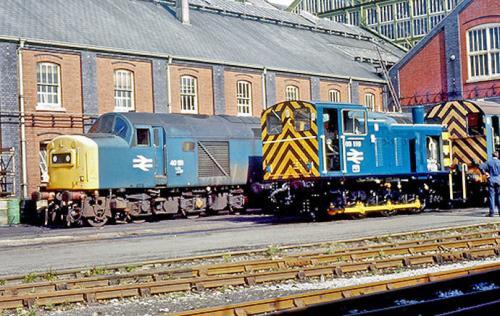
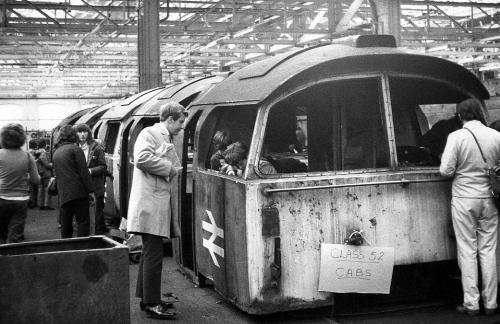
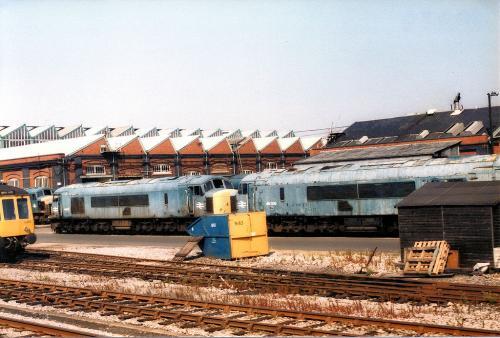
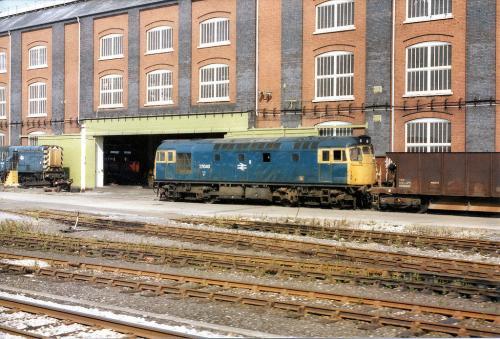
In 1962 new building of locomotives finished at Swindon. Locomotive repairs and carriage and wagon work continued, though the original carriage and wagon workshop was sold. The works closed in 1986, but one building currently houses a museum dedicated to the Great Western Railway. The engineers' office is now the headquarters of English Heritage. Purpose-built storage now houses the archive of the National Monuments Record. Most of the remaining buildings are part of a Designer Outlet.


By road: On Kemble Drive north west of the town centre or on foot through a tunnel under the railway tracks just west of Swindon Station.
By Rail: A ten minute walk westward from the station. South of the railway is the Railway Village built in 1842-7 by Brunel.

Cattell, John; Falconer, Keith. Swindon: the Legacy of a Railway Town. 1995
Child,Mark Swindon : An Illustrated History. 2002
Child,Mark Swindon Works, and its Place in British Railway History. 2005
Larkin, E.J.; Larkin, J.G. The Railway Workshops of Great Britain 1823-1986. 1988.
Simmons, J The Railway in Town and Country. 1986
Williams, Alfred Life in a Railway Factory. 1915