Thames Tunnel

The first tunnel constructed underneath a navigable river.
Region:
Red Wheel Site:
Transport Mode(s):
Address:
Rotherhithe Station, London, SE16 4LF
Brunel Museum, Railway Avenue, Rotherhithe, London SE16 4LF
Postcode:
Visitor Centre:
Opening Times:
The Brunel Museum- Open every day, see website, email
education@brunel-museum.org.uk or telephone 0207 231 3840
Website:
Visit websiteThe Thames Tunnel was the first tunnel constructed underneath a navigable river, built between 1825 and 1843 by Marc Isambard and Isimbard Kingdom Brunel, using the former's revolutionary tunnelling shield technique.
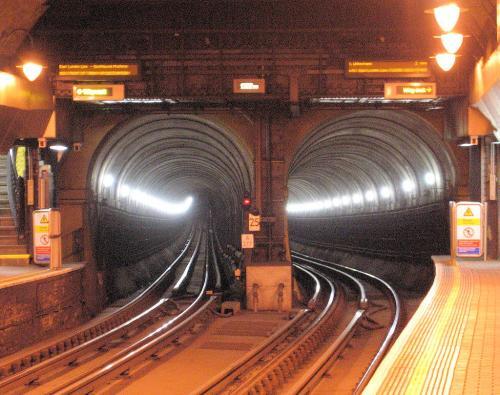
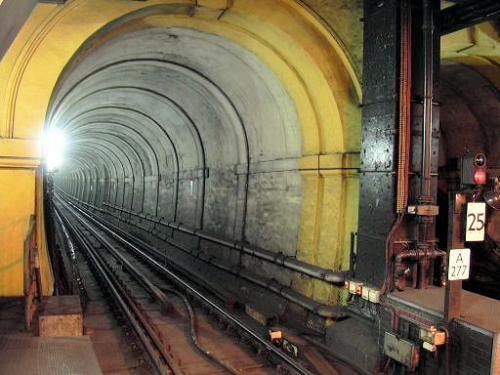
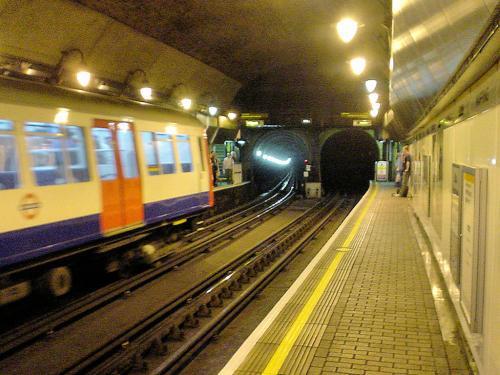
Built beneath the River Thames in London, it runs between Rotherhithe and Wapping at a depth of 23 m (75 feet) below the river's surface at high tide and is 11 m (35 feet) wide , 6m (20 feet high and 396 m (1,300 feet) long. It was designed for, but never used by, horse-drawn carriages and was most recently used by trains of the London Underground's East London Line, although services were suspended at the end of 2007 for conversion of the line to become part of the London Overground network by 2010.
Previous attempts to link the north and south banks of the Thames had failed ignomously. The engineer Ralph Dodd tried, but failed, to build a tunnel between Gravesend and Tilbury in 1799. Between 1805-1809 Richard Trevithick attempted to dig a tunnel further upriver between Rotherhithe and Wapping but failed because of the difficult conditions of the ground.
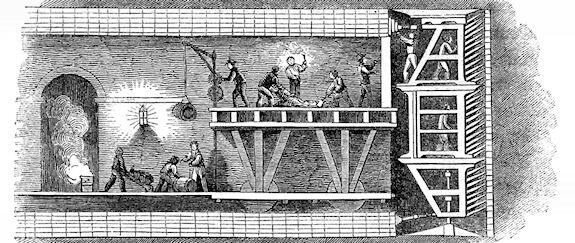
In 1814 Marc Brunel proposed to Tsar Alexander I the building of a tunnel under the river Neva in St Petersburg. Despite a rejection, Brunel continued to develop new tunnelling methods and assembled private investors to form the Thames Tunnel Company which began construction of the Rotherhithe Shaft in 1825. Brunel's tunneling shield, built at Maudslay's Works at Lambeth, then began to cut the bore, supporting the unlined clay before and above the team to permit both forward progress and the construction of the tunnel liner.
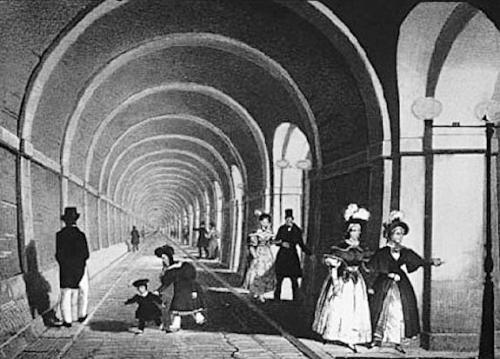
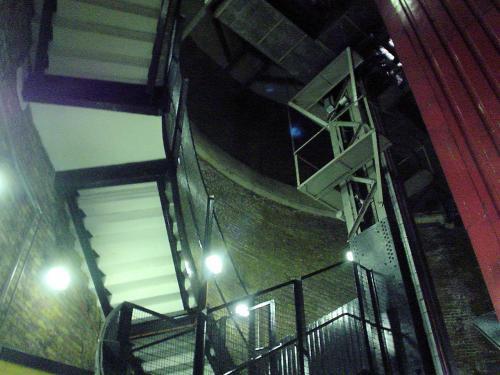
The drain on resources caused by painfully slow progress (just 3-4 m a week) was partly alleviated by permitting the public to view the shield in operation, with some 600-800 visitors daily each paying one shilling for the exciting tour. Illness amongst the workforce was also a problem, with explosive methane gases and foul sewage constant hazards. Worse, the tunnel flooded in 1827 and 1828 - six workers drowned and Brunel the younger only just survived in the latter incident and the project was abandoned until 1836. The tunnel was completed in 1841, with the roadways, staircase and engine house (for drainig the tunnel, now home to the Brunel Museum) in place for the grand opening in 1843.
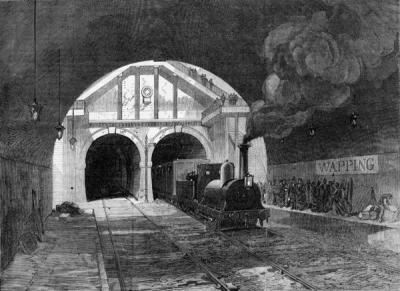
Although an engineering triumph, financially it was a disaster, with costs way over budget and the company unable to finance an extended entrance to permit the passage of carriages. Some two million people a year paid one penny to walk through the tunnel. In 1865 the tunnel was purchased by the East London Railway Company, a consortium of six mainline railways, to provide a rail link for goods and passengers between Wapping (and later Liverpool Street) and the South London Line. The tunnel's generous headroom, resulting from the architects' original intention of accommodating horse-drawn carriages, provided a sufficient loading gauge for trains as well.
The first train ran through the tunnel on 7 December 1869. In 1884, the tunnel's disused entrance shafts in Wapping and Rotherhithe were converted into Wapping and Rotherhithe stations respectively. The East London Railway was later absorbed into the London Underground as part of the East London Line. Still used for goods services until 1962, the Thames Tunnel remains the oldest piece of the Underground's infrastructure.
By rail: Canada Water (DLR) or Bermondsey (Tube) stations
By road: On A101 Brunel Road, off A200 Jamaica Road.
Click here for a location map for the Brunel Museum.
Drew, William Allen, Glimpses and Gatherings During a Voyage and Visit to London and the Great Exhibition in the Summer of 1851, pp. 242-249. Homan & Manley, (1852)
Illustrated London News, 25 March 1843.
Smith, Dennis, "London and the Thames Valley", Thomas Telford, 2001.
Smith, James, "The Thames Tunnel", in Memoirs, Letters, and Comic Miscellanies in Prose and Verse, of the Late James Smith,H. Colburn, 1840
Timbs, John, Stories of Inventors and Discoverers in Science and the Useful Arts,Kent, 1860.
The Brunel Museum- A Scheduled Ancient Monument on an International Landmark site andopenevery day
Thames Tunnel - panoramic views of the tunnel.