The Titan Crane, Clydebank

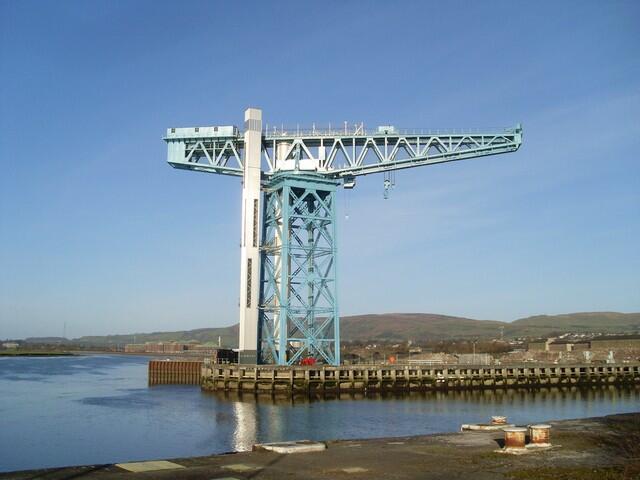
When completed in 1907 it was the largest cantelever crane built, the first of four surviving such cranes on the Clyde. Commisioned by John Brown & Co to fit out the large ships built at Clydebank including Lusitania, Queen Mary, Queen Elizabeth, QE2, RY Britannia.
Designated an International Historic Civil & Mechanical Engineering Landmark in 2013
Region:
Red Wheel Site:
Transport Mode(s):
Address:
Queens Quay,
Clydebank
Postcode:
Visitor Centre:
Website:
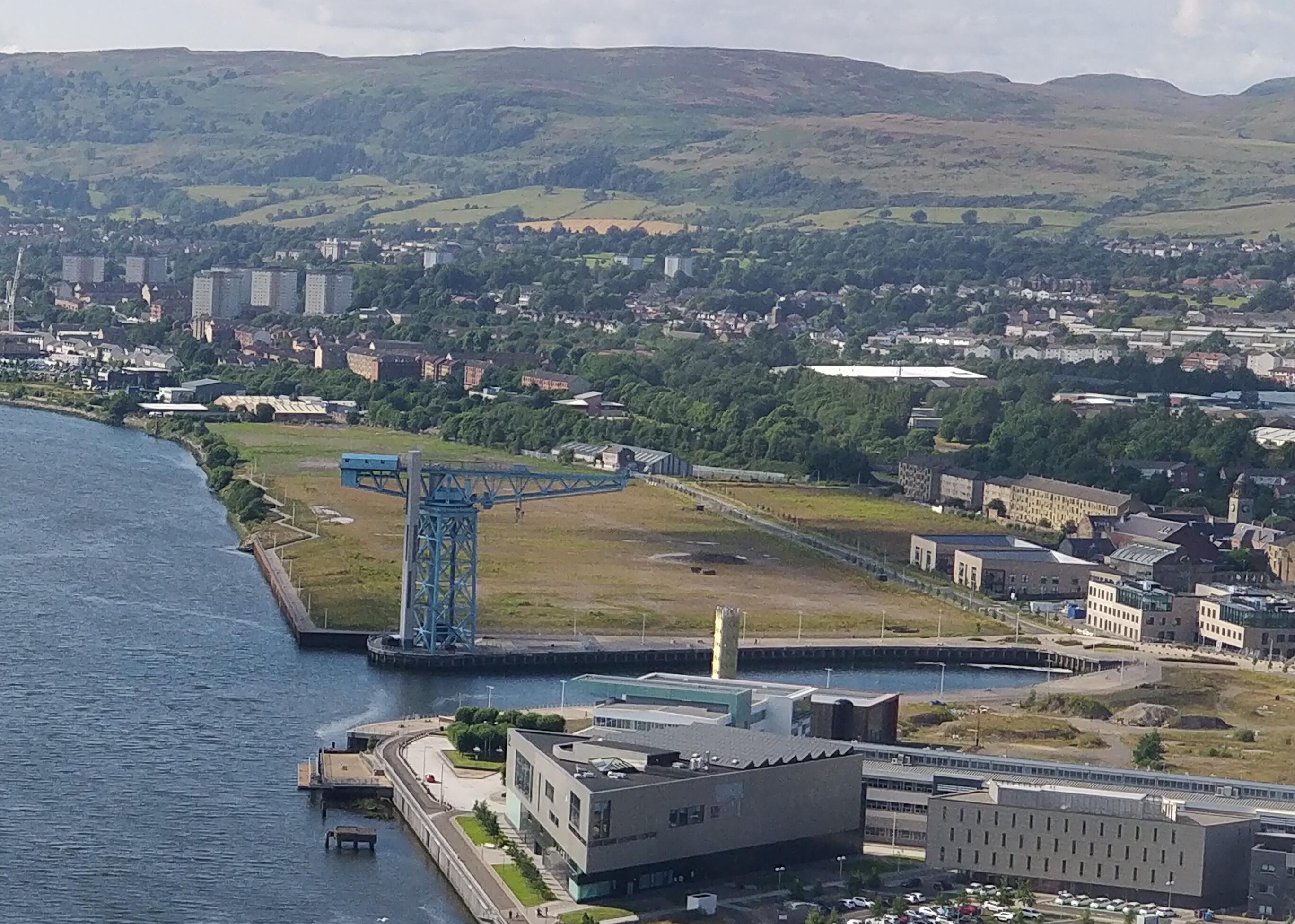
Visit websiteThe Clydebank shipyard was created in 1871 after marine engineering and shipbuilding firm John Brown & Company bought the site. The yard's position at the junction of the rivers Clyde and Cart made it a good location for building larger ships. Brown & Company commissioned the Clydebank Titan to help fit out these larger ships.
The Titan was designed and built by engineer Adam Hunter, who had previously worked on construction of the Forth Bridge.
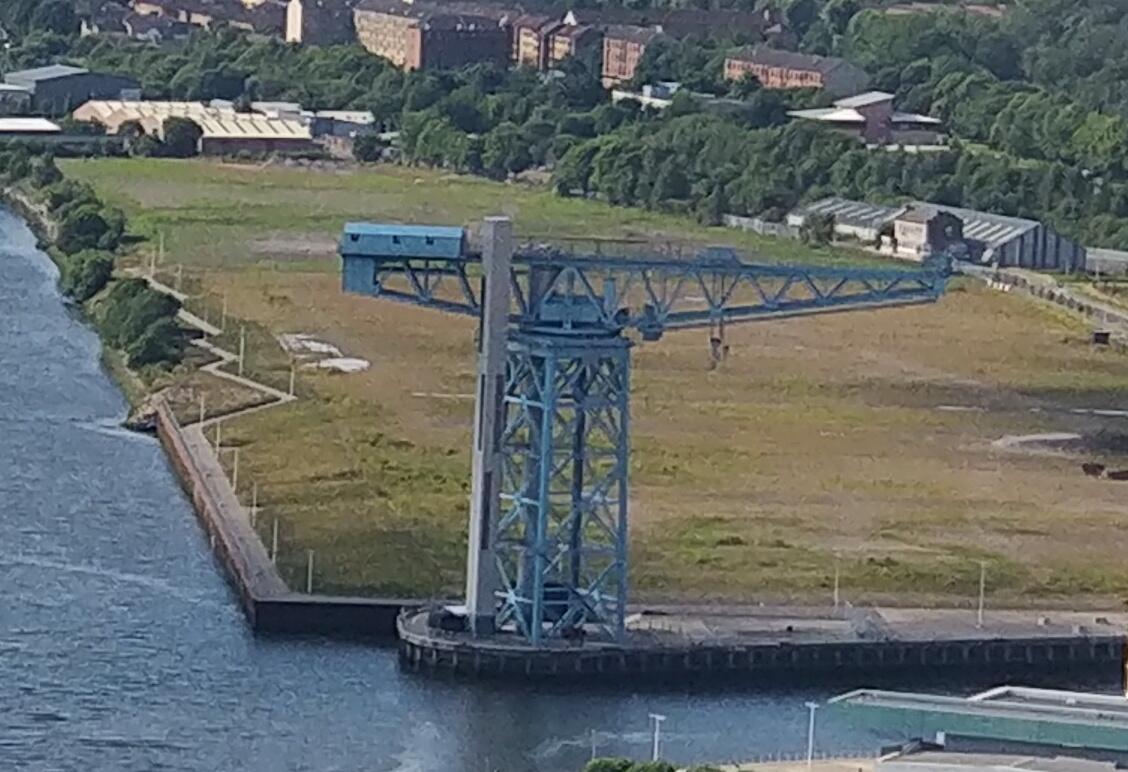
At the time the Titan was the biggest crane of its type ever built. At 161ft (49m) tall, it weighed around 800 tonnes and had a lifting capacity of 160 tonnes. Completed in 1907, this was the first of the four surviving cantilever cranes on the Clyde, the others being at Finnieston, Whiteinch and Greenock. A cantilever crane is a crane with a tower and a horizontal, revolving, cantilever or jib. The longer part of the jib carries lifting equipment, the shorter part extends backwards and carries the crane's machinery and counterweight. Titan's tower was 39ft (12m) square. The arms of the cantilever were 150ft (45.7m) and 90ft (27.4m) long. The centre of the crane is 35ft (10.7m) from the edge of the quay.
Engineer Adam Hunter designed Titan with a fixed counterweight and electrically-driven hoists mounted on a rotating jib. This made Titan faster and more responsive than previous steam-powered cranes. Hunter and the construction team sank 4 concrete piles 75ft (23m) to support the crane's massive weight of 800 tonnes.
Titan was later upgraded to handle heavier loads. Its original capacity of 160 tonnes was boosted to 203 tonnes in 1938 to install long-range gun turrets into battleships. The Clydebank Titan helped construct some of Britain's best-known ships. This includes the ocean liners Queen Elizabeth and Queen Elizabeth 2 and the royal yacht Britannia.
The crane fell into disuse in the 1980s. It reopened in 2007 as a tourist attraction after 2 years' restoration work costing £3.75m.
The Titan is acknowledged as a masterpiece of civil engineering and won the 2012 Engineering Heritage Award from the Institution of Mechanical Engineers. In 2013, four leading engineering groups (the American Society of Civil Engineers Board of Direction, the American Society of Mechanical Engineers, the Institution of Civil Engineers and the Institution of Mechanical Engineers) came together to designate the crane an International Historic Civil and Mechanical Engineering Landmark. This was the first time all four institutions had come together to make such an award.
You can now enjoy a panoramic view of Clydeside from the top of the Titan Crane. There you can see the remains of the slips where the Lusitania (1906), HMS Hood (1918), Queen Mary (1934), Queen Elizabeth (1938), the royal yacht Britannia (1953) and the Queen Elizabeth II (1967) were launched. Without the extra space created by the mouth of the River Cart opposite there would not have been enough room to launch these great ships.
Photo: Stephen Sweeney / Clydebank Titan Crane, Mike Lunch, with thanks.
DC27739,71 and 74, (1907), in William Arrol collection RCAHMS. Sir William Arrol and Company Limited Bridges, Structural Steel Work, and Mechanical Engineering Productions,(1909) partly reprinted from 'Engineering' London, p146, 148 147, 149. J R Hume The industrial archaeology of Scotland, 1, Lowlands and Borders London, (1976), p113. Baker, 'Queen's Quay, Clydebank (Old Kilpatrick parish), survey',
Discovery Excavation Scotland, (2004s) vol.5, p131. Paxton and Shipway,
Civil engineering heritage: Scotland - Lowlands and Borders, (2007) p185.
http://www.titanclydebank.com/history.aspx