Wearmouth Bridge

Site of the world's largest single span iron bridge
Region:
Red Wheel Site:
Transport Mode(s):
Address:
North Bridge Street, Sunderland, SR5 1AP
Postcode:
Visitor Centre:
Opening Times:
Permanently viewable
Website:
Visit websiteAt the end of the 18th century Sunderland was rapidly growing in importance, but further development was hampered by the lack of a bridge across the River Wear, the nearest bridge being at Chester-le-Street. Newly elected MPs for County Durham, Rowland Burdon and Ralph Milbanke, championed the passage of an Act of Parliament in 1792 to allow a bridge to be built. The technical problems were enormous - the Wear is 75m (250ft) wide at that point, a high single span was required to allow tall masted ships to pass and the amount of stone required to build a traditional bridge would impose severe weight and cost issues.
Burdon recognised that iron bridges were at the cutting edge of construction technology, but the iron bridge at Coalbrookdale spanned a river only half the width of the Wear. In 1793 Walker Ironworks at Rotherham cast and tested a trial iron rib and work started on the bridge abutments either side of the river. When these were finished in 1795, two wooden scaffolds were erected in the river to support the building of the bridge itself.
The bridge had six arched ribs, cast in blocks about 75 cms (2ft 5in) long and held together with wrought iron bands then joined together by cast iron cross tubes for additional rigidity. It took just ten days to move the ribs into position, but almost another year to complete the rest of the bridge under the supervision of Thomas Wilson, a local engineer. When it opened on 9th August 1796, it was by some margin the largest single span iron bridge in the world.
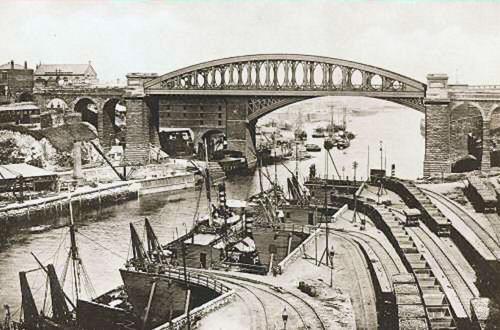
In 1805 solar expansion caused some of the cross tubes to fall out and repairs continued until 1857, when major work was needed to rebuild the bridge. Robert Stephenson had the bridge stripped back to the six iron ribs and added new arches between them to help spread the load. The abutments were then raised to straighten out the arch and the hump in the road. Large panels were added, with the motto "Nil Desperandum Auspice Deo" (Do not despair, trust in God"). The bridge was re-opened in March 1859 with the six original ribs still in place.
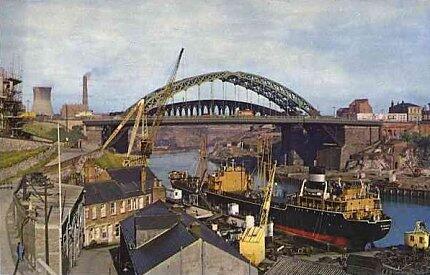
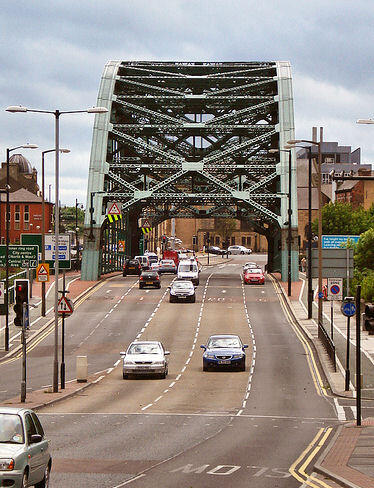
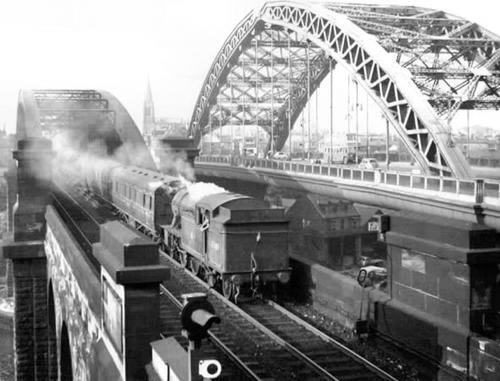
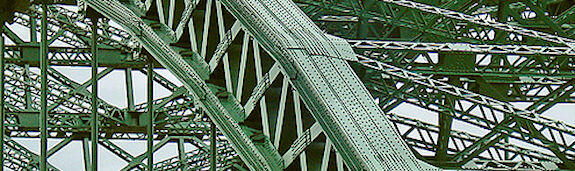
By the 1920s, the volume of traffic using the bridge had increased so much that a new structure was needed. In 1927 work began on the present bridge, which was designed by Mott, Hay and Anderson. In order to allow the road to remain open, the new bridge was built around the old one. The six iron ribs of the original bridge survived until 1929, when they were finally taken down and the new bridge was formally opened. It is now a Grade II Listed structure.


By road: On A 1018 in central Sunderland, adjacent to the Monkwearmouth Station Museum
By rail: Close to St Peters Metro Station, approx 1 km from Sunderland Central Station
Robert William Rennison & M. F. Barbey, Civil Engineering Heritage: Northern England, Thomas Telford, ISBN 0727725181 (1996)
Gillian Cookson- A history of the Wearmouth Bridge
Explore County Durham's Past' - Project resources
SINE Project, University of Newcastle-upon-Tyne - Structural details
Thomas Wilson - A biography
Sir William Arrol Collection - Contains many pictures of Wearmouth Bridge under construction