Whaligoe Steps

The Steps date originally from the mid-18th century and were once used by fisherwomen to haul up the creels of herring landed at the harbour beneath. Crews of women, some in their early seventies, would gut the fish, herring, cod haddock or common ling and would carry them up the steps in baskets to be taken on foot to be sold in Wick, seven miles away.
Region:
Red Wheel Site:
Transport Mode(s):
Address:
Whaligoe Steps
Caithness
Postcode:
Visitor Centre:
Website:
Visit websiteA "goe" is a rocky inlet surrounded by cliffs, and Whaligoe seems to have been named after a dead whale that was washed ashore here. Harbours along this stretch of the Caithness coast are so scarce that local residents were forced to use Whaligoe as a fishing station, possibly from a very early date. Opinions differ about when the steps were built.
Thomas Pennant, who visited in 1769, remarked on the use of steps by locals carrying heavy loads. Whali-goe was prospected by Thomas Telford in 1786 during his tour of northern fishing harbours for the British Fishing Society. His judgement of the place was that it was a "terrible spot". However, undaunted, Captain David Brodie spent £8 on improving the famous 330 steps. His confidence was rewarded in 1814 with the harbour supporting 14 herring boats.
Barrels made in the cooperage at the top of the cliffs were taken down for salted herring to be stored in then taken away by schooner.
The steps were repaired early in the 19th century and again very recently. The use of Whaligoe declined to-wards the end of the 1800s, and by 1920 only five boats remained, fishing for salmon. By 1946 this had declined to two boats, and the last one ceased to fish from Whaligoe in the 1960s.
The steps have since been maintained by enthusiastic local volunteers and it is thanks to them that we can still enjoy this amazing place. The late Etta Juhle cleared about 30 tons of rubble by herself in 1975 after a landslip and David Nicolson of Ulbster has worked continuously on the steps with local historian Iain Sutherland and many other volunteers since 1998, repairing the barking kettles, quarrying stone, manually carrying it up or down the cliffs and grass-cutting about every three weeks during the summer season.
'Whaligoe Steps' has won the Shell Best of Britain award twice.
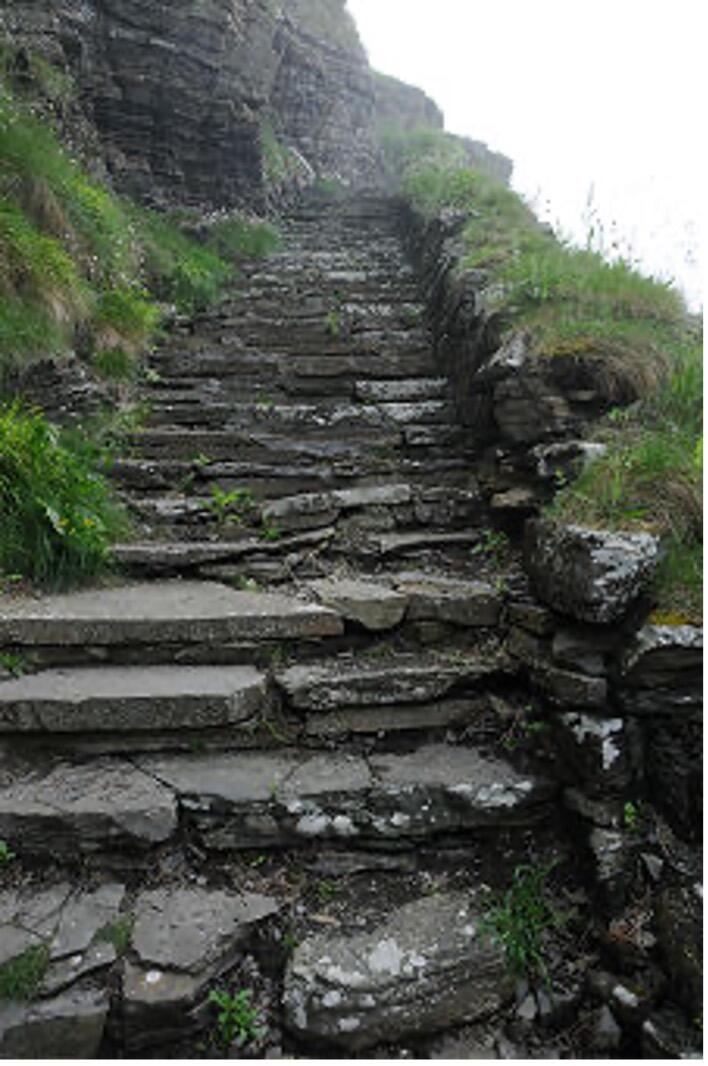
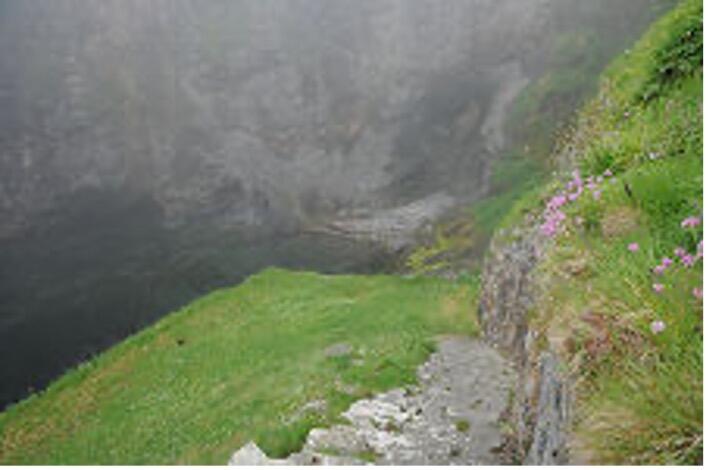
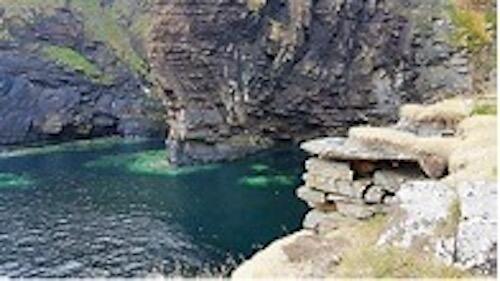
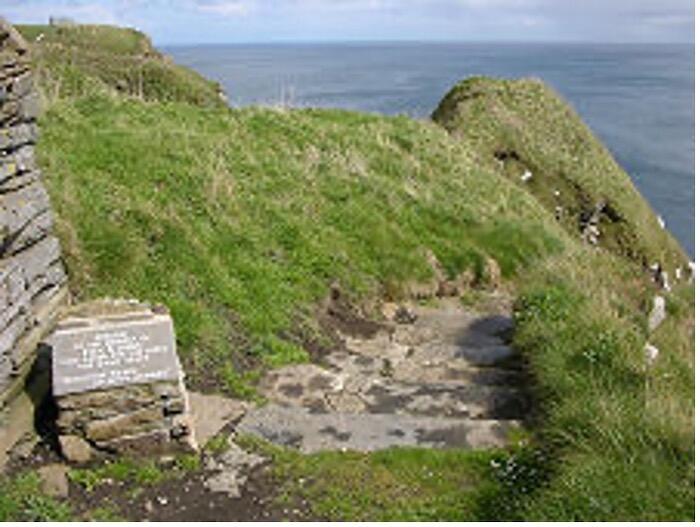
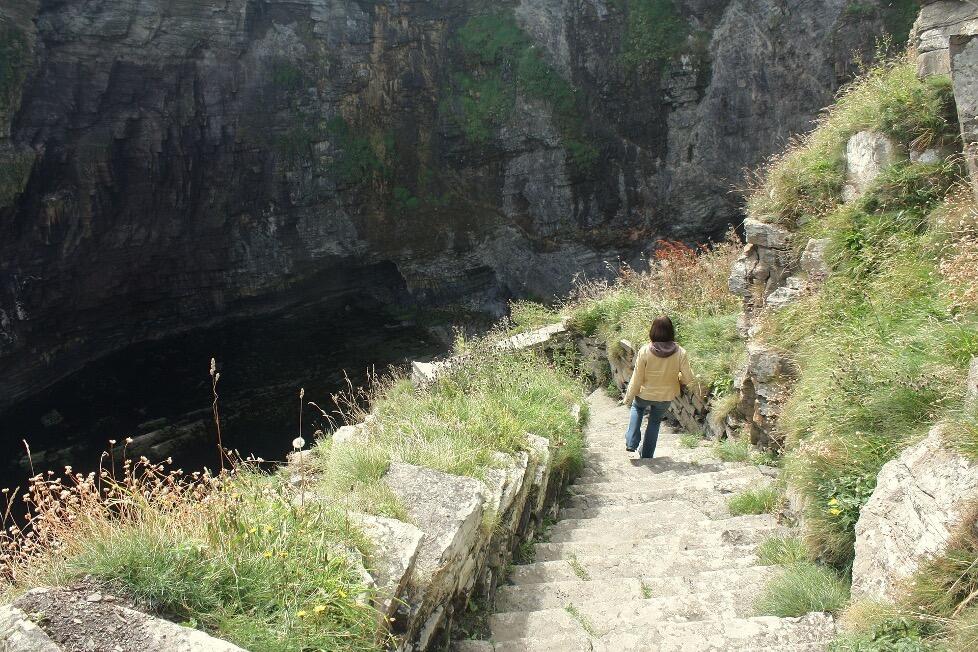
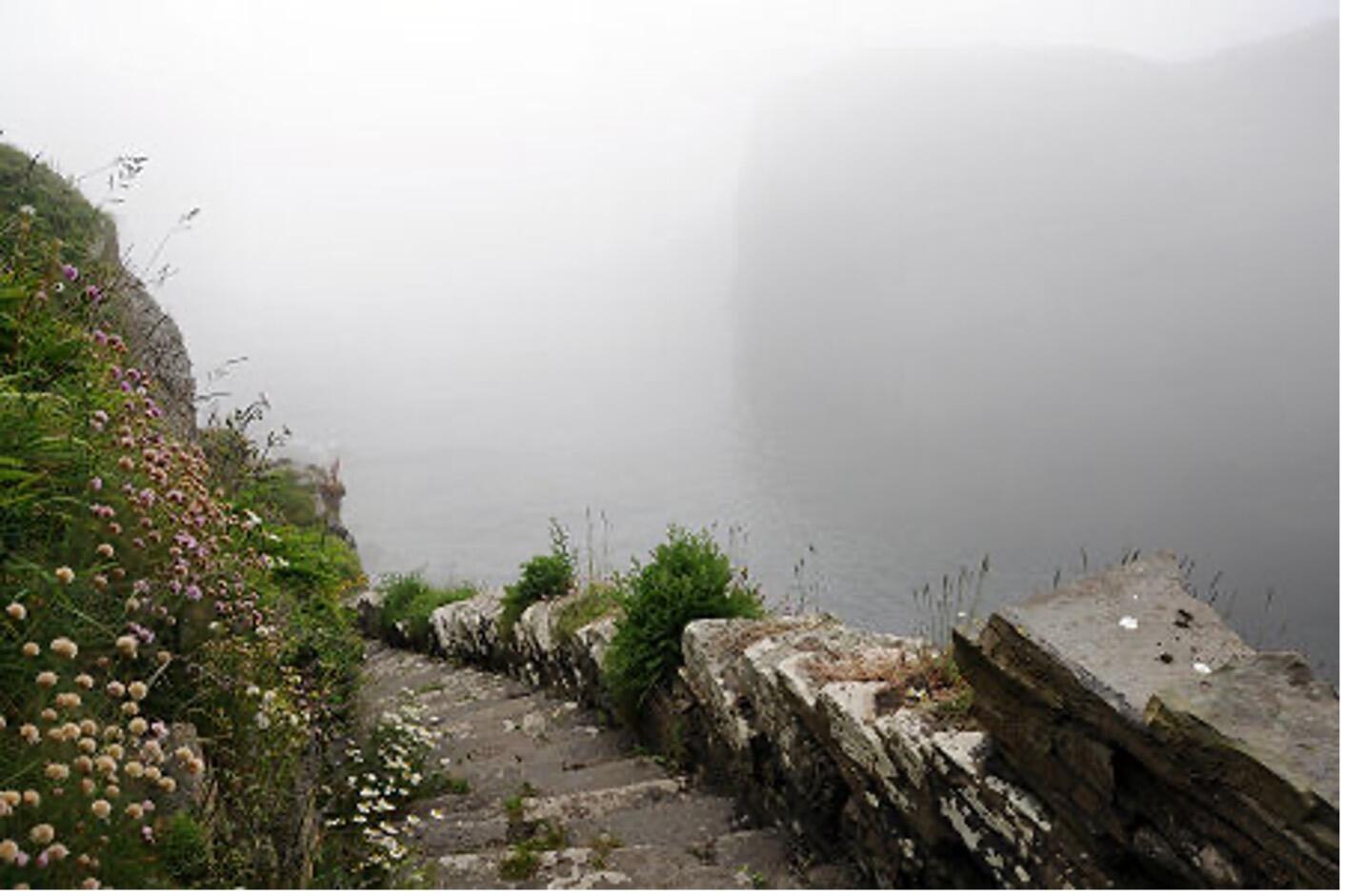
Whaligoe forms part of the long and highly dispersed settlement of Ulbster which straggles along the line of the A99 some seven miles south of Wick. There are no signs directing you to Whaligoe itself. Look out for an insignificant crossroads from which a sign points inland to the Historic Environment Scotland ancient monu-ment at Cairn o' Get. Take the road opposite, which leads past a row of fishermen's cottages, and you will find a tarmac parking area at the far end, where you can leave your car. From here you follow a track which passes the front and along the right hand side of what appears to be a farmstead on the edge of the cliffs, and begin the descent of the Whaligoe Steps: remembering that you are at one point effectively wandering through someone's back garden. At the bottom of the steps is an artificial grassy area called the Bink, which is perhaps the size of a narrow tennis court. One end of this is home to the ruin of a building once used to store salt using in curing the fish. At the other end, more steps descend to a rocky shelf known as the Neist.