Wolf Rock Lighthouse

Region:
Red Wheel Site:
Transport Mode(s):
Address:
Postcode:
Visitor Centre:
Opening Times:
Not open to the public.
Website:
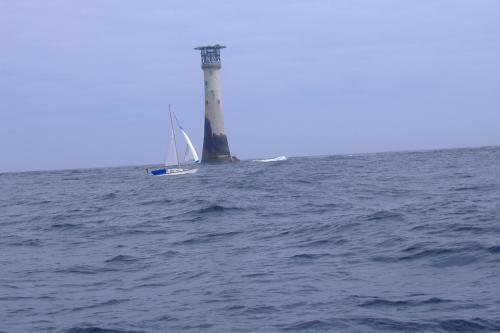
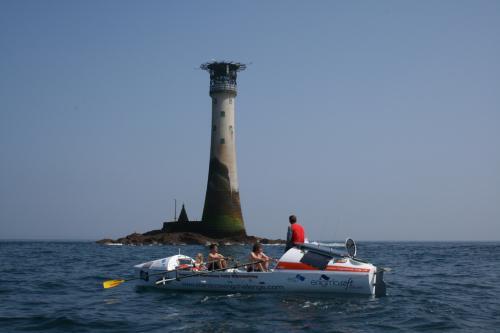
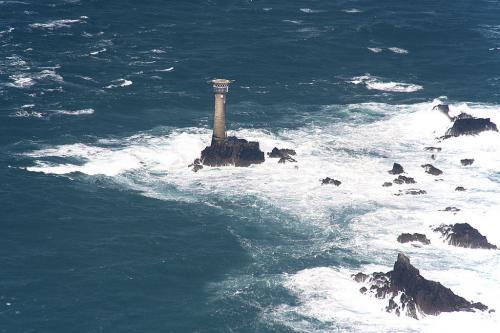
Visit websiteSituated 13 km (8 miles) south west of Lands End, Henry Smith leased the right to mark this marine hazard in 1791. The structure owes its name either to the unique howl heard when the wind fills the fissures of the rocks on which it stands or due to the shape of the rocks themselves.
Smith found the construction of a lighthouse too daunting and finally erected a wrought iron mast 6 m (20 ft) high and 10 cms (4 in) in diameter, complete with six stays and a metal model of a wolf on the rock. This daymark (since it was not a lighted beacon, was completed in 1795 - it was not only less substantial than had been specified, but also offered little resistance to the Atlantic and was soon washed away.
Between 1836 and 1840, an iron beacon was located on the rock, designed by James Walker in the form of a cone constructed of iron plates and filled with cement rubble. Its base was 4.8 m (15.8 ft) in diameter and of equal height. The difficulties of erecting a beacon were enormous - over a period of five years, only three hundred productive hours work were possibel. However, the beacon was completed successfully, at a cost of £12,000, and its sturdiness can be judged by the fact that it still remains part of the present landing.
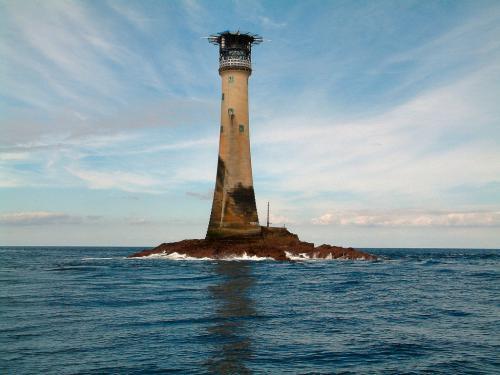
In 1861, work commenced on a granite tower, also designed by James Walker, which followed the generally accepted lines of Smeaton's Eddystone tower. In order to prevent the action of the waves from breaking up the cement in the exposed joints, leading to disintegration, the upper surface of each stone was given a wide rabbet and the stone above fitted into the recess, so that the horizontal joint between the two was covered by the outer fillet, thereby protecting it completely. This practice was followed throughout all the courses to a height of 11.8 m (39 ft) and the security thus obtained is reflected by the strength of the tower today.
Work proceeded so slowly in the early stages owing to the appalling conditions that by the end of 1864 only thirty seven stones in the second course of masonry were laid. In the meantime, however, the landing stage had been practically completed and the erection of a crane enabled blocks for the tower to be more easily transferred to the rock. The tower was completed on 19th July 1869, the light coming into service early in the following year. Initially lit by oil, it has generated electric power since 1955.
The height of the tower from foundation to gallery is 35 m (115 ft), the diameter at the base is 12.7 m (42 ft) taping to 5.2 m (17 ft) at the top. It is solid for 11.8 m (39 ft), the walls are 2.4 m (7.9 ft) tapering to 0.7 m (2.3 ft) in thickness; 3,297 tonnes of granite were used in constructing the tower and 1,078 tonnes of granite in constructing the landing platform. The cost of the enterprise was £62,726.
In July, 1988 the station was automated and de-manned and is now monitored from the Trinity House Operations Control Centre at Harwich. It achieved world wide publicity as the first rock lighthouse to have a helideck constructed on top of the lantern housing, the prototype for many offshore Trinity House lighthouses.


Popular with divers, because of the water clarity, it is visible from the coast of Cornwall near Lands End on a clear day.

Bowen, J.P., British Lighthouses, British Council, ASIN: B001A8HS24 (1947)
Boyle, Martin, Wolf Rock (Lighthouses of England and Wales) ISBN 978 19010 43075 (1998)
Denton, A. & Leach, Nicholas, Lighthouses of England and Wales: A Complete Guide, Landmark Publishing, ISBN-10: 1843063190 (2007)
Hague, Douglas and Christie, Rosemary, Lighthouses, Their Architecture, History and Archaeology, Gomer Press, ISBN-0850883245(1975)
Hague, Douglas, Lighthouses of Wales, RCHM Wales, ASIN: B00165SQSG (1994)
Mudd, David, Cornish Sea Lights, Bossiney Books, ISBN-10: 0906456010 (1978)
Naish, John, Seamarks, Their History and Development Adlard Coles Nautical, ISBN-10: 0540073091 (1985)
Nicholson, Christopher, Rock lighthouses of Britain; The end of an era?, Whittles Publishing, ISBN 1870325419. (1995)
Payton, Charles, Lighthouses: Towers of the Sea, National Trust Books, ISBN-10: 1905400128 (2006)
Tarrant, Michael, Cornwall's Lighthouse Heritage, Twelveheads Press, ISBN-10: 0906294207 (1990)
Woodman, Richard & Wilson, Jane, The Lighthouses of Trinity House. ISBN 1 904050 00 X. (2002)