Woodhead Tunnels

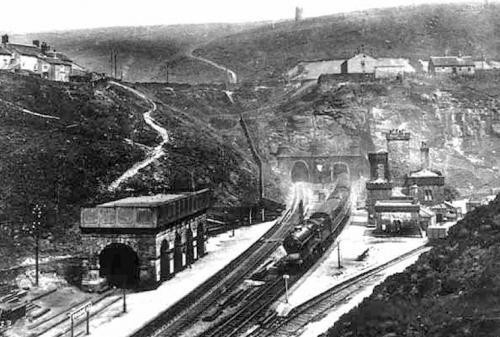
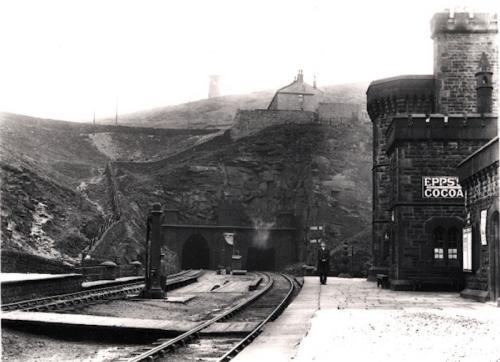
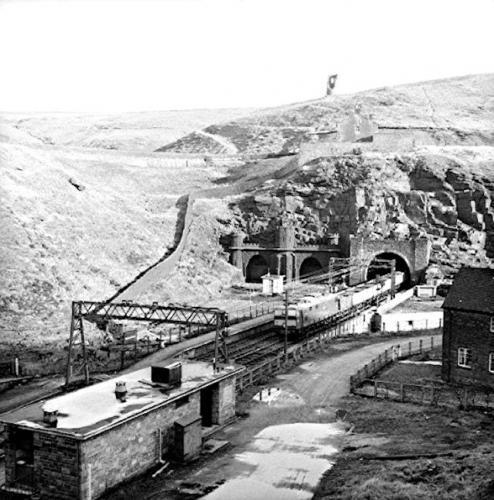
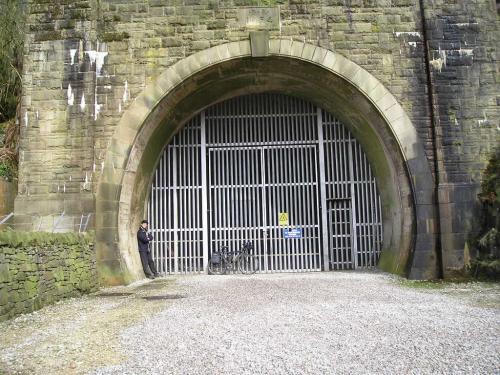
Woodhead Tunnel No. 1 was one of the world's longest railway tunnels at 4,840 m (3 miles 13 yards) when completed in 1845.
Region:
Red Wheel Site:
Transport Mode(s):
Address:
Near Woodhead, Derbyshire SK13 1HZ
Postcode:
Visitor Centre:
Opening Times:
Unrestricted access to the entrance area.
Website:
Visit websiteThe Woodhead Tunnels are three trans-Pennine railway tunnels which formerly carried the Woodhead Route from Manchester to Sheffield. During the excavation of the first bore by the Sheffield, Ashton-under-Lyne & Manchester Railway (precursor to the MSLR), thirty-two navvies were killed and a further two hundred and fifty were seriously injured. It was said that a soldier at the Battle of Waterloo had a better chance of survival than a navvy working on the Woodhead Tunnel construction.
Woodhead 1 was then one of the world's longest railway tunnels at a length of 4,840 m (3 miles 13 yards) and the first of several trans-Pennine tunnels. The engineer, Charles Vignoles, began work as soon as the line obtained its Act of Incorporation in Parliament in 1837. First the line was marked over the ridge and a series of vertical shafts were bored. From the bases of these, a horizontal driftway was driven along the line of the first bore. Although sufficient land had been purchased for two tunnels, only one would be built initially. The accuracy was such that the driftways met with less than three inches of error. The second bore was completed by the later Manchester, Sheffield and Lincolnshire Railway in 1852 under Joseph Locke. Despite a greater attention to worker safety, 28 died following an outbreak of cholera in 1849.
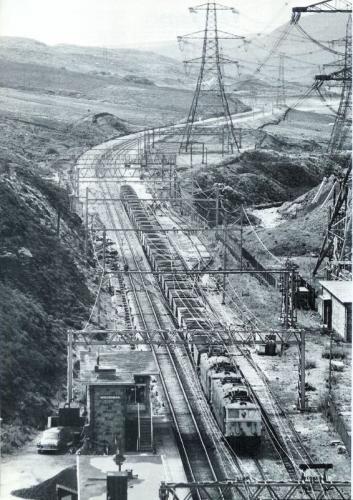
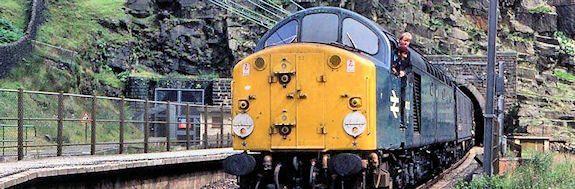
The twin tunnels saw heavy use by steam trains, with up to 250 trains a day each way, the higher than anticipated useage leading to excessive levels of maintenance. They were also unpopular with crews, the claustrophobic narrow bores also rendering them as unsuitable for electrification and they were closed Woodhead 3 was completed in 1953.
The new tunnel involved the realignment of the line and Woodhead Station was resited fractionally to the south with a pair of staggered platforms. After withdrawal of the passenger service in 1970 the line remained in use until the summer of 1981. Although the track between Deepcar and Hadfield was left in situ until 1986, road construction has cut across their line.
Since 1963 the north tunnel has been used by National Grid to carry the trans-Pennine 400 kV electricity link below ground, with a narrow gauge railway running into the tunnel to service this link. The south tunnel has suffered from collapses and is no longer suitable for cabling or transport. The Woodhead railway line closed in 1981, the trackbed between Woodhead and Hadfield now forming the Longdendale Trail.
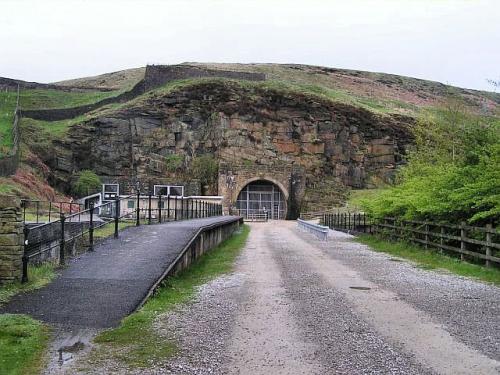
By road: Off A628
By foot or cycle: Follow the Longendale Trail
Bain, Simon,(1986) Railroaded! (Battle for Woodhead Pass), London, Faber and Faber. ISBN 0-571-13909-4
BBC Archives - The Woodhead Line, video, 1969
Disused Stations - Woodhead
Dow, G. (1959) Great Central, Volume One: The Progenitors (1813-1863) , Shepperton: Ian Allan Ltd
Dow, G.(1962) Great Central, Volume Two: Dominion of Watkin (1864-1899) , Shepperton: Ian Allan Ltd
Dow, G. (1962) Great Central, Volume Three: Fay Sets The Pace (1900-1922) , Shepperton: Ian Allan Ltd
Industrial Railway Society, Industrial Locomotives 1979: including preserved and minor railways. ISBN 0901096385
Longendale Cycle Trail- follows the track from Hadfield to the Woodhead tunnels
Nationmaster Encylopedia- Woodhead Line
Peak District National Park Authority - Report September 2007
Railways of Britain - The Woodhead Route
Save The Woodhead Tunnel - Blog
The last Main Line- The Road to Woodhead
Walk- Bleaklow Head from Woodhead Tunnel