Belle Toute Lighthouse

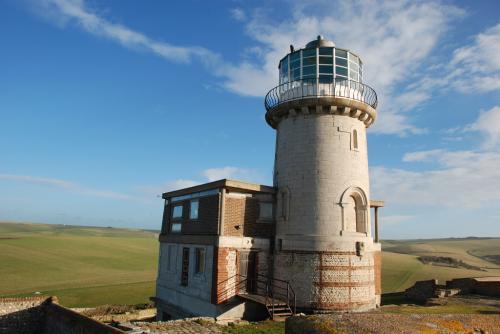
First Beachy Head lighthouse, now a private house
Region:
Red Wheel Site:
Transport Mode(s):
Address:
Beachy Head, Eastbourne, East Sussex BN20 7YA
Postcode:
Visitor Centre:
Website:
Visit website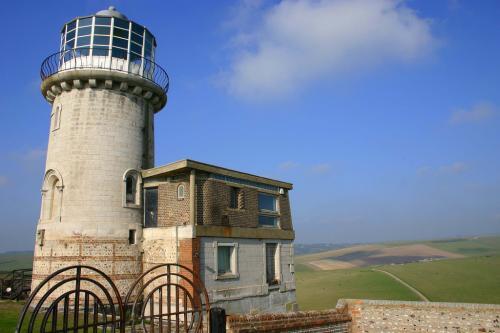
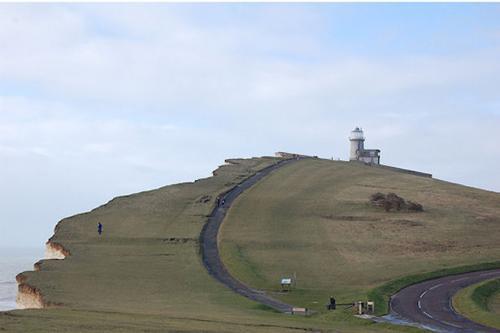
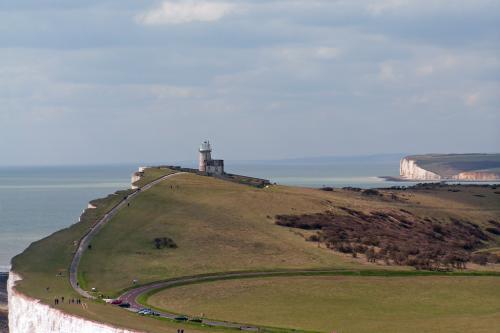
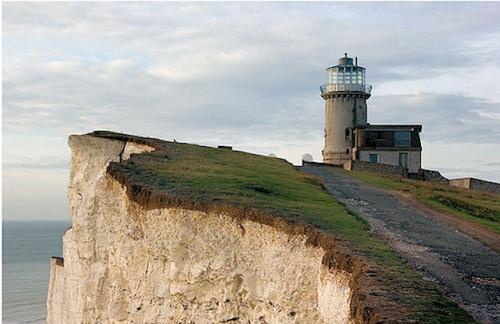
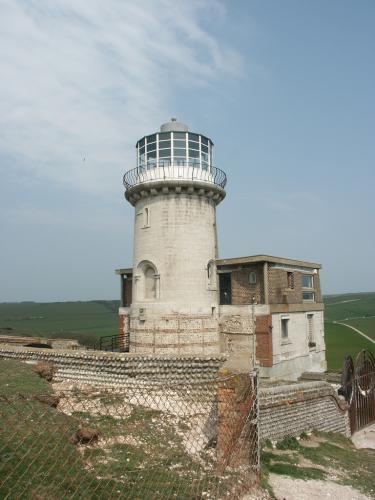
Beachy Headwas the site ofnumerous shipwrecksduring the 17th and early 18th centuries and,since 1670, a light has been shone to guide passing vessels from the top of the cliffs. A petition to erect a permanentlighthouse started around 1691, but the calls were ignored for overa hundredyears until 'The Thames', an East Indiaman, crashed into the rocks. The petition gained momentum with the support of a Royal Naval Captainand Trinity House, the official lighthouse authority, agreed toprogress the issue. Having witnessed the incident himself, John 'Mad Jack' Fuller, MP for Sussex, used his influence and some of his personal wealth to fund the lighthouse construction.
The very first Belle Toute lighthouse was a temporary wooden structure that started servicein October 1828, but the construction ofa permanent granite lighthouse began in 1829 and it became operational in October 1834. Its use ofthirty oil lamps meant that the lighthouse would requirenine litres (two gallons) ofoil every hour. The Belle Toute was in service until October 1902, when a new lighthouse was built at the bottom of the cliffs and Trinity House sold off the building in 1903.
During the Second World War, its owners were evacuated and a firing range constructed some 200 m (650 ft) to the east of the lighthouse. Canadian troops managed to breach Belle Tout's 2 m (6 ft) thick walls on a number of occasions.The damaged building was purchased by Eastbourne Borough Council in 1950, since whenit has changed hands several times. It now includes six bedrooms and large walled gardens, but the approach road remains mere inches from the cliff.
Originally the lighthouse was situated some 34m (112 ft) from the edge of the cliff andby 1890 this had fallen to 30m (98 ft). By 1999 the erosion of the cliffs was threatening the foundations of the building and drastic steps had to be taken to stop it from falling into the sea. In a remarkable feat of engineering, the Belle Toute was re-located 17 m (56 ft) away from the cliff face in March 1999. The 850 tonnes lighthouse was moved using a pioneering system of hydraulic jacks which pushed the building along four steel-topped concrete beams that were constantly lubricated with grease. The underpinning was designed to enable further moves when required. (See also entry for Beachy Head Lighthouse)
By road: Off B2103 - a footpath leads to the Lighthouse.
By rail: 4.5 km from Eastbourne Station
Bowen, J.P., British Lighthouses, British Council, ASIN: B001A8HS24 (1947)
Denton, A. & Leach, Nicholas, Lighthouses of England and Wales: A Complete Guide, Landmark Publishing, ISBN-10: 1843063190 (2007)
Hague, Douglas and Christie, Rosemary, Lighthouses, Their Architecture, History and Archaeology, Gomer Press, ISBN-0850883245(1975)
Naish, John, Seamarks, Their History and Development Adlard Coles Nautical, ISBN-10: 0540073091 (1985)
Nicholson, Christopher, Rock lighthouses of Britain; The end of an era?, Whittles Publishing, ISBN 1870325419. (1995)
Ockenden, Michael, Canucks by the Sea, Eastbourne Local History Society, ISBN 0 9547647 1 4 (2006)
Payton, Charles, Lighthouses: Towers of the Sea, National Trust Books, ISBN-10: 1905400128 (2006)
Surtees, Dr. John, Beachy Head, SB Publications ISBN 1 85770 118 6 (1997)
Woodman, Richard & Wilson, Jane, The Lighthouses of Trinity House, ISBN 1 904050 00 X (2002)
The Belle Tout Preservation Society
Jones, Richard - An analysis of deaths at Beachy Head
Lantern Room - Beachy Head
Subterranea Britannica - RAF Beachy Head