Broomielaw Station

Private halt for the Bowes-Lyon family
Region:
Red Wheel Site:
Transport Mode(s):
Address:
Stainton, Barnard Castle, Co Durham DL12 8RB
Postcode:
Visitor Centre:
Website:
Visit website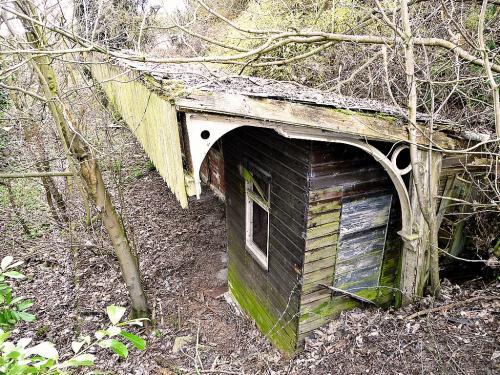
The South Durham & Lancashire Union Railway SD&LUR), also known as the Stainmore Railway, was authorized by an Act of 13 July 1857 to build a line from Bishop Auckland via Barnard Castle to Tebay on the Lancaster & Carlisle Railway (L&NWR). The Engineer was Thomas Bouch, later knighted for designing the ill-fated Tay Bridge.
The countryside traversed by the line was extremely sparsely populated; the company's projection was that the bulk of the railway's income would come from mineral traffic, with a small contribution from passenger traffic. First to be opened was the 35-mile section between Tebay and Barnard Castle on 1 August 1863, and this was followed by the Barnard Castle to Bishop Auckland section on 1 August 1863. Meanwhile, the Eden Valley Railway was authorized by an Act of 21 May 1858 to build a line from Clifton on the Lancaster & Carlisle line to Kirkby Stephen on the South Durham & Lancaster Union Railway. This line opened 1 August 1863.
Junctions were later effected with the Cockermouth, Keswick and Penrith Railway at Penrith, and with the Settle & Carlisle Railway (MR) at Appleby. Both company's lines were worked by the Stockton & Darlington Railway, which absorbed them under an Act of 8 April 1862 which in turn became part of the North Eastern Railway under an Act of 1 August 1863. British Railways closed the lines on 20 January 1962, except for the Darlington to Barnard Castle line which remained open to supply service to Middleton-in-Teesdale. This last section closed to passengers on 30 November 1964 and to goods on 5 April 1965.
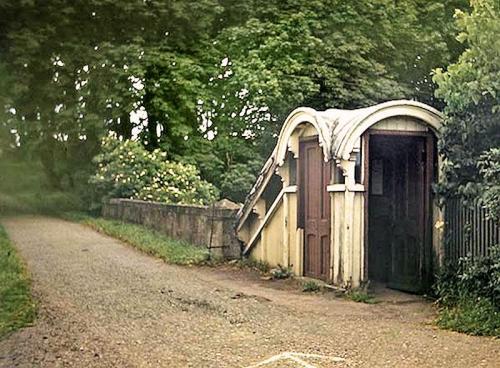
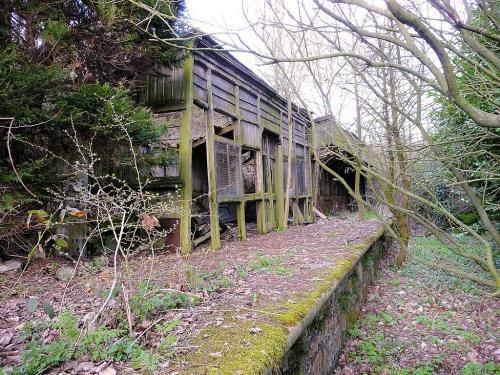
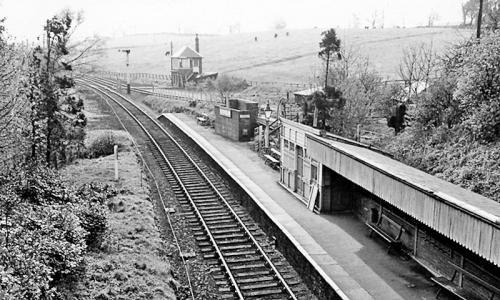
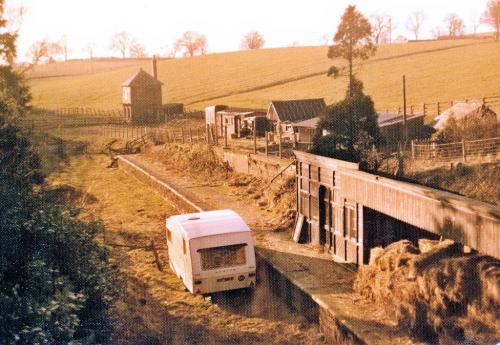
While the other stations on the Darlington - Barnard Castle line opened to the public on the 9th July 1856, the day after the formal opening, Broomielaw opened on the 8th July as a private halt for the Bowes-Lyon family who lived in nearby Streatham Castle. The station had a single platform located in a cutting on the up side of the line with a covered stairway down from the road above.
John Bowes was the High Sheriff of Durham and creator of the nationally important public art gallery, the Bowes Museum, designed in the grand French style by the French architect Jules Pellechet and John Edward Watson of Newcastle, He was so proud of Broomielaw station that he named one of his horses after it in 1862; Broomielaw won the Chester cup and the Prince of Wales stakes.
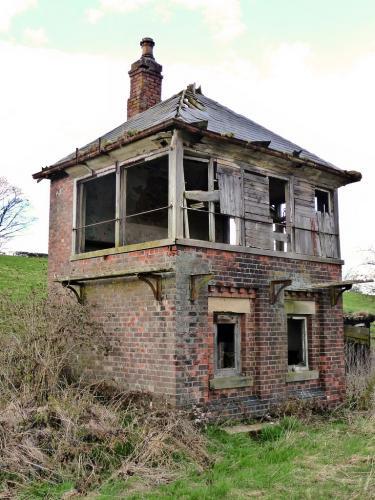
Although private the halt was used by children from the local village who caught excursion trains. The station was opened to the public on 9th June 1942. The station had no general freight facilities although a siding were provided on the north side of the line controlled by a signal box to the west of the station and Broomielaw did handle parcels and continued to do so until final closure of the line on 5th April 1965. The halt was the railhead for an army base and, in the late 1950s, it was used as a storage area for withdrawn steam locomotives.
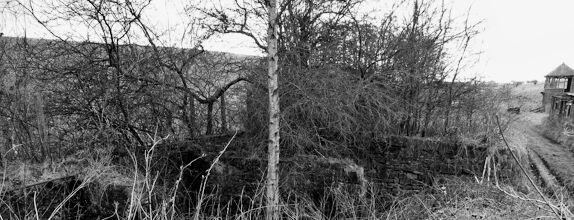
The station is virtually intact although in a very dilapidated condition. The platform is heavily overgrown but the brick and timber station building including the canopy although in a very poor condition. The covered stairway down from the road above has gone. At the west end of the station the signal box is also extant and in a similar condition. A number of small buildings also survive alongside the siding to the north of the station. The station house on the road above is now a private residence.
A short section of the line at Kirkby Stephen East station has been restored by the Stainmore Railway Company.
By road: Off A688
Biddle, Gordon, Great Railway Stations of Britain, David & Charles, ISBN 0 7153 8263 2 (1986)
Biddle, Gordon, Britain's Historic Railway Buildings, Oxford University Press, ISBN-10: 0198662475 (2003)
Biddle, Gordon, Victorian Stations, David & Charles, ISBN 0 7153 5949 5 (1973)
Biddle, Gordon & Nock, O.S., The Railway Heritage of Britain : 150 years of railway architecture and engineering, Studio Editions, ISBN-10: 1851705953 (1990)
Biddle, Gordon and Simmons, J., The Oxford Companion to British Railway History, Oxford, ISBN 0 19 211697 5 (1997)
Biddle, Gordon,and Spence, Jeffry, The British Railway Station, David & Charles, ISBN 0 7153 7467 2(1977)
Butt, R.V.J. The Directory of Railway Stations, Sparkford: Patrick Stephens Ltd. ISBN 1-8526-0508-1. (October 1995, 1st Edition)
Conolly, W. Philip, British Railways Pre-Grouping Atlas And Gazetteer, Ian Allan Publishing, ISBN 0-7110-0320-3 (1958/97)
Holmes, P.J., Stockton & Darlington Railway, First Avenue, ISBN-10: 0950449008 (1975)
Jowett, Alan, Jowett's Railway Atlas of Great Britain and Ireland, Patrick Stephens Ltd. ISBN 1-8526-0086-1. (March 1989)
Lloyd, David & Insall, Donald, Railway Station Architecture, David & Charles, ISBN 0 7153 7575 X (1978)
Richardson,T., History of the Darlington & Barnard Castle Railway ASIN: B000WVDCCA (1877)
Simmons, J., The Railways of Britain, Macmillan, ISBN 0 333 40766 0 (1961-86)
Simmons, J., The Victorian Railway, Thames & Hudson, ISBN 0 500 25110X (1991)
Walton, P., The Stainmore and Eden Valley Railways, OPC, ISBN-10: 0860933067 (1992)
North Eastern Railway Association
Railscot - Images of the South Durham & Lancashire Union Railway