Clifton Suspension Bridge

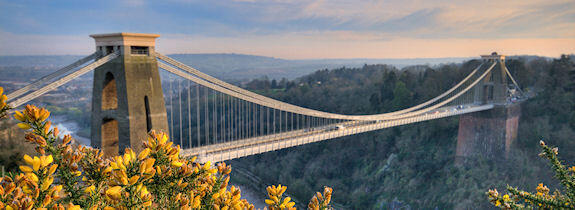
A suspension bridge which spans the Avon Gorge and links Clifton in Bristol to Leigh Woods in North Somerset.
Region:
Red Wheel Site:
Transport Mode(s):
Address:
Clifton Suspension Bridge Trust, Bridgemaster's Office, Leigh Woods, Bristol BS8 3PA
Postcode:
Visitor Centre:
Website:
Visit website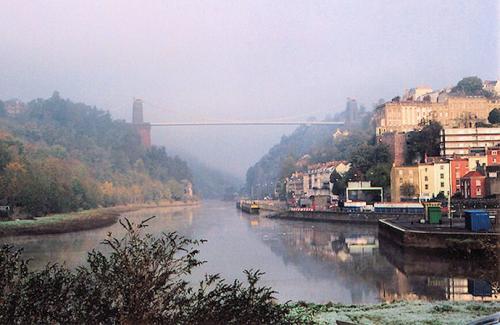
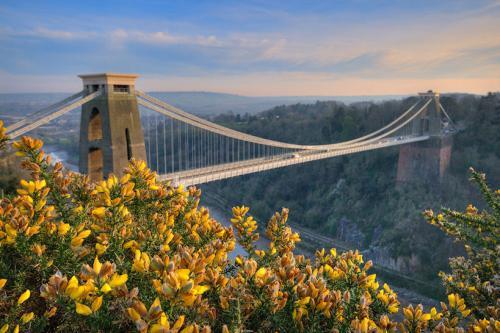
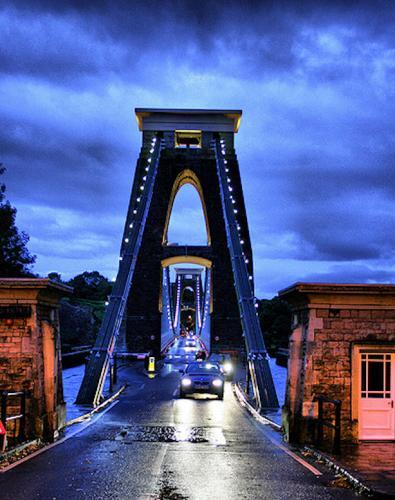
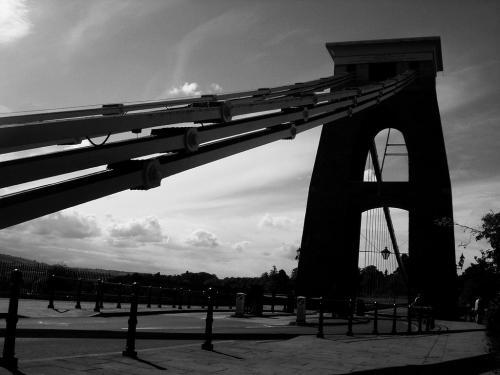
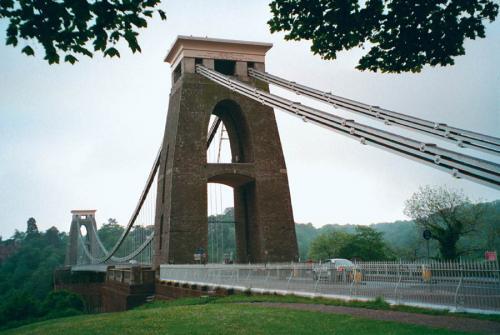
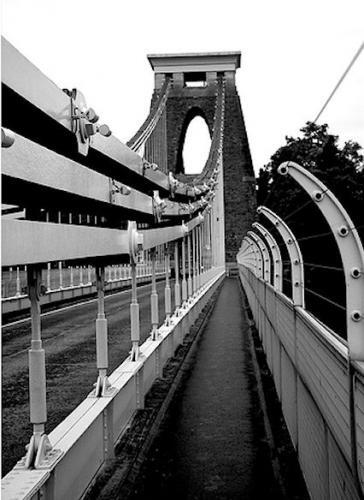
Designed by Isambard Kingdom Brunel, the Clifton Suspension Bridge is a Grade I listed building and a distinctive landmark for Bristol. The towers from which the bridge is suspended are not completely identical in construction, although they are generally similar in size - Clifton has cut outs in the sides and the Leigh tower has more pointed arches. Brunel proposed that sphinxes be built on the top of the two towers, which were then fashionable, but they were never built.
The weight of the Bridge, including chains, rods, girders and timber deck is approximately 1,500 tons. The tower on the Leigh Woods side of the gorge is 85 ft (26 m) high but stands on a red sandstone clad abutment 110 ft (33 m) high. In 2002 it was discovered that this was not a solid structure but contained 12 vaulted chambers, up to 35 ft (11 m) high, linked by shafts and tunnels.
The bridge has a set of three independent wrought iron chains on each side, which are made of eyebars, in numerous parallel rows, connected by bolts, from which the hangers reach down to the bridge. The chains are anchored in tunnels in the rocks 60 ft (17 m) below ground level at the side of the gorge. The deck or floor of the roadway is suspended from the chains by 162 wrought iron rods (81 on each side) which range from 65 ft (20 m) in length at the ends to 3 ft (0.9 m) in the centre. The deck was originally laid with wooden planking which was later covered with asphalt.
The idea of building a bridge across the Avon Gorge originated in 1753, with a bequest in the will of Bristolian merchant William Vick, who left £1,000 invested with instructions that when the interest had accumulated to £10,000, it should be used for the purpose of building a stone bridge between Clifton Down and Leigh Woods. By 1829, Vick's bequest had reached £8,000, but it was estimated that a stone bridge would cost over ten times that amount.
An Act of Parliament was passed to allow a wrought iron suspension bridge to be built instead, and tolls levied to recoup the cost. A competition was held to find a design for the bridge; the judge, Thomas Telford, rejected all designs, and tried to insist on a design of his own, a suspension bridge supported on tall Gothic towers. Telford claimed that no suspension bridge could exceed the 600 feet (183 m) span of his own Menai Suspension Bridge. A second competition, held with new judges, was won by Brunel's design on 16 March 1831, for a suspension bridge with fashionably Egyptian-influenced towers.
An attempt to build Brunel's design in 1831 was stopped by the Bristol Riots, which severely dented commercial confidence in Bristol. Work was not started again until 1836, and thereafter the capital from Vick's bequest and subsequent investment proved woefully inadequate. By 1843, the towers had been built in unfinished stone, but funds were exhausted. In 1851, the ironwork was sold and used to build the Brunel-designed Royal Albert Bridge on the railway between Plymouth and Saltash.
Brunel died in 1859, without seeing the completion of the bridge. Brunel's colleagues in the Institution of Civil Engineers felt that completion of the Bridge would be a fitting memorial, and started to raise new funds. In 1860, Brunel's Hungerford suspension bridge, over the Thames in London, was demolished to make way for a new railway bridge to Charing Cross railway station, and its chains were purchased for use at Clifton. A slightly revised design was made by William Henry Barlow and Sir John Hawkshaw; it has a wider, higher and sturdier deck than Brunel intended, triple chains instead of double, and the towers were left as rough stone rather than being finished in Egyptian style.
Work on the bridge was restarted in 1862, and was completed by 1864. The bridge is now managed by a trust set up by Act of Parliament in 1952. Tolls are levied on vehicles but no longer on cyclists or pedestrians.
By rail and bus: From Bristol Temple Meads (BTM) railway station take a No 8 or 8A bus which departs every few minutes. At the Centre Promenade the 8/8A bus stop is opposite the Hippodrome theatre, near the 'Sails' structure (you'll know it when you see it !) and the statue of Neptune. Get off the 8/8A bus at Clifton Village or Christ Church, Clifton. The Bridge is a short level walk from either of these bus stops. Taxis are always available at BTM and on the Centre Promenade. To make the return journey back down to the city centre or to BTM take the 9 or 9A from Clifton Village or Christ Church.
By Road: In the centre of Clifton.
Burr, William Hubert, A Course on the Stresses in Bridge and Roof Trusses, Arched Ribs and Suspension Bridges (1886), Kessinger Publishing, ISBN-10: 1104171740 (2009)
Drewry, C.S., A Memoir of Suspension Bridges: Comprising a History of their Origin, BiblioBazaar, ISBN -10 05547 25657 (2008)
Melan, Josef, Theory of Arches and Suspension Bridges (1913, Kessinger Publishing, ISBN-10: 1437437125 (2008)
Minchinton, W., A Guide to Industrial Archaeology sites in Britain, Granada ASIN: B0020ZCPRY (1984)
Peters, Tom, Transitions in Engineering: Guillaume Henri Dufour and the Early 19th Century Cable Suspension Bridges, Birkhauser, ISBN-10: 3764319291 (1987)
Steinman, David, A Practical Treatise on Suspension Bridges: Their Design, Construction and Erection (1922), Kessinger Publishing, ISBN-10: 1436606446 (2008)
Steinman, David, Suspension Bridges and Cantilevers, BiblioBazaar, ISBN-10: 0559673132 (2008)
Vaughan, Adrian, Isambard Kingdom Brunel - Engineering Knight Errant, John Murray, 1991, ISBN 0-7195-5748-8.