Coplawhill Tramcar Works and Depot, Glasgow

Surviving main works and depot for Britain's second largest tram system
Region:
Red Wheel Site:
Transport Mode(s):
Address:
25 Albert Drive, Glasgow G41 2PE
Postcode:
Visitor Centre:
Opening Times:
Not normally open to the public.
Website:
Visit websiteGlasgow's tramways were at one time one of the largest urban tramway systems in Europe. Over 1,000 municipally-owned trams served the city. The system closed in 1962 and was the last city tramway in Britain prior to the construction of new systems in the 1990s.
The Glasgow Street Tramways Act was enacted by Parliament in 1870, granting Glasgow Town Council the authority to build tramways within the city. The Council constructed its first 4km (2.5 miles) of tracks for a horse-drawn service in 1872 from St George's Cross to Eglinton Toll; as the Council was not permitted to operate the service, rights were granted to the Glasgow Tramway and Omnibus Company until 1894, when the Council formed the Glasgow Corporation Tramways and commenced their own municipal tram service.
Glasgow's tramlines had a highly unusual track gauge of 1,416 mm (4 feet 7¾ in), allowing 1,435 mm (4 ft 8 1„2 in) standard gauge railway wagons to operate over parts of the tram system (notably in the Govan area) using their wheel flanges running in the slots of the tram tracks.
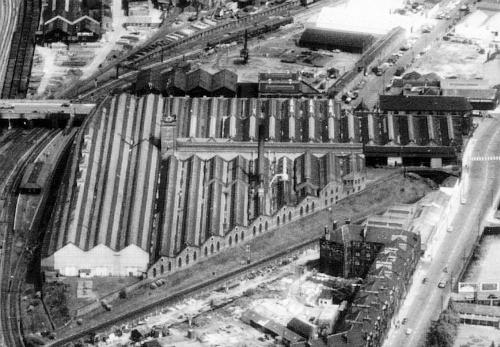
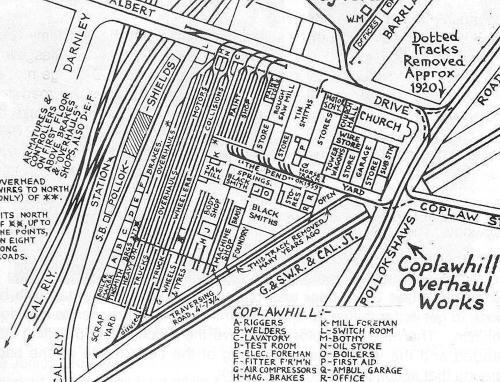
The electrification of the tram system was piloted in 1898 on the route between Springburn and Mitchell Street, using a fleet oftwenty onenewly built tramcars and the city-wide horse-drawn tram service was withdrawn in 1902. Four hundred new trams were built and fitted with electrical equipment at the Glasgow Corporation Tramways Workshops at Coplawhill, Pollokshields for the new system. With the opening of further depots, it was extended and turned over solely to manufacturing and overhauling the tramcar fleet. In it's final years, it took responsibility for the scrapping of obsolete trams and the assembly of bus bodywork.
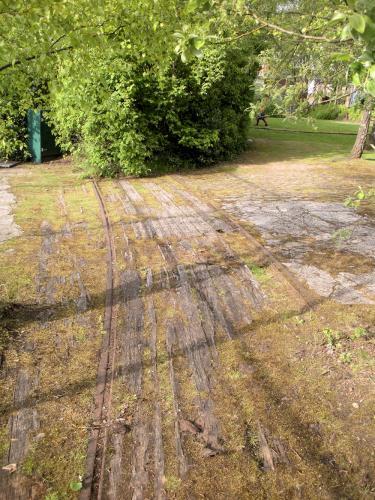
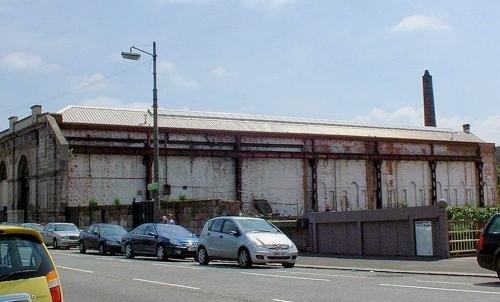
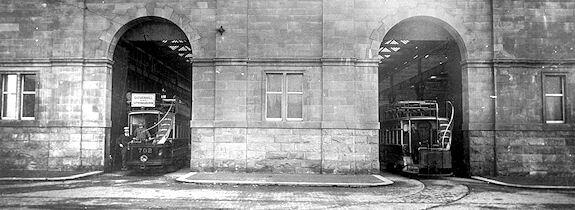
The original horse tram depot buildings were situated on Pollockshaw Road, the oldest part of the site and where an electrical sub-station was later housed for the network. In 2006, part of the stone facade collapsed after years of neglect and the entire section - including the upper story stables - wasdemolished (see image above). Short sections of the track still remain.
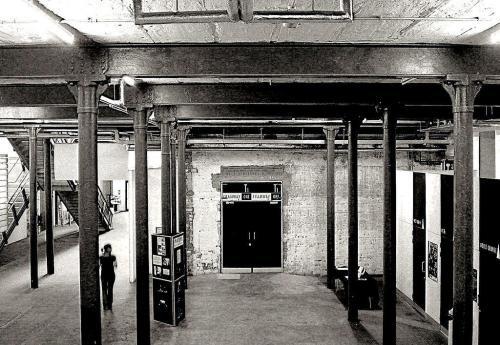
Following the closure of the tram system, the workshops were converted into the Glasgow Museum of Transport in 1964. Following the Museum's relocation to the Kelvin Hall in 1987, the buildings were subsequently adapted to become the Tramway Theatre. In 2007, plans began to relocate Scottish Ballet to its new location alongside the Tramway Theatre. This £11 m project entailed knocking down or renovating the five most eastern bays of the Tramway Theatre building and the new facilitywas officially opened on 17 September 2009.


By road: Off A77, Pollockshaws Road
By rail: Pollokshields Station (East Rail) is adjacent
Anderson, Paul, Glasgow's Trams - The Twilight Years, Irwell Press, ISBN-10: 1871608538 (1998)
Browning, Anthony, Glasgow's Trams: Their History and a Descriptive Guide to the Various Types Which Have Been Used, The Glasgow Museum of Transport, ASIN: B0020KYSGA (1965)
Cormack, Ian Leslie, Glasgow Trams Beyond the Boundary, Scottish Tramway Museum Society, ISBN-10: 0900648074 (1967)
Noble, Tom, The Wee Book of Glasgow Trams, Black and White Publishing, ISBN-10: 1902927966 (2003)
Stewart, Ian G., Glasgow by Tram, Scottish Tramway Museum Society, ISBN-10: 0900648163 (1977)
Tollan, William, The Wearing of the Green: Reminiscences of the Glasgow Trams, Adam Gordon, ISBN-10: 1874422273 (2000)
Turnbull, Alasdair, Twilight Years of the Glasgow Tram, Adam Gordon, ISBN-10: 1874422222 (1998)
Twidale, Graham & Mack, Robert, A Nostalgic Look at Glasgow Trams Since 1950, Silver Link Publishing, ISBN-10: 0947971211 (1988)
Coplaw Horse Tram Depot - RCAHMS Site Record
David Bradley Online - Glasgow Tram Gallery
Glasgow's Transport Depots and Garages
Glasgow Museum of Transport (Old) - RCAHMS Site Record
Glasgow Trams (Video)
The Last Days of Glasgow Trams (Video)