
De Havilland Aircraft Heritage Centre

Region:
Red Wheel Site:
Transport Mode(s):
Address:
PO. Box 107
Salisbury Hall
London Colney
Postcode:
Visitor Centre:
Opening Times:
Opening times vary - visit website, email w4050.dhamt@fsmail.net or telephone 01727 826400/822051
Website:
Visit website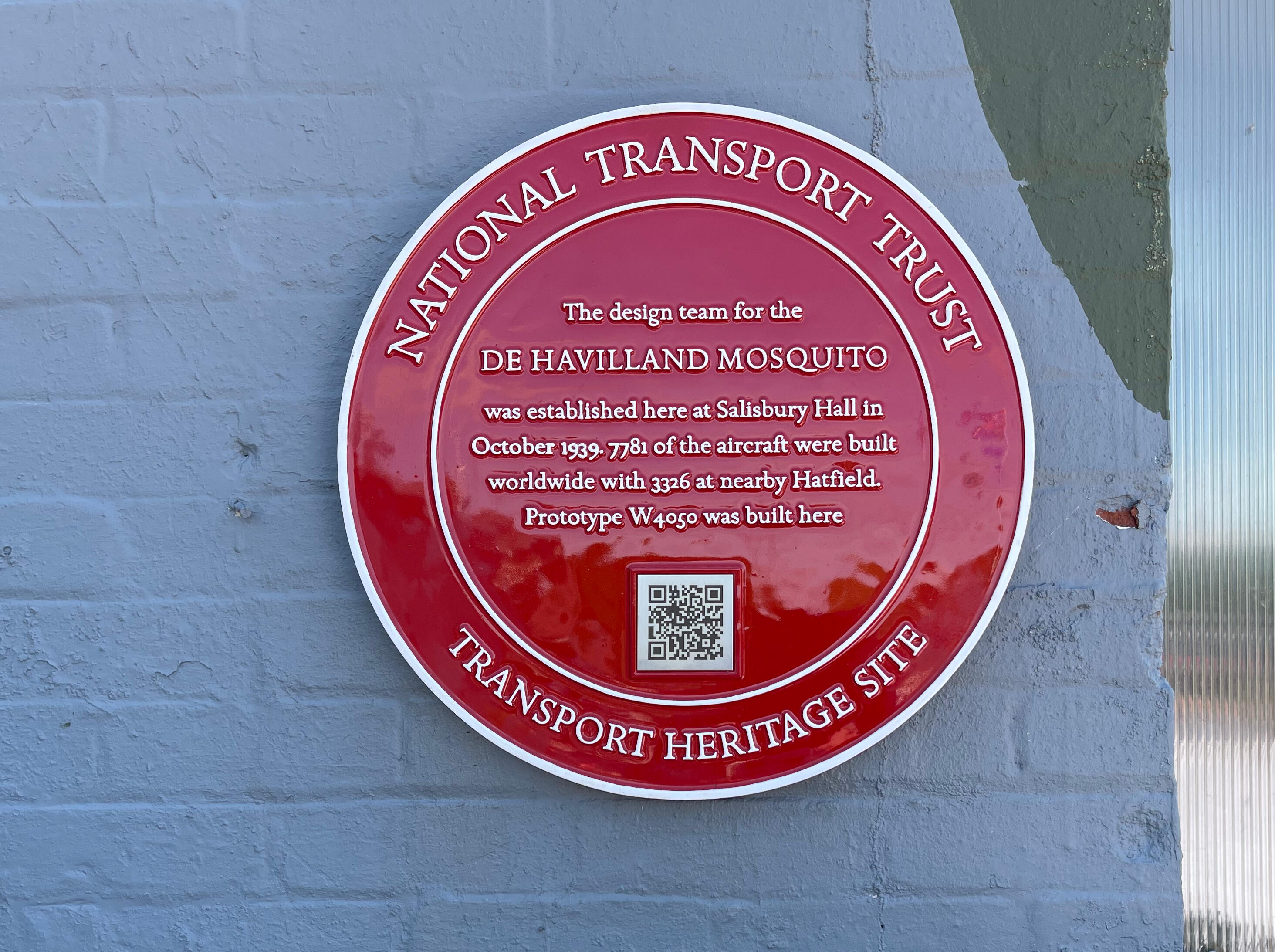
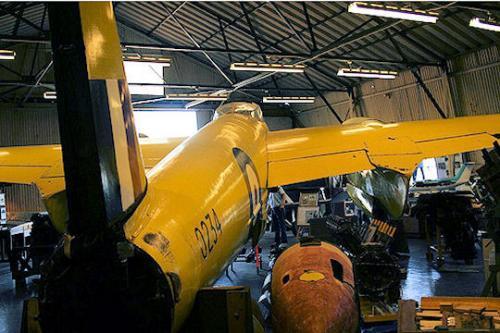
The design team for the De Havilland Mosquito was established here at Salisbury Hall in October 1939. 7781 of the aircraft were built worldwide with 3326 at nearby Hatfield. Prototype W4050 was built here
The first Salisbury Hall was built in 1507 by Sir John Cutte, Treasurer to King Henry VII and Henry VIII, but the current building was built in 1668 by James Hoare, a London banker. Nell Gwynne lived in a cottage by the bridge to the Hall. The Hall was purchased by Winston Churchill's mother, Lady Randolph Churchill, in 1905; then by Sir Nigel Gresley, who designed the A4 Pacific Steam Locomotives for the LNER, in the early 1930's.
In September 1939, the de Havilland Aircraft Company established the Mosquito design team in the Hall and the prototype (Mosquito E0234/W4050) was built in out buildings. When the company left in 1947, the Hall slipped into a derelict condition. However, in 1955 the Hall was taken in hand by Walter Goldsmith, who restored it and opened it up to the public in 1955. He brought back the prototype Mosquito as one of the attractions in 1959, leading to the establishment of the Mosquito Aircraft Museum.
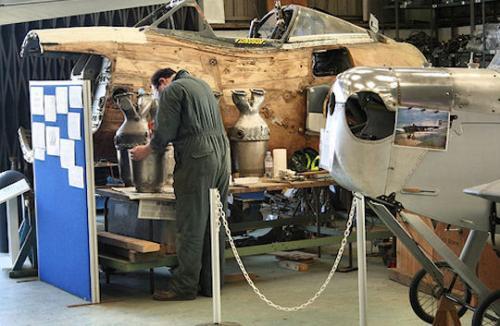
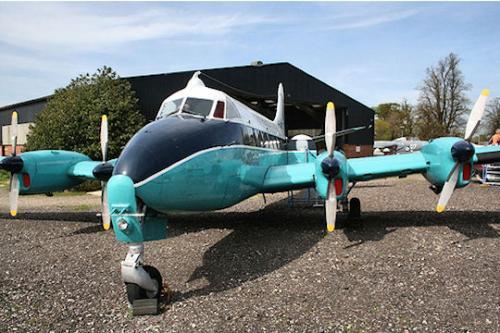
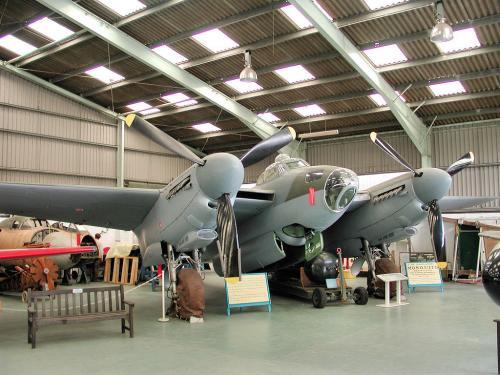
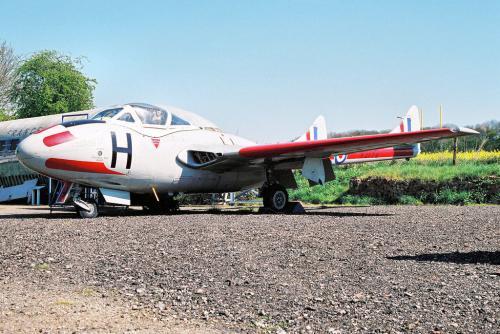
The Centre has some thirty aircraft on display, under restoration or in store, including the complete fuselage of DH106 Comet 1A F-BGNX. In addition to Mosquito E0234/W4050, the collection includes two now very rare complete Mosquito airframes - an FB6 and a TT.35 - as well, as the rear fuselage section of a TT.35. There is also a composite nose and fuselage section from a BAPC.232 Horsa I/II.
The DH82 Tiger Moth on display marks one of the world's great aviation success stories. Developed by Geoffrey de Havilland during the early 1930s and flown for the first time on 26 October 1931, the biplane became the most important elementary trainer used by Commonwealth forces. More than 1,000 Tiger Moths were delivered before WWII, and subsequently around 4,000 were built in the UK with an extra 2,000 being manufactured in Canada, Australia and New Zealand.
About the Mosquito
The de Havilland DH88 Mosquito is one of the most unusual military aircraft of any period. It was first flown in 1940 and first saw service in 1941. Its roles encompassed day or night bombing, reconnaissance, fighter and night fighter and pathfinder. In BOAC colours and with crew in BOAC uniforms, it also flew vital engineering bearings from neutral Sweden to the UK and brought physicist Niels Bohr from Scandinavia to Britain.
It was very light, was powered by two Rolls Royce Merlin engines, equal to half a Lancaster or two Spitfires, and could exceed 400 miles an hour. It was constructed very largely from wood, leading to its light weight, individual components being produced by furniture factories whose usual work had been suspended "for the duration" during the war. The fuselage was a sandwich of a layer of balsa wood between two skins of plywood and its wing was an intricate wooden frame covered with Irish linen and then doped - Biggles would have been at home here.
Almost 8000 Mosquitos were produced and went on to serve in many allied air forces. They remained in RAF front-line service until December 1955, the last examples finally being retired in 1963.
The Mosquito for which a National Transport Trust Award was made was built in 1945, saw limited active service but remained with the RAF in Germany until 1950 It was restored by the de Havilland Museum over a period of almost 50 years. The Museum is based in the very premises in which the Mosquito was designed, Salisbury Hall, the then home of the de Havilland family just south of the M25 in Hertfordshire, which, in 1940, was a safer location than the main factory in Hatfield.
The early years of the restoration work were spent gathering components and activity often sank into abeyance as other projects took priority. This Mosquito, TA 122, a fighter bomber, was sold in June 1950 to Delft Museum of Technology for £15, minus engines, armament and instruments. The idea was to use it to instruct students on airframe technology. To make it fit in its new home, the wing was sawn off either side of the fuselage. By 1965 TA122 had been moved to the store of a military museum, still in Holland.
Around this time the de Havilland Museum was beginning to expand and was looking for a fighter-bomber to fill a gap in its collection. TA122 was prised out of its Dutch storage and brought to Salisbury Hall, albeit anything but complete. A wing was sourced from Israel, with radiators and undercarriage and this assembly was flown to Heathrow courtesy of El Al. Other components came from Canada, Australia and New Zealand. Work on the wing began in 1985, led by Colin Ewer who had worked on the de Havilland production line in 1946. It took 15 years.
The wing and fuselage were re-united in March 2009. Engine and propellers were fitted in 2014. Although she is a static exhibit, all electrical systems are in working order following a complete rewiring.
She is painted in her 1945 605 Squadron colours and stands as a remarkable testament to the astonishing efforts of the team at the de Havilland Museum, Preservationists of the Year for 2025.
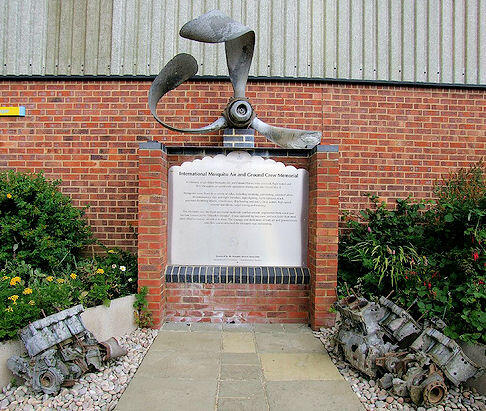
By road: Off J22 M25, via B556. The museum is adjacent to Salisbury Hall - location map here.

Direct navigation links:
what3words address: ///valve.blast.cones

Bramson, Alan, The Tiger Moth Story, Crecy Publishing, ISBN-10: 0859791033 (2005)
Birtles, Philip, Hatfield Aerodrome - A History, British Aerospace, ISBN-10: 0952161303 (1993)
Davies, R. E. G. & Birtles, Philip, de Havilland Comet: The World's First Jet Airliner, Paladwr Press, ASIN: B0014GEYZ6 (1999)
Darling, Kevin, de Havilland Comet, Crowood Press, ISBN-10: 1861267339 (2005)
Graham-Cowell, J., de Havilland Comet: The World's First Jet Airliner, Mach III Plus, ISBN-10: 1898129444 (1999)
Howe, Stuart, de Havilland Mosquito: An Illustrated History: Vol 1, Crecy Publishing, ISBN-10: 0947554769 (1998)
Jackson, Aubrey Joseph, de Havilland Aircraft Since 1909, Putnam Aeronautical, ISBN-10: 085177802X (1987)
Jones, Barry, de Havilland Twin-Boom Fighters: Vampire, Venom and Sea Vixen, Crowood Press, ISBN-10: 1861266812 (2004)
Phipp, Mike, The Brabazon Committee and Airliners 1945 - 1960, The History Press, ISBN-10: 0752443747 (2007)
Royal Australian Air Force, Tiger Moth Pilot's Notes, Facsimile Edition, Air Data Publications, ISBN-10: 0859790886 (1985)
Skinner, Stephen, British Airliner Prototypes Since 1945, Midland Publishing, ISBN-10: 1857802993 (2008)
Thirsk, Ian, de Havilland Mosquito: An Illustrated History: Vol 2, Crecy Publishing, ISBN-10: 0859791025 (2008)
UK Government, East of England: Case Study: Hatfield Aerodrome, Office of the Deputy Prime Minister, ASIN: B001PDIOFY (2005)
The de Havilland Aeronautical Technical School Association
The de Havilland Mosquito Page
Mosquito Aircraft Restoration - Restoration to flight status of Australian built dual control T43 NZ2308 in New Zealand.
Warbirds Restoration - Restoration to flight status of Australian built FB26 in New Zealand