Discovery

Captain Scott's ship - the world's first vessel to be constructed speciïcally for scientific research and the last wooden three-masted ship to be built in Britain.
Region:
Red Wheel Site:
Transport Mode(s):
Address:
Discovery Point, Discovery Quay, Dundee DD1 4XA
Postcode:
Visitor Centre:
Website:
Visit website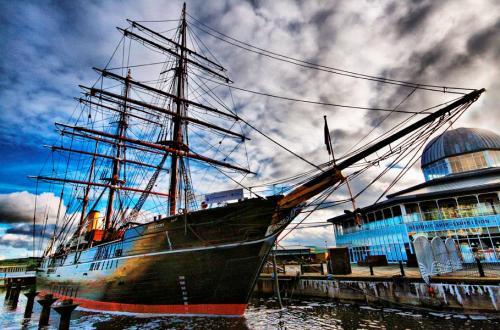
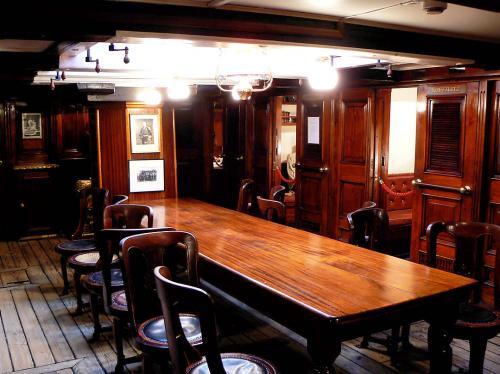
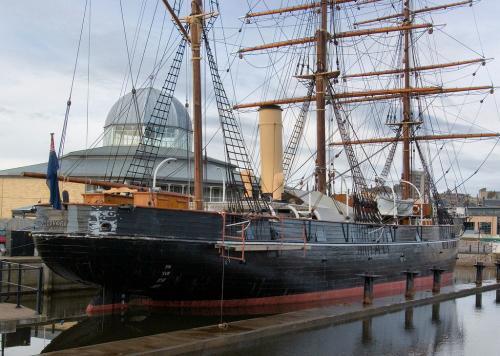
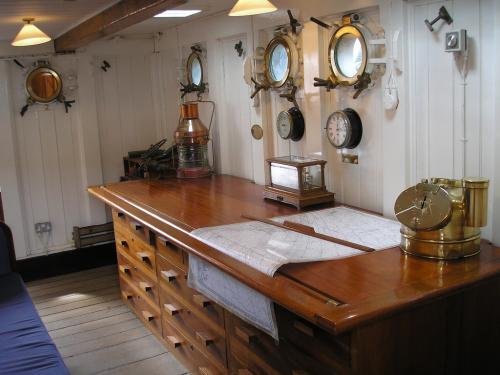
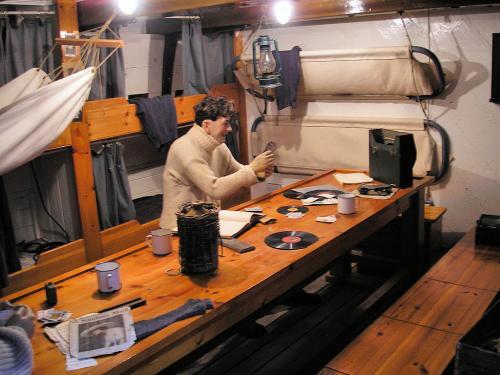
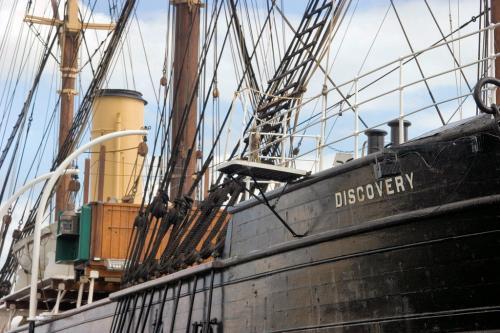
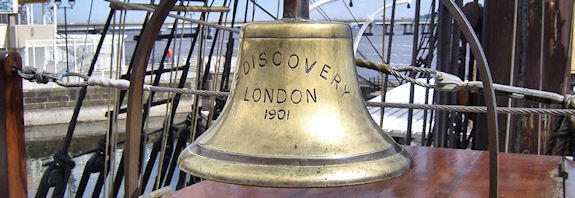
The RRS Discovery was the last wooden three-masted ship to be built in Britain, and was launched on 21 March 1901, designed for Antarctic research. Her first mission was the British National Antarctic Expedition, carrying Robert Falcon Scott and Ernest Shackleton on their first, successful journey to the Antarctic, known as the Discovery Expedition. The Space Shuttle Discovery is named after this ship.
At the beginning of the 20th Century Antarctica remained an uncharted wilderness, requiring a long and arduous voyage through difficult seas simply to reach the continent. The 1901 British National Antarctic Expedition was the vision of Sir Clements Markham, President of the Royal Geographical Society. Designed on one of the great Dundee whalers, the RRS Discovery - the ï¬rst vessel to be constructed speciï¬cally for scientiï¬c research - important modifications permitted the construction of the magnetic observatory, with no iron or steel allowed within 9 m (30 ft) of the area.
Following a chance reunion in a London street with Markham, the young naval officer he had first encountered twelve years earlier in St.Kitts, Lieutenant Robert Falcon Scott, volunteered to lead the expedition and was appointed in June 1900. He was also promoted to Commander RN at the age of just thirty three. The ship set off in August 1901 with a complement of forty nine men, a mixture of naval and merchant seamen, two of which would become key members of the expedition - Ernest Shackleton and Edward Wilson. Sufficient provisions for three years were on board, including both tropical and polar clothing, sledges, tents, furs, tools, explosives, signal rockets, a library, lamps, candles, medicines, alcohol and tobacco. Additional stores were purchased when the ship docked in New Zealand.
After twelve months at sea, Antarctica was finally sighted on 8 January, 1902. The five scientists on board began their magnetic surveys and carried out meteorological, oceanographic, geological and biological research. Hauling sledges through blizzards in temperatures as low as minus 45º C, they risked frostbite and snow blindness to take measurements and collect specimens, but their work was ground-breaking - when the Royal Geographical Society published the results, they amounted to ten weighty volumes.
On 2 November, 1902, Scott, Wilson and Shackleton set off to cross the Great Ice Barrier and explore the frozen desert beyond. The personal cost was high - by 30 December, at latitude 82º 17' and about 850 km (530 miles) from the Pole, they reluctantly turned for home, arriving back at Discovery on 3 February 1903 after trudging over 950 miles in 93 days and travelling further south than any man before them. The ship reached Spithead on 10 September, 1904 with Scott a national hero and the recipient of numerous honours. Scott was promoted to the Royal Navy rank of Captain and invested by the King as a Commander of the Royal Victorian Order. Scott perished in his tent on 29 March, 1912, during his second expedition to the Pole - the Terra Nova Expedition (1910-1913) - the last of his party to die from a combination of frost-bite, snow-blindness, hunger and exhaustion. The world was informed of the tragedy when Terra Nova reached Oamaru, New Zealand, on 10 February 19.
RRS Discovery's adventures continued, however, first with the Hudson Bay Company, then running munitions to Russia during the First World War. She was to make two further voyages to Antarctica before being laid up on the Thames alongside The Embankment in London. By 1979 Discovery was in a serious state of dilapidation and the first stage of her restoration was funded by The Maritime Trust. In 1986, Discovery finally returned home to the River Tay and now sits proudly as the centrepiece of the Discovery Point Visitor Centre, a fitting memorial to the heroes of Antarctica.
By road: Off A90 - follow signs for city centre. Discovery Point is on the waterfront on A85 Riverside Drive before the Tay Road Bridge.
By train: Discovery Point is directly opposite Dundee Railway Station.
By air: Dundee Airport is approximately 1.5 km from Discovery Point.
Barczewski,Stephanie, Antarctic Destinies: Scott, Shackleton, and the Changing Face of Heroism, Continuum International Publishing Group, ISBN-10: 0826445624 (2009)
Bickel, Lennard, Shackletons Forgotten Men: The Untold Tale of an Antarctic Tragedy, Pimlico, ISBN-10: 0712668071 (2001)
Cherry-Garrard, Apsley, The Worst Journey in the World, Pimlico, ISBN-10: 1844131033 (2003)
Crane, David, Scott of the Antarctic: A Life of Courage and Tragedy in the Extreme South, Harper Perennial, ISBN-10: 0007150717 (2006)
Fiennes, Ranulph, Race to the Pole: Tragedy, Heroism, and Scott's Antarctic Quest, Hyperion Books, ISBN-10: 078688858X (2005)
Huntford, Roland, The Last Place on Earth, Pan Books, ISBN 0 330 82697 5 (1985)
Jones, Max, The Last Great Quest: Captain Scott's Antarctic Sacrifice, Oxford University Press, ISBN 0 19 280483 9 (2003)
Scott, Robert Falcon, Journals: Captain Scott's Last Expedition, Oxford University Press, ISBN-10: 0199536805 (2008)
Shackleton, Ernest, South: The "Endurance" Expedition, Penguin, ISBN-10: 0140288864 (1999)
Solomon, S., The Coldest March: Scott's Fatal Antarctic Expedition, Yale University Press, ISBN-10: 0300089678 (2001)
Thomson, David, Scott's Men, Allen Lane, ISBN 0 7139 1034 8 (1977)
Tyler-Lewis, Kelly, The Lost Men: The Harrowing Story of Shackleton's Ross Sea Party, Bloomsbury Publishing, ISBN-10: 0747579725 (2007)
Eye Witness To History - Doomed Expedition to the South Pole, 1912
Scott Polar Reaearch Institute - University of Cambridge
Times Online - Scott of The Antarctic