Forth Road Bridge

Iconic link between Edinburgh and Fife, the largest suspension bridge outside of America when constructed
Region:
Red Wheel Site:
Transport Mode(s):
Address:
Forth Road Bridge, South Queensferry, West Lothian EH30 9SF
Postcode:
Visitor Centre:
Website:
Visit website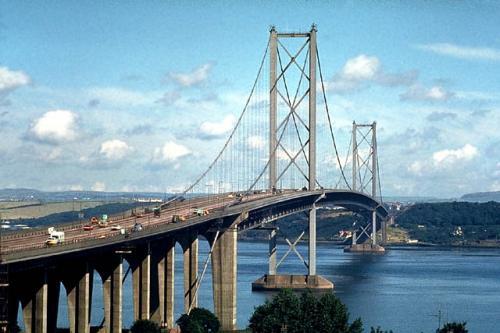

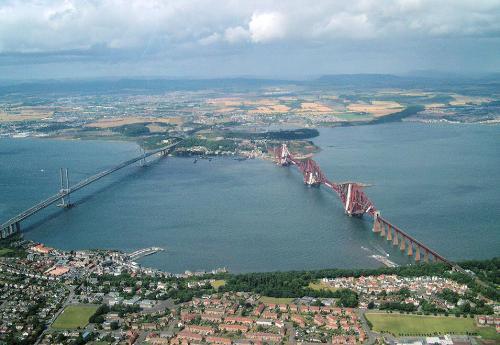
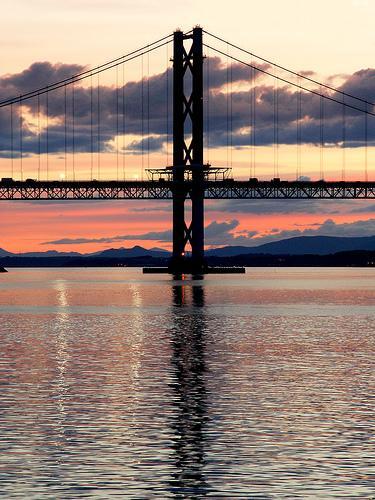
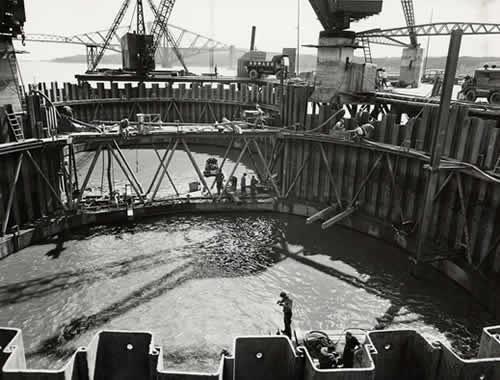
The Forth Road Bridge spans the Firth of Forth linking Fife and the North with Edinburgh and the central belt, and provides a vital strategic link to the rest of the UK for industry and tourism in the north and east of Scotland.
The first crossing at what is now the site of the bridge was established in the 11th century by Margaret, queen consort of King Malcolm III, who founded a ferry service to transport religious pilgrims from Edinburgh to Dunfermline Abbey and St Andrews. Its creation gave rise to the port towns which remain to this day, and the service remained in uninterrupted use as a passenger ferry for over eight hundred years. Since 1740 various proposals to provide a road crossing at Queensferry had been put forward. However, it was the Victorian's age of railways that brought about the construction of the world famous and iconic Forth Bridge which was completed in 1890.
With ever increasing road traffic, motorists faced the choice of waiting in the queue for the ferries at Queensferry or a detour of over 40 miles via Kincardine. There was a period of renewed lobbying for a road crossing in the 1920s and 1930s, at which time the only vehicle crossing was a single passenger and vehicle ferry. Sir William Denny championed the expansion of that service in the 1930s, providing and operating two additional ferries on behalf of the London and North Eastern Railway that aimed to supplement the services of the adjacent railway bridge. Their success allowed for the addition of two more craft in the 1940s and 1950s, by which time the ferries were making 40,000 crossings, carrying 1.5 million passengers and 800,000 vehicles annually.
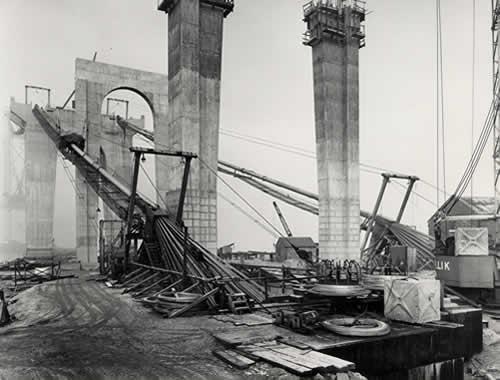
However, it was not until 1947 that the Government committed itself to building the bridge and set up the Forth Road Bridge Joint Board (FRBJB) as the Authority to promote the construction of the bridge and to operate and maintain the structure after its completion. Following Government approval, construction work started in early 1958 on what was then the longest to be built outside the United States, with a main span of 1006 metres, and the first long span suspension bridge to be built at such a northerly latitude.
The bridge was designed and supervised by Mott Hay and Anderson and Sir Freeman Fox and Partners, with the work was carried out by a consortium of the three largest construction firms in Britain at that time - Sir William Arrol & Company, The Cleveland Bridge & Engineering Company and Dorman Long ( Bridge and Engineering).
The bridge has a main span of 1006 metres between the two main towers. The side spans which carry the deck to the side towers are each 408 metres long. The approach viaducts are 252 metres and 438 metres long on the north and south sides respectively. The two main aerially spun cables from which the suspended deck is hung are 590 mm in diameter, and each is made up of 11,618 high tensile wires with a 4.98 mm diameter. The suspended deck is made up of a steel stiffening truss, with three longitudinal air gaps at roadway level to improve aerodynamic stability.
The main cables are anchored at each end to take the 13,800 tonnes of total load in each cable. These anchorages are concrete, cast in tunnels of tapering section, cut into rock at an inclination of 30º to the horizontal. The tunnel lengths vary between 56 and 79 metres. The cost of constructing the bridge and approach viaducts was £11.5 million. The total cost of the construction of the bridge project including eight miles of dual carriageway on the approaches; a further eight miles of minor roads and 24 other minor bridges was £19.5 million. Seven men lost their lives during the construction of the bridge and it's approaches.
The deck on the main and side spans carries traffic loadings to the main cables via the hangers and does not contribute significantly towards the resistance of the truss to global effects. On the main span the deck is an orthotropic stiffened steel plate. However, on the side spans the deck is of composite construction with a 200 mm thick reinforced concrete slab on steel beams. On all the suspended spans the surfacing is limited to a thickness of 38 mm.
The main towers are of welded cellular high tensile steel construction and rise up over 150 metres above high water level. The maximum thickness of the steel in the towers in about 25 mm. These towers were strengthened in the late 1990's to take the ever increasing weights of heavy goods vehicles crossing the bridge. An engineering study completed in 2005 found that the main cables had already suffered an estimated 8-10% loss of strength due to excessive traffic loads, with an accelerating loss projected and a worst case scenario of full closure by 2020. The bridge was awarded Historic Scotland's Category A listed structure status in 2001.
By road: On A90
By bike: On National Cycle Route 1
Burr, William Hubert, A Course on the Stresses in Bridge and Roof Trusses, Arched Ribs and Suspension Bridges (1886), Kessinger Publishing, ISBN-10: 1104171740 (2009)
Drewry, C.S., A Memoir of Suspension Bridges: Comprising a History of their Origin, BiblioBazaar, ISBN -10 05547 25657 (2008)
Forth Road Bridge Joint Board, The Forth Road Bridge: the official story, Edinburgh Publicity Dept., ASIN B001A9ZOBU, (1964)
Inst. of Civil Engineers, Forth Road Bridge, ASIN B000QA9NY8 (1967)
Mackay, Sheila, Silver Highway: Story of the Forth Road Bridge, Moubray, ISBN-10 0948473096 (1988)
Mackie, Albert, A Tale of Two Bridges, CommEnt, ASIN B0007K1EP8 (1964)
Melan, Josef, Theory of Arches and Suspension Bridges (1913, Kessinger Publishing, ISBN-10: 1437437125 (2008)
Minchinton, W., A Guide to Industrial Archaeology sites in Britain, Granada ASIN: B0020ZCPRY (1984)
Peters, Tom, Transitions in Engineering: Guillaume Henri Dufour and the Early 19th Century Cable Suspension Bridges, Birkhauser, ISBN-10: 3764319291 (1987)
Steinman, David, A Practical Treatise on Suspension Bridges: Their Design, Construction and Erection (1922), Kessinger Publishing, ISBN-10: 1436606446 (2008)
Steinman, David, Suspension Bridges and Cantilevers, BiblioBazaar, ISBN-10: 0559673132 (2008)
Forth Road Bridge - First internal inspection and strength review.
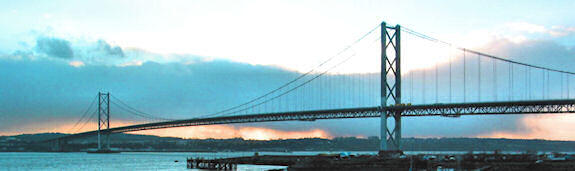
Forth Road Bridge- Panoramic view of Forth road and rail bridges (Greg Barbier)

Undiscovered Scotland- The Forth Road Bridge