
Heaton Park Tramway Siding, Manchester

Sole surviving element of Britain's second largest tramway system
Region:
Red Wheel Site:
Transport Mode(s):
Address:
Heaton Park Tramway, Heaton Park, Manchester
Postcode:
Visitor Centre:
Opening Times:
Opening times vary - visit website
Website:
Visit websiteUsed 1905-34 by Manchester Corporation Tramways. Reopened 1980 incorporating the oldest section of original tram track in the UK
The first suggestion for the construction of tramways in Manchester came from Henry Osborn O'Hagan, a well-known promoter of such schemes, whose name figures later in the development of tramways in the outer districts. His proposals of 1872 were resisted, but by 1875, the introduction of tramways could not be put off for much longer. The Corporations of both Manchester and Salford obtained Tramways Orders under the terms of the 1870 Tramways Act, which empowered them to construct and lease, but not operate, tramways within their respective districts.
The Manchester Suburban Tramways Company was formed in 1877 to build and operate its own lines and to undertake the operation on lease of lines constructed by the municipalities. On 17th May, 1877, horse tramway operations began with a service between the Grove Inn on Bury New Road, and Deansgate, the first tramway in Manchester.
In 1880 a new company was formed to amalgamate the interests of the Manchester Carriage Company and the Manchester Suburban Tramways Company. Called the Manchester Carriage and Tramways Company, the new organisation began a process of expansion, which by the 1890s made them the major transport operator in Greater Manchester. At their maximum, the tramways of this company extended over 89 miles of route and employed 515 cars and 5,300 horses, working from 20 depots.
Manchester Corporation adopted a resolution in 1895 to take over the tramways and operate them as an electric system. The first section of the reconstructed tramway, between Albert Square and Cheetham Hill, was opened for electric traction on 7th June 1901. Reconstruction and electrification was completed by 1903, and the last horse trams within the City ran in that year. The years up to 1914 saw the consolidation of an extensive system of electric tramways stretching over the whole of Greater Manchester,
The first tramway route in Manchester to be converted to motor bus operation was the 53 service from Cheetham Hill to Stretford Road, in 1930, and this was quickly followed by other services such as Bradford Road, and then by the trunk route through Sale to Altrincham. After the war, delivery of new buses began again, and the last Manchester tramcar operated on the morning of Monday 10th January 1949.
The Manchester Transport Museum Society (MTMS) was born in 1961 with the aim of creating a museum in which to make the society's various exhibits available to the public. The Society was keen to reopen the former tramway siding in Heaton Park which was still in existence under a layer of tarmac. The siding was originally built to allow special cars to operate from various parts of the city bringing Sunday School parties for days out in the extensive grounds of Heaton Hall.The aim was to operate tram no. 765 in its home city. Manchester City Council was approached during the 1970s and following negotiations a start was made on unearthing the existing tram rails.
The initial idea, to construct a new tramway from Grand Lodge to Heaton Hall, was considered too expensive, as it would require remedial works to carry it across the railway tunnel. Therefore a new scheme was proposed to open up the old Manchester Corporation Tramways spur from Middleton Road to the old tram shelter some 300 yards (270 m) inside the park. The original track was buried under a layer of tarmac which had to be cleared and the old tram shelter had to be restored to form the centre of the society's operations.
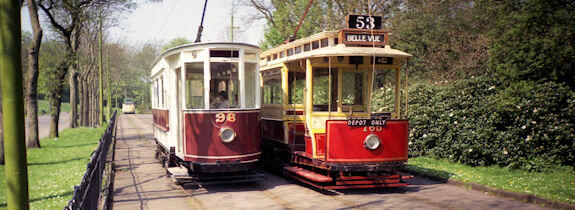
The work was completed in 1979 and the Heaton Park Tramway was officially opened on the 28 March 1980.The tramway currently has an operating fleet of 3 electric trams and one horse tram.
The operation based upon the original siding has since been extended (by the use of track salvaged from elsewhere), largely on a private right of way to a new terminus short of the Boating Lake. Plans exist for a further extension, perhaps as far as the hall. A major restoration of the depot and museum complex has recently (2007) been completed. A newly restored horse tram has been added to the collection.
The Manchester Transport Museum Society Ltd is a registered charity, set up in the early 1960s as the Manchester Transport Historical Collection. The Society's aim is the preservation of documents and artifacts relating to public transport in the Manchester region. The key project the group took on was the restoration of Manchester single deck California car 765. Having rescued the tram from the moors above Huddersfield, it was taken to the tramway museum at Crich in Derbyshire, where early restoration work took place. Further restoration was undertaken in Manchester and the restored car returned to Crich, operating for a couple of seasons.


By road: Off A576, adjacent to M60 J19
By rail: Close to Heaton Park Metro Station
Bett, W.H. & Gilham, J. C., Tramways of South-East Lancashire, Light Railway, ISBN-10: 0900433620 (1976)
Clarkson, T., The Tram Depots of Manchester, Colamda, ISBN-10: 0954551702 (2003)
Dunbar, Charles, Buses, Trolleys and Trams, Paul Hamlyn, ISBN-10: 0753709708 (1967)
Dunstone, D., For the Love of Trains. The Story of British Tram and Railway Preservation, Ian Allan, ISBN 0 7110 3301 6 (2007)
Garratt, Colin, The Golden Years of British Trams, Milepost Publishing, ISBN 1 900193 00 0 (1995)
Gray, Edward & Kirby, Arthur, Manchester Trams: A Pictorial History of the Tramways of Manchester, Memories, ISBN-10: 1899181067 (1995)
Grieves, Robert, Glasgow's Trams and Buses: A Centenary Journey, XS Publications, ISBN-10: 0950638137 (1994)
Harvey, David, City to the Lickeys: A Nostalgic Journey by Tram and Bus, The History Press, ISBN-10: 0752446975 (2008)
Klapper, Charles, The Golden Age of Tramways, (1961)
Turnbull, Alasdair, Twilight Years of the Glasgow Tram, Adam Gordon, ISBN-10: 1874422222 (1998)
Waller, Peter, British Trams (Glory Days), Ian Allan, ISBN-10: 0711029113 (2003)
Wiseman, R. J. S., Edinburgh's Trams, The Last Years, Stenlake Publishing, ISBN-10: 184033343X (2005)
Yearsley, Ian, Tramway Adventure, Tramway Publications, ISBN 0 949007 04 8 (1998)