London Eye

Region:
Red Wheel Site:
Transport Mode(s):
Address:
Postcode:
Visitor Centre:
Opening Times:
Open daily - see schedule, visit website or telephone 0870 5000 600
Website:
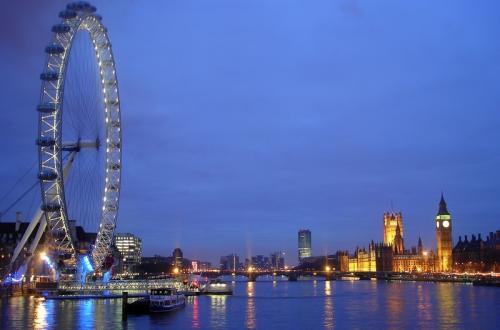
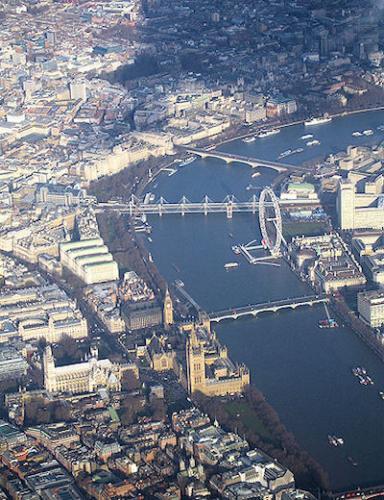
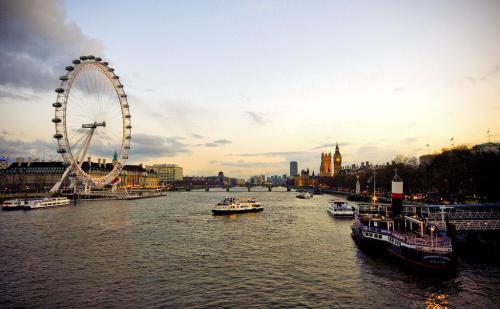
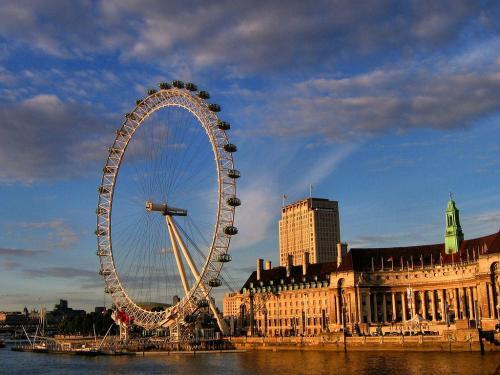
Visit websiteThe London Eye (aka Millennium Wheel) is 135 m (443 ft) tall - when erected, it was the tallest Ferris wheel in the world until surpassed by the Star of Nanchang (160 m) in May 2006 and then the Singapore Flyer (165 m) in February 2008. It remains the world's tallest cantilevered observation wheel (the structure is supported by an A-frame on one side only)and the tallest Ferris wheel in Europe. It is also the most popular paid tourist attraction in the United Kingdom, visited by over three million people a year. The London Eye is located adjacent to that of the former Dome of Discovery, built for the Festival of Britain in 1951, on the South Bank of the River Thames between Westminster Bridge and Hungerford Bridge.
Designed by architects David Marks, Julia Barfield, Malcolm Cook, Mark Sparrowhawk, Steven Chilton and Nic Bailey, the wheel carries thirty two sealed and air-conditioned passenger capsules attached to its external circumference. The wheel was constructed in sections which were floated up the Thames on barges and assembled lying flat on piled platforms in the river. Once the wheel was complete it was raised into an upright position by a strand jack system, at two degrees an hour until it reached 65 degrees. It was left in that position for a week while engineers prepared for the second phase of the lift. The total weight of steel in the Eye is 1,700 tonnes.
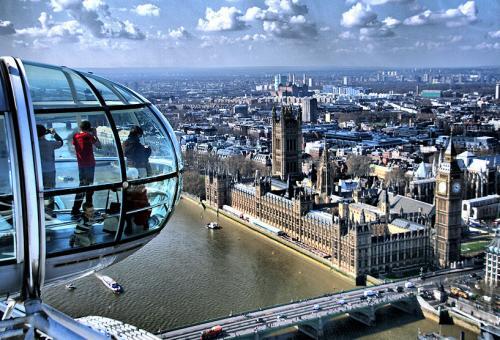
Each capsule holds approximately 24 people and rotates at 0.9 km/h (0.5 mph), with one revolution taking thirty minutes. The slow rate of rotation allows passengers to walk on and off the moving capsules at ground level, although the wheel can be stopped to allow disabled or elderly passengers time to embark and disembark safely.
The Eye opened to the public in March 2000 and 8.5 million people had ridden the Eye in its first 27 months of operation. It initially had planning permission for only for five years, but Lambeth Council eventually agreed to make the attraction permanent. Since 1 January 2005, the Eye has been the focal point of London's New Year celebrations, with extravagant fireworks displays fired from the wheel itself.
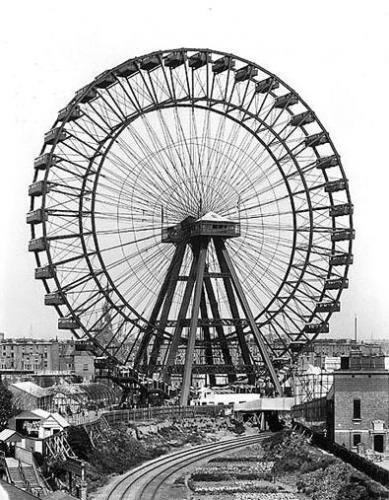
A predecessor to the London Eye, 'The Great Wheel of London', was erected at Earl's Court in 1895, making imaginative use of a derelict site between two railway lines. Based on the famous Ferris wheel at the Chicago Exhibition of 1893, construction work began on the wheel in March 1894 and it was opened to passengers in July 1895. It had a diameter of 300ft, weighed 1,100 tons and a complete revolution took around twenty minutes. The wheel got stuck in May 1896 when passengers were stranded for four and a half-hours. Capable of carrying 1,600 people, it was demolished in 1907 when it was no longer profitable.
By road: Off A4, Northumberland Avenue
By rail: Close to Waterloo, Embankment, Charing Cross and Westminster underground stations and to Waterloo Station
By boat: via Millennium Pier
Long, David, Spectacular Vernacular: London's 100 Most Extraordinary Buildings, The History Press, ISBN-10: 0750941871 (2006)
Marks, David & Barfield, Julia, Reinventing the Wheel; the Construction of British Airways London Eye, Watermark Publications, ASIN: B0010JTJOS (1999)
A.P Mann, A. P., Thompson, N. & Smits, M., Proceedings of ICE: Civil Engineering 44, May 2001 Paper 2496, pages 60-72 (2001)
Murray, John R., London Above Eye Level, Frances Lincoln, ISBN-10: 0711228310 (2007)
Rose, Steve & Marks Barfield Architects, Eye: The Story Behind the London Eye, Black Dog Publishing, ISBN-10: 1906155089 (2007)
360 Degree Panoramic View - London Eye
Beckett Rankine Structural Engineers - BA London Eye: pier and impact protection system
Structurae Database - London Eye