
MV Lymington and the Voith Schneider propulsion system

MV Lymington (1923-1973 on the route to Yarmouth) used the Voith Schneider propulsion system, the first vessel to do so in Britain. She was retired to Scotland and after a further life with Western Ferries was broken up in the 1990's
Region:
Red Wheel Site:
Transport Mode(s):
Address:
Lymington Ferry Port
Undershore Road
Lymington
Postcode:
Visitor Centre:
Opening Times:
The ferry port is open to support today's Wightlink service from Lymington to Yarmouth
Website:
Visit website


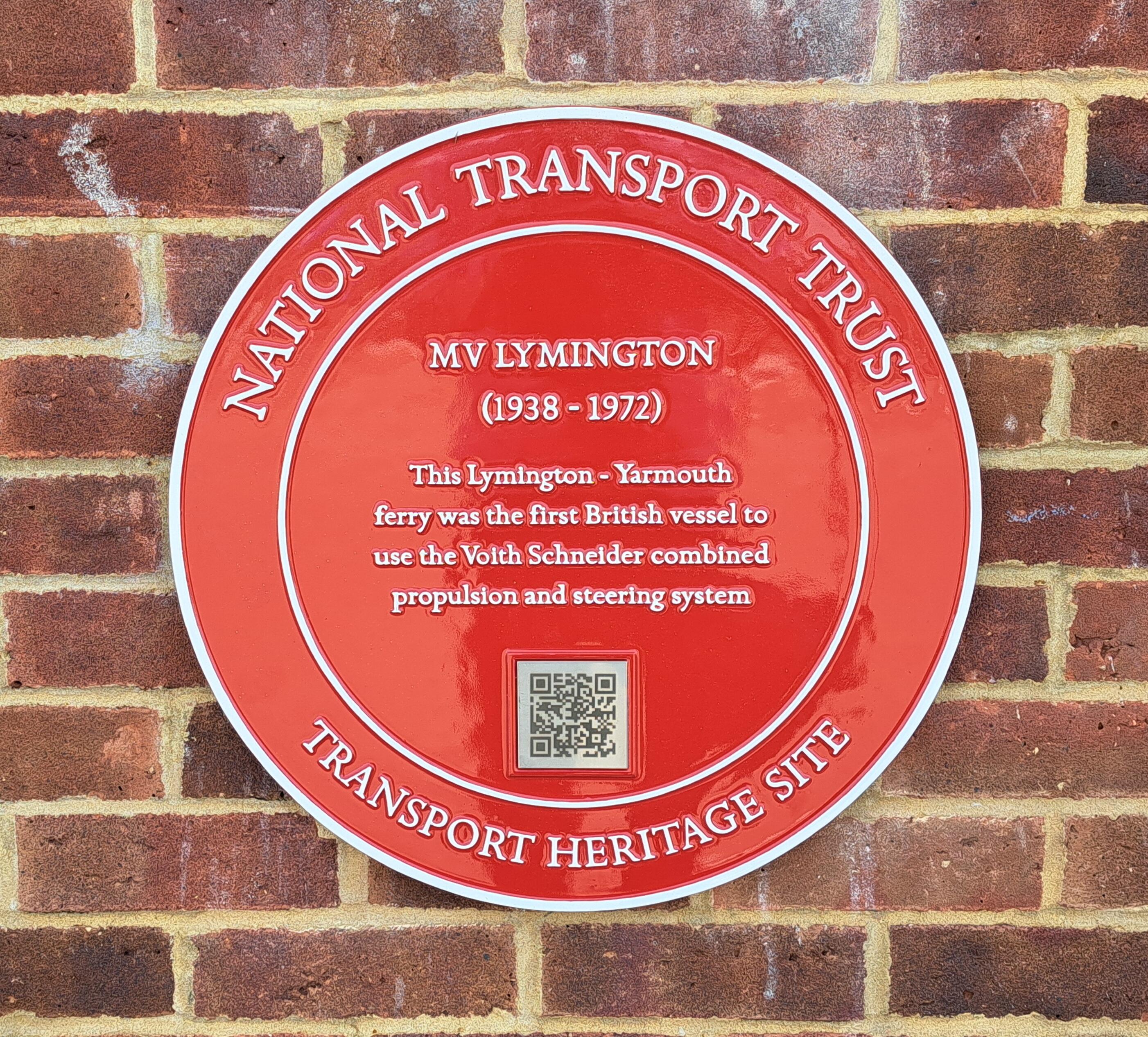
MV LYMINGTON (1938 - 1972) This Lymington - Yarmouth ferry was the first British vessel to use the Voith Schneider combined propulsion and steering system
Built by William Denny of Dumbarton in 1938 for the Southern Railway's crossing to Yarmouth Isle of Wight, the MV Lymington a vessel of 275 gross tonnes, was the first British application of the Voith Schneider propulsion system which had been trialled a decade earlier by Austrian inventor Ernst Schneider on Lake Constance and then in German minesweepers.
The Voith Schneider propeller was originally a design for a hydro-electric turbine. Its Austrian inventor, Ernst Schneider, had a chance meeting on a train with a manager at Voith's subsidiary St. Pölten works; this led to the turbine being investigated by Voith's engineers, who discovered that although it was no more efficient than other water turbines, Schneider's design worked well as a pump by reversing the flow through the device. By changing the orientation of the vertical blades, it could be made to function as a combined propeller and rudder.
In 1928 a prototype was installed in a 60-hp motor launch named Torqueo (Latin:I spin) and trials were carried out on Lake Constance. A number of German minesweepers (R boats) were fitted with VSPs; the first of these was the R8, built in 1929 by Lürssen. By 1931 VSPs were being fitted in new vessels on Lake Constance run by the German State Railways. The first such ship to use the Voith Schneider propeller was the excursion boat Kempten. Two German 1935-type M class minesweepers M-1 and M-2 were fitted with VSPs.
The Voith Schneider unit enables a vessel to turn in her own length, and success in Germany and England led to it becoming a standard feature of modern shipping. Typical uses today include tugs and oil rig and wind turbine support vessels.
The MV Lymington served the Yarmouth route throughout the second war when a slab of concrete placed above her wheelhouse to offer some protection against an airborne attack.
By 1972 it was clear that she was too small for growing demand. British Rail Sealink's procurement of a larger replacement led to her sale to Western Ferries and she left the route in 1973. Western Ferries took her back to Scotland for their new crossing of the Firth of Clyde from McInroy's Point near Gourock to Hunter's Quay on the Cowal Peninsula.
Now renamed the Sound of Sanda, she served Western Ferries from late August 1974 until 1989 latterly carrying cement tankers to Faslane for construction of the new Trident submarine base.
Again however her small capacity meant that she was no longer suited to increasing custom. Efforts by the Lymington Preservation Society to find money and a new home were unsuccessful. Western Ferries offered her to the Scottish Maritime Museum at Irvine, but here too there was neither money nor a secure berth, so they were forced to place her on the open market.
She lay for a number of years at their mooring on the Holy Loch before being sold for use as a fish farm support vessel. Leaving the Clyde for the last time in 1994, she was beached on Loch Etive in Argyllshire to allow work to be carried out. After some time, with much of her structure cut away, the local authority decided that she had been abandoned and stripped out her main engines and other machinery.
Over a couple of months, she was reduced to a hulk which was refloated and left to rot at a mooring on the loch. An inglorious end to a proud pioneer.
Please note: The Red Wheel indicates that MV Lymington left the route in 1972. This is an error: she left in 1973. We apologise for this error.
By rail: services from Waterloo, change at Brockenhurst
By road: M27 (from east) or A31 to Cadnam junction, then A337 to Brockenhurst, Lymington and follow signs for the ferry
Direct navigation links:
what3words address: ///confronts.digit.admit
Jürgens, Birgit (2002). The Fascination of the Voith-Schneider Propeller. Hamburg: Koehler. ISBN 3-7822-0859-5.
Marriott, Leo (2001). The Vital Guide to Modern Warships. Shrewsbury: Airlife. ISBN 9781840371772.
"Sea Going Eggbeaters". Popular Mechanics. 93 (3): 102–103. March 1950.
Brown, R. Allen (1988). Lymington: The Sound of Success. Allan T Condie Publications. ISBN 978-0-907742-62-3.
Jürgens, Dirk (2006). The Voith Schneider Propeller Current Applications and New Developments. Voith. S2CID 6955631