Rossie Viaduct and Two Others, Montrose

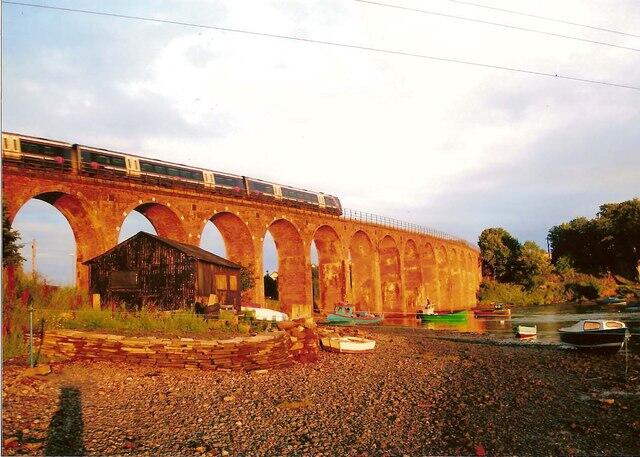
There are three interesting viaducts around Montrose, Rossie the last operational bridge by Sir Thomas Bouch of Tay Bridge fame, listed Grade B*, South Esk of bow-string girder construction , and North Water, a stone viaduct listed Grade B.
Region:
Red Wheel Site:
Transport Mode(s):
Address:
Western Road, Montrose, DD10 8LW
Postcode:
Visitor Centre:
Opening Times:
Visible at all times.
Website:
Visit websiteThe route of the North British Railway in its effort to reach Aberdeen lay from Arbroath through Montrose to a junction with the Caledonian at Kinnabar. This line was to be the fastest route to Aberdeen from the south once the Tay and Forth Bridges were built. Construction reached Montrose in 1881 but passenger services were delayed as a result of the Tay Bridge disaster.
Sir Thomas Bouch was responsible for two bridges on the south side of Montrose. The first consisting of a single track laid on 17 brick spans with a total length of 275 m. survives as the only remaining Bouche structure still in use. It carries the East Coast Main Line which at this point is single track only. Known as the Rossie or Inchbraoche, it is a listed structure graded B*.
Closer to Montrose the railway is carried over the South Esk on another single track viaduct, consisting of 14 bowed iron lattice girders on iron columns filled with concrete and a total length of 436 m. This was built in 1881, but not by Sir Thomas Bouch. He was responsible for the initial bridge at this point, which was completed in 1880. But, after the fall of the Tay Bridge in 1879, the Board of Trade inspectors were very wary of Bouch and subjected his structure to an extremely vigorous test. It failed and the railway company had to build an alternative, which is what we see today. Perhaps fortuitously, Bouch died before this further disgrace was revealed.
A third structure across the North Water of Esk on a branch along the coast to Bervie was completed in 1865. It consists of 12 arches in rock-faced stone and is also single track. Listed Grade B, it is a fine structure and is now in use as a footpath.
Montrose also boasts a very handsome closed station. This was the terminus of the Caledonian Railway and was closed in 1934, but it has survived as a private dwelling. It was at the end of a short branch from Durton on the Caledonian main line between Aberdeen and Perth and was opened as early as 1848. Three of the original bridges survive on the former short branch line.
Photo: Rich Tea, CC BY-SA 2.0 <https://creativecommons.org/licenses/by-sa/2.0>, via Wikimedia Commons
By Road: The Rossie is visible from the A 92. The South Esk is parallel to the new road bridge carrying the A 92 over the same river, and the North Water is best approached on foot off B 9100.
Biddle, Gordon, Britain's Historic Railway Buildings, Oxford University Press, ISBN-10: 0198662475 (2003)
Biddle, Gordon & Nock, O.S., The Railway Heritage of Britain : 150 years of railway architecture and engineering, Studio Editions, ISBN-10: 1851705953 (1990)
Biddle, Gordon and Simmons, J. The Oxford Companion to British Railway History. ISBN 0 19 211697 5 (1997)
Conolly, W. Philip, British Railways Pre-Grouping Atlas And Gazetteer, Ian Allan Publishing, ISBN 0-7110-0320-3 (1958/97)
Prebble, J. The High Girders: The Story of the Tay Bridge Disaster, ISBN 0-14-004590-2. (1956 published by Penguin Books in 1975)
Rapley, J. Thomas Bouch : the builder of the Tay Bridge, Stroud : Tempus, ISBN 0-7524-3695-3 (2006)
Ransom, P.J.R. Iron Road: The Railway in Scotland. ISBN 1 84158 728 1 (2007)
Smith, Martin. British Railway Bridges and Viaducts. ISBN 0 7110 2273 9 (1994)
Thomas, J. and Turnock,D. A Regional History of the Railways of Britain, North of Scotland. ISBN 0 946537 03 8 (1993)
Thomas, J. The Tay Bridge Disaster: New Light on the 1879 Tragedy, David & Charles, ISBN 0-7153-5198-2. (1972)
Forgotten Relics - Listed Bridges and Viaducts