York Station

Region:
Red Wheel Site:
Transport Mode(s):
Address:
Postcode:
Visitor Centre:
Opening Times:
The station is open daily. See schedules, visit website or telephone 0845 722 5225. Note that much of the complex is now private office accommodation.
The National Railway Museum is open daily - visit website, email nrm@nrm.org.uk or telephone 08448 153139.
Website:
Visit websiteThe first York railway station was a temporary building on Queen Street outside the walls of the city, opened in 1839 by the York & North Midland Railway. It was the terminus of the original trunk route for trains to London, via Derby and Birmingham.
A second station, inside the walls, was built by G.T. Andrews in 1840 and opened on 4 January 1841. Alongside the departure platform he built a two storey Italianate structure in ashlar sandstone with Tuscan columns. On the first floor was the board room. Opposite and on the arrival platform he built a brick refreshment room and offices, which received a second floor in 1850.
York lay where two railway companies met, the Great North of England, and the York & North Midland, and it was the influence of George Hudson, the railway entrepreneur and a citizen of the city, which led to the modestly sized city of York becoming such an important railway hub.
In 1853 a three storey hotel was opened across the end of the lines, adjoining the two earlier buildings. This was the first station hotel in the world. All three buildings are listed Grade II*.
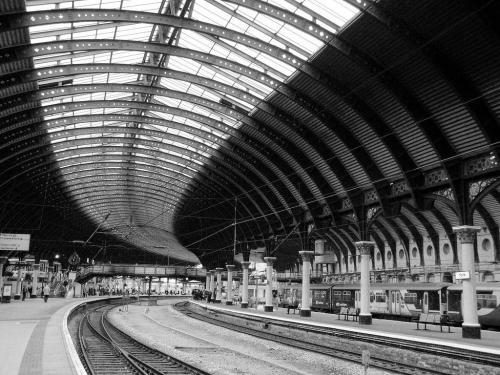
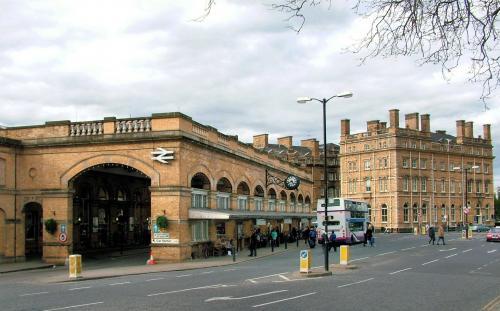
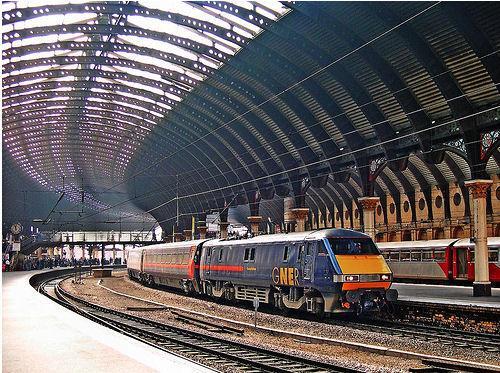
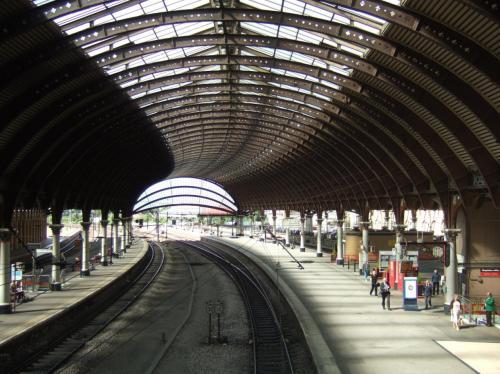
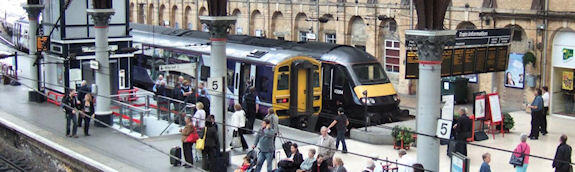
The present station opened in 1877. It was designed by Thomas Prosser and the railway company's engineer T.E. Harrison, the purpose being to create a through station instead of the original terminus. Its modest nine arch porte cochere stands before its principal glory which is the three vast curved wrought-iron spans which compose the train-shed. Like that at Newcastle (seeNewcastle Station entry) it is enormously impressive. It is listed Grade II*.
In 1878 a new railway hotel was opened designed by Thomas Prosser and William Peachey. The Royal York is massively constructed in yellow brick and is a Grade II listed building.
The next listed building in this railway complex is the 1906 North Eastern Railway headquarters building, built by William Bell. It consists of four storeys and two attic tiers in red brick with stone facings, with a baroque entrance. Inside is equally impressive and it contained the new boardroom for the railway company. It stands as amonument to a proud and profitable railway. It too is listed Grade II*.
A further Grade II* listed structure in this complex is the North Eastern Railway Lutyens War Memorial of 1923. It recorded the death of 2,236 railway employees in World War I.
York's railway pre-eminence has been augmented since 1975 by the conversion of a museum inaugurated by the North Eastern Railway into the National Railway Museum in a collection of railway buildings slightly outside the main complex. This has become a major attraction in the city.
By road: On A1036, Station Road.
Biddle, Gordon, Britain's Historic Railway Buildings, Oxford University Press, ISBN-10: 0198662475 (2003)
Biddle, Gordon & Nock, O.S., The Railway Heritage of Britain : 150 years of railway architecture and engineering, Studio Editions, ISBN-10: 1851705953 (1990)
Conolly, W. Philip, British Railways Pre-Grouping Atlas And Gazetteer, Ian Allan Publishing, ISBN 0-7110-0320-3 (1958/97)
Dunstone, D, For the Love of Trains: The history of railway preservation in Britain (2007)
Hoole, K, Rail Centres: York (1983)
Hoole, K. Railway Stations of the North East. ISBN 0 7153 8527 5 (1985)
Hoole, K. A Regional History of the Railways of Britain, North East. ISBN 0 7153 6439 1 (1974)
Pevsner, Nikolaus & Neave, David, Yorkshire: York and the East Riding, Penguin Books, ISBN 0-14071-061-2 (1995)
Tomlinson, W.W, The North Eastern Railway (1967)
English Heritage - Images of England, York Old Station (Toft Green)
English Heritage - Images of England, York Railway Station